
Scientists Find Evidence That Our Entire Universe Might Be Inside a Black Hole
Are We Living Inside a Black Hole? Scientists Find Evidence That Could Change Everything

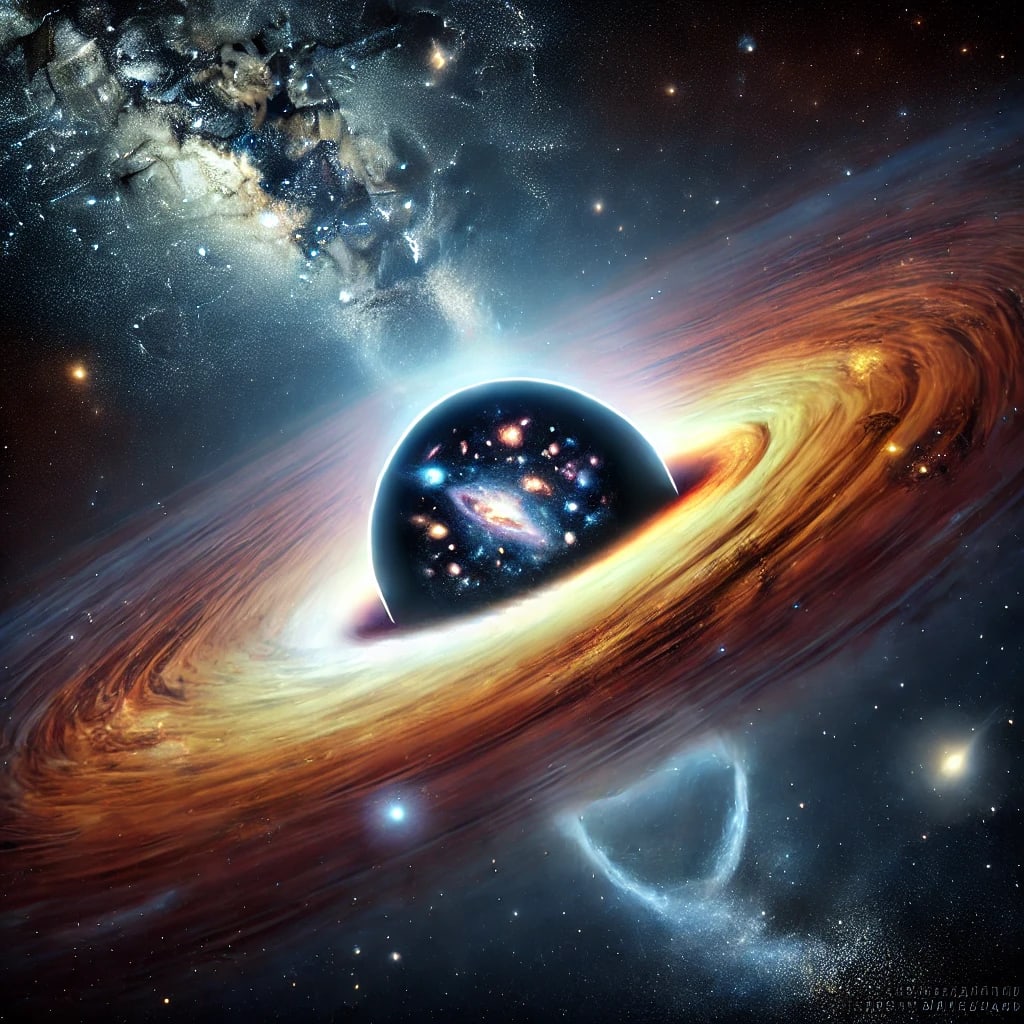
Are We Living Inside a Black Hole? Scientists Find Evidence That Could Change Everything
For centuries, humanity has sought to understand the true nature of our universe. From the ancient philosophers who gazed at the night sky to the modern physicists unlocking the secrets of quantum mechanics, we have continuously pushed the boundaries of our knowledge. But what if everything we thought we knew about the universe was wrong? What if our entire cosmos—galaxies, stars, planets, and even time itself—is actually inside a black hole?

This radical idea, once considered purely theoretical, is now gaining scientific support. Recent discoveries suggest that our universe shares remarkable similarities with the interior of a black hole. If true, this hypothesis could redefine our understanding of space, time, and reality itself.
The Black Hole Universe Hypothesis
The notion that our universe might exist inside a black hole is not entirely new. Physicists have long speculated that black holes could harbor entire worlds within them. This idea stems from the fact that black holes possess event horizons—boundaries beyond which nothing, not even light, can escape. Interestingly, the observable universe also has a kind of "horizon," beyond which we cannot see due to the limitations imposed by the speed of light and cosmic expansion.
If our universe is inside a black hole, it raises the question: Where is this black hole located? Could it be part of a much larger "parent" universe? And what if black holes within our own cosmos contain other universes, creating a fractal-like structure of nested realities?
New Scientific Evidence Supporting the Theory
Recent discoveries from astrophysicists studying gravitational waves, cosmic background radiation, and quantum fluctuations have provided intriguing hints that our universe might, in fact, exist within a black hole.
1. The Cosmic Horizon and the Event Horizon Similarity
One of the most striking similarities between our universe and a black hole is the concept of an event horizon. In black holes, the event horizon marks the boundary beyond which no information can escape. Similarly, in cosmology, we observe a "cosmic horizon"—a limit beyond which we cannot see due to the speed of light and the expansion of space.
This suggests that what we perceive as the vast expanse of the universe might actually be the interior of a massive black hole in a higher-dimensional space.
2. Hawking Radiation and Cosmic Microwave Background Radiation
Stephen Hawking famously theorized that black holes emit radiation due to quantum effects at their event horizon. This "Hawking radiation" causes black holes to slowly lose mass over time.
Interestingly, physicists have observed patterns in the cosmic microwave background (CMB) radiation—the afterglow of the Big Bang—that resemble the theoretical predictions of Hawking radiation. Could it be that what we observe as leftover radiation from the Big Bang is actually evidence of energy leaking from a black hole in a higher dimension?
3. The Big Bang and Black Hole Singularities
The current leading theory of the universe's origin, the Big Bang, suggests that everything began from an infinitely dense point—a singularity. Similarly, at the center of black holes lies a singularity, a point where space and time become infinitely compressed.
This raises an intriguing possibility: Could our universe have been "born" from the collapse of matter into a black hole in another universe? Instead of emerging from nothing, the Big Bang might have been a "bounce" event—the formation of a new universe inside a black hole.
4. Gravitational Waves and Black Hole Echoes
Scientists studying gravitational waves—ripples in spacetime caused by massive cosmic events—have detected unusual patterns that some believe could be echoes from a black hole's interior. If true, this would provide direct observational evidence that space itself behaves like the inside of a black hole.
What Would This Mean for Physics?
If our universe is inside a black hole, it would fundamentally change how we understand physics. General relativity and quantum mechanics, two of the most successful yet seemingly incompatible theories in science, might finally be unified under this framework.
1. The Multiverse Becomes More Plausible
The idea that black holes contain universes suggests that our cosmos is not unique. Every black hole in our universe could be a gateway to another universe, just as our universe might be inside a black hole in a higher-dimensional reality. This aligns with the concept of the multiverse—the idea that countless universes exist, each with its own laws of physics.
2. Dark Matter and Dark Energy Could Be Explained
Currently, about 95% of the universe is made up of dark matter and dark energy—mysterious substances that we cannot directly observe. If our universe is inside a black hole, these strange phenomena could be linked to interactions between different layers of reality.
For example, dark energy—the force driving the accelerated expansion of the universe—might be the result of the black hole itself growing in size as it absorbs more matter from the "parent" universe.
3. Time Might Behave Differently Than We Think
Inside a black hole, time slows down dramatically due to extreme gravitational forces. If we are inside a black hole, this could explain some of the puzzling properties of time and entropy in our universe. It might also suggest that what we perceive as billions of years could be only a fraction of a second from the perspective of an outside observer in the "parent" universe.
Could We Ever Prove This Theory?
While the idea of living inside a black hole is compelling, proving it remains an enormous challenge. However, scientists are exploring several ways to test this hypothesis:
Studying Black Holes More Closely: Observing black hole mergers and their gravitational wave signals might provide clues about whether they contain hidden internal structures.
Simulating Universes Inside Black Holes: Advanced computer models could help us determine if our universe's properties match those predicted for black hole interiors.
Looking for Anomalies in Cosmic Expansion: If our universe is inside a black hole, we might detect unique signatures in the way galaxies move and the distribution of cosmic matter.
What Lies Beyond the Black Hole?
If our universe is truly inside a black hole, what exists beyond it? Could there be an even larger cosmos with completely different laws of physics?
Some physicists speculate that the "parent" universe might operate under entirely different physical principles, and that intelligent beings—possibly far beyond our comprehension—could exist outside our black hole universe.
Others believe that reality itself might be an infinite series of nested black holes, with each universe birthing new ones through the formation of black holes within it.
Conclusion: A Universe of Infinite Possibilities
The idea that our universe is inside a black hole challenges everything we think we know about space, time, and existence. While the evidence remains indirect, new discoveries in physics continue to point in this direction.
If true, this theory could revolutionize our understanding of the cosmos and open the door to new realms of exploration—perhaps even allowing us to one day escape the confines of our own cosmic black hole.
Whether or not we are living inside a black hole, one thing is clear: the universe remains full of mysteries waiting to be unraveled. And as we continue our quest for knowledge, we may find that reality is even stranger—and more incredible—than we ever imagined.
References
Hawking, S. (1975). Particle creation by black holes. Communications in Mathematical Physics, 43(3), 199-220.
Stephen Hawking's groundbreaking work on Hawking radiation, which suggests that black holes emit energy and slowly lose mass over time.
Penrose, R. (1965). Gravitational collapse and space-time singularities. Physical Review Letters, 14(57), 57-59.
Roger Penrose's work on the nature of singularities in black holes, which parallels the singularity at the beginning of our universe.
Einstein, A. (1915). The field equations of gravitation. Sitzungsberichte der Preußischen Akademie der Wissenschaften.
Albert Einstein’s general theory of relativity, which provides the foundation for modern black hole physics and cosmic expansion theories.
Smolin, L. (1992). Did the universe evolve? Classical and Quantum Gravity, 9(1), 173-191.
Discusses the idea that black holes might give birth to new universes, leading to a "cosmological natural selection" hypothesis.
Popławski, N. J. (2010). Radially moving observer in Einstein-Cartan gravity. Physics Letters B, 694(3), 181-185.
Proposes that our universe could be the interior of a black hole inside a higher-dimensional space.
Bousso, R. (2002). The holographic principle. Reviews of Modern Physics, 74(3), 825-874.
Explores the holographic principle, which suggests that all the information in our universe may be encoded on a distant surface, similar to an event horizon.
Maldacena, J. (1998). The large N limit of superconformal field theories and supergravity. Advances in Theoretical and Mathematical Physics, 2(2), 231-252.
Juan Maldacena's AdS/CFT correspondence, which describes how a universe inside a black hole could be mathematically linked to the physics on its boundary.
Abbott, B. P., et al. (2016). Observation of gravitational waves from a binary black hole merger. Physical Review Letters, 116(6), 061102.
The first direct detection of gravitational waves, which could help us study the interior of black holes and their possible connections to the universe.
Gurzadyan, V. G., & Penrose, R. (2010). Concentric circles in WMAP data may provide evidence of violent pre-Big-Bang activity. arXiv preprint arXiv:1011.3706.
Suggests that traces of past cosmic events could be detected in the cosmic microwave background, possibly supporting the black hole universe hypothesis.
About the Creator
JONATAN DAVID VEGA
Hello Welcome! I am Jonatan Vega
Iam self-published mexican author living Sacramento,California
My Instagram: @JonatanVega_writesbooks
My published books in lulu.com
www.lulu.com/spotlight/JonatanVega
Amazon: Jonatan Vega
Keep reading
More stories from JONATAN DAVID VEGA and writers in Futurism and other communities.
Scientists Develop a Helmet to Talk to Extraterrestrials
The Future of Alien Communication: Scientists Develop a Helmet to Talk to Extraterrestrials For centuries, humanity has gazed at the stars, wondering if we are alone in the universe. We have sent out radio signals, built massive telescopes, and even launched probes carrying messages in the hopes that an intelligent extraterrestrial civilization might receive and understand them.
By JONATAN DAVID VEGA10 months ago in Futurism
Home Alone Cast
Home Alone Cast: Then and Now – A Complete Look at the Stars Behind the Classic Movie writer: king pokhtoon Home Alone is one of the most loved family movies of all time. It was released in 1990 and quickly became a holiday classic. Even after more than three decades, people still enjoy watching it, especially during the winter and Christmas season. The movie is funny, emotional, and full of memorable scenes. One big reason for its success is its cast. The actors gave life to the characters and made the story unforgettable.
By king pokhtoon2 days ago in Futurism
Self Help: Grifters' Gospel
On Self-Help, Snake Oil, and the Illusion of Change Psychology professionals and students can be imagined on two opposite sides of a line called self-help books: likely a larger group opposes pop-science and step-by-step manuals filled with talk of success, journaling, and not giving a f**k; others love them, but they aren’t many.
By Avocado Nunzella BSc (Psych) -- M.A.P about 15 hours ago in BookClub




Comments
There are no comments for this story
Be the first to respond and start the conversation.