
Robots Will Be Able to Give Birth
Born from the Machine: The Promise and Peril of the First Pregnancy Robot
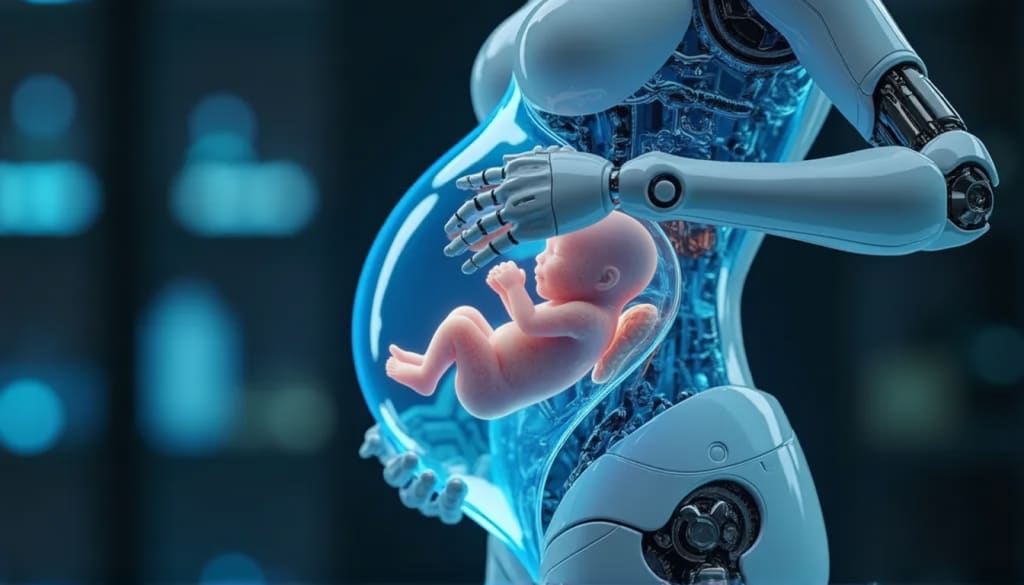
A Chinese company claims it is on the verge of creating an artificial womb inside a humanoid robot, capable of carrying a baby to term. This announcement forces us to confront a fundamental question: are we witnessing a revolution that could end infertility, or standing on the edge of a dystopian nightmare that redefines the very origin of life?
For a moment, let us picture the scenes that science fiction has seared into our minds: rows of translucent pods where fetuses float in amber fluid, monitored by a centralized intelligence. It is a vision that has represented both the utopia of a perfectly ordered society and the dystopia of a humanity disconnected from its biological roots. What once belonged to the pages of Aldous Huxley or the frames of The Matrix is now knocking on the door of reality in an unexpectedly concrete form. The fantasy of ectogenesis—gestation outside the womb—has ceased to be a futuristic speculation and has become a news headline that has sent a shockwave across the globe.
The news comes from China, where Kaiwa Technology, a company founded by Dr. Zhang Qifeng in Guangzhou, has announced the development of the "world’s first humanoid pregnancy robot." The project, which aims to combine advanced artificial womb technology with a robotic form, is expected to unveil a prototype next year and become commercially available by 2026, with a projected price of around 100,000 yuan (~$13,900 USD).
This announcement is not just a technological milestone; it is a direct challenge to our most deeply held conceptions of family, motherhood, and the very act of being born. Is this the ultimate triumph of human ingenuity, or an irreversible step toward the dehumanization of the miracle of life?
The Technological Core: Anatomy of a Robotic Womb
At the heart of this innovation lies an artificial womb, a high-tech "biobag" that seeks to replicate the uterine environment with millimeter precision. This is no simple container. It is a complex biotechnological interface where a fetus would float in synthetic amniotic fluid, maintained at a constant temperature and pressure. An exchange system, dubbed an "umbilical cord 2.0," would act as an artificial placenta, delivering a carefully calibrated mixture of oxygen, hormones, and nutrients, while a separate circuit would filter out carbon dioxide and other waste products with relentless efficiency.
What distinguishes Kaiwa Technology's proposal is the integration of this biobag into a humanoid robot. According to Dr. Zhang, the goal is "to allow interaction between a real person and the robot." While details are scarce, one can speculate that the humanoid body could simulate movement, transmit sounds—such as the voices of the future parents—or even generate vibrations that mimic a heartbeat, in an attempt to replicate, however artificially, the sensory environment of a natural pregnancy. The womb technology itself, Dr. Zhang claims, is already in a "mature stage"; the current challenge is to perfect this symbiosis of biology and robotics.
This project stands on the shoulders of giants. Science has been pursuing artificial gestation for decades. A pivotal moment arrived in 2017 when researchers at the Children's Hospital of Philadelphia kept extremely premature lambs alive and developing for weeks in a biobag. That experiment proved that vital organs like the lungs and brain could continue to develop outside the biological womb. However, replicating that success for the full nine months of a human gestation is a challenge of exponentially greater magnitude.
The Promise: A Future Without Biological Limits
Proponents of the project present it as a solution to some of humanity's most painful problems.
- The End of Infertility: In a world where millions suffer the emotional and financial burden of infertility—in China, rates have reached an alarming 18%—this technology could offer an almost certain path to parenthood. "Many families pay significant expenses for artificial insemination only to fail," one commentator noted. The pregnancy robot is positioned as the ultimate answer.
- Freeing Women from the Biological Burden: Pregnancy, for all its beauty, carries significant medical risks, from debilitating conditions like hyperemesis gravidarum to life-threatening dangers like pre-eclampsia. It can also mean a pause or halt to a woman's professional career. Ectogenesis could eliminate these risks and inequalities, offering a safe, controlled gestation.
- New Reproductive Horizons: The implications for family structure are revolutionary. Same-sex couples, transgender individuals, or women who have lost their uterus to disease could have biological children without the need for a human surrogate. Age would no longer be a limiting factor for motherhood, redefining life cycles and family planning.
The Ethical Abyss: A Labyrinth of Dilemmas
Despite the touted benefits, the announcement has unleashed a whirlwind of criticism and existential fears. The objections are not merely technical; they strike at the very fiber of our identity.
- The Specter of Dehumanization and the Severed Bond: The most visceral criticism focuses on the maternal-fetal connection. Science has shown that a fetus hears its mother's voice, feels her heartbeat, and responds to her emotions. This prenatal dialogue is fundamental to neurological and psychological development. What happens when this bond is replaced by the sensors and algorithms of a machine? The prospect of a baby born "without any biological bond to a living woman" could, critics argue, "sever one of the most intimate and defining aspects of human life."
- The Commodification of Life: There is a pervasive fear that this technology will lead to the "commodification" of childbirth, turning birth into a consumer product. This could create a new social divide: an elite who can afford "perfect," risk-free gestations in state-of-the-art robots, while the rest of the population continues to face the perils of natural birth. It also opens the door to the mass production of children or genetically engineered populations, evoking the clone farms of science fiction.
- The Legal and Regulatory Labyrinth: The current legal framework is utterly unprepared for this reality. Unanswerable questions arise: Who are the legal parents if the process fails due to a software error? What citizenship would a child have if gestated in a robot owned by an international corporation? Chinese law prohibits developing human embryos beyond 14 days. Overcoming this barrier would require "rewriting the fundamental rules of bioethics," a monumental task with global implications.
- Reasonable Scientific Skepticism: Beyond ethics, many experts doubt the near-term feasibility. Replicating the complex hormonal symphony, the maternal immune response, and the countless subtleties of a biological womb is a colossal challenge. As one skeptic noted on a forum, "We can barely keep an entire adult human alive... on machines... A developing human, who is sensitive to any little thing being different, is a whole other problem." The lack of concrete data from Kaiwa Technology fuels suspicion that this may be more of a strategy to attract investors than an imminent reality.
The Crossroads of Creation
In the near future, it is plausible that we will see more modest versions of this technology, such as improved "biobags" that revolutionize Neonatal Intensive Care Units and save the lives of thousands of premature infants. That, without question, would be an extraordinary advance for humanity.
However, full ectogenesis and the figure of the pregnancy robot place us at a philosophical crossroads. This is no longer just about curing a disease, but about altering the fundamental process of human creation. Even if Kaiwa Technology's robot is never mass-produced, its mere conception forces us to confront the deepest questions about our relationship with technology and our own nature.
If this is the future, it is one we must debate openly, honestly, and globally before it arrives, not after. The conversation is crucial, because what is at stake is not just a new reproductive technology, but the very definition of what it means to be born human.
About the Creator
Francisco Navarro
A passionate reader with a deep love for science and technology. I am captivated by the intricate mechanisms of the natural world and the endless possibilities that technological advancements offer.
Keep reading
More stories from Francisco Navarro and writers in Futurism and other communities.
AI with Maternal Instincts
Imagine a future where humanity's fate hinges not on our collective intellect, but on the nurturing "love" of a machine. Sounds like a dystopian sci-fi plot, doesn't it? Welcome to the latest, and perhaps most unsettling, proposition from Geoffrey Hinton, the so-called "Godfather of AI."
By Francisco Navarro6 months ago in Futurism
Why Is the B2B Payments Market Undergoing a Major Digital Transformation?
Business-to-business payments form the backbone of global trade and commerce. Every transaction between manufacturers, suppliers, distributors, wholesalers, and service providers depends on reliable payment systems. Unlike consumer payments, B2B payments often involve large transaction values, longer payment cycles, multiple approval layers, and complex documentation. Because of this complexity, B2B payments have traditionally relied on manual and paper-based processes.
By Rohit Shaha day ago in Futurism
Dead and Wearing Green
She was wearing that green dress when I first saw her, five years ago to the day. Flowing meadow fabric draped over long legs, thick auburn hair flowing down her back. That smile. Of course, she is still beautiful now. But now she is no longer alive.
By Karen Cave6 days ago in Fiction




Comments
There are no comments for this story
Be the first to respond and start the conversation.