
Recent Space Discoveries & Breakthroughs
Major Cosmic Discoveries

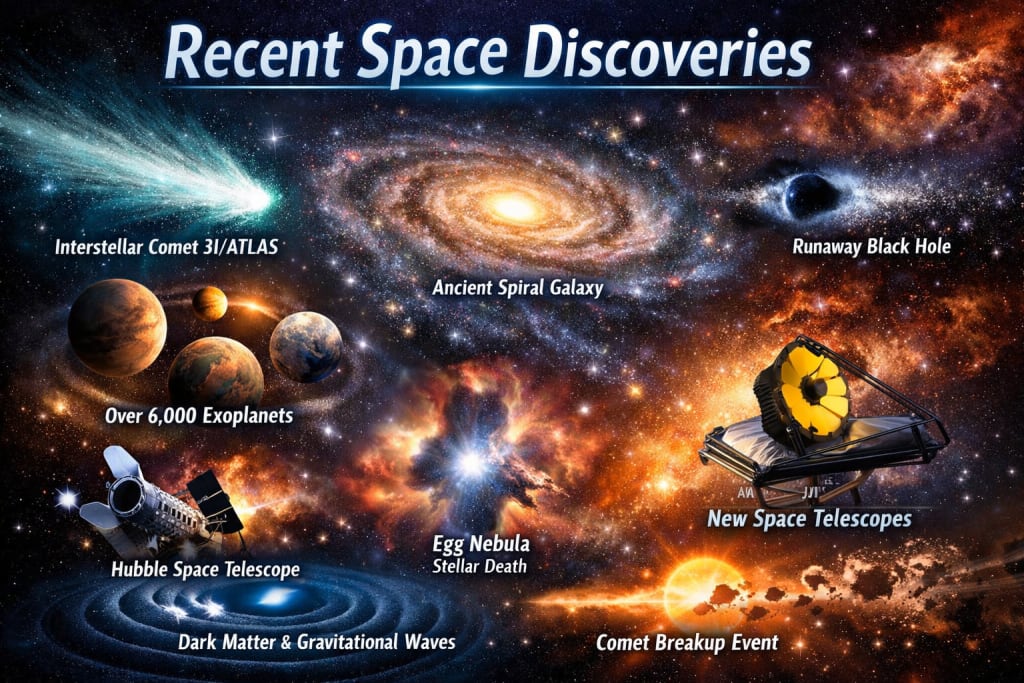
Here’s an up-to-date overview of recent space discoveries and breakthroughs — spanning astronomy, planetary science, cosmic structures, and new insights into the physics of the universe:
Major Cosmic Discoveries
🪐 Interstellar visitors and organic materials
Scientists observed organic molecules — including methanol, cyanide and methane — streaming from the interstellar comet Comet 3I/ATLAS during its 2025 pass through the Solar System. These complex molecules are considered building blocks of life, offering clues about the chemistry of the early solar system and interstellar space.
🌋 Huge underground lava tube on Venus
Analysis of historic radar measurements from the Magellan spacecraft unveiled a massive subsurface lava tube beneath Venus’s surface. At around 1 km wide and hundreds of meters tall, this feature provides insights into Venus’s volcanic past and could influence future exploration.
🌟 Rare stellar death insights
The Hubble Space Telescope captured unprecedented images of a pre-planetary nebula — the “Egg Nebula” — showing complex structures as a star nears the end of its life. Observations like this help scientists understand how stars distribute elements that later become planets and life.
🔭 Deep Universe Insights
🧠 Dark matter behavior and galaxy evolution
Studies using data from major space observatories including the James Webb Space Telescope (JWST) have provided deeper clues into how dark matter influences the structure and motion of stars and galaxies — a key piece of the cosmic puzzle.
🌌 Young planetary systems revealed
Observations from the Atacama Large Millimeter/submillimeter Array (ALMA) are showing the early “teenage years” of planetary systems, capturing dust and gas structures where new planets are forming.
🤖 AI revealing cosmic anomalies
Advanced artificial intelligence applied to the Hubble archive has uncovered a wealth of previously missed astronomical features — from gravitational lenses to interacting galaxies — demonstrating how new computational tools accelerate discovery.
🌠 Rapid asteroid and comet detection
New survey telescopes like the Vera C. Rubin Observatory are discovering thousands of asteroids and small bodies, vastly increasing our catalog of Solar System objects and improving planetary defense.
🚀 Expanding Planetary Census
🪐 Record number of exoplanets
Astronomers have confirmed around 6,000 exoplanets — planets orbiting stars beyond our Solar System — revealing an astonishing diversity of worlds, from lava worlds to mini-Neptunes and potentially habitable rocky planets.
🌍 New Earth-like planets in unusual systems
In late 2025 scientists announced the discovery of three Earth-sized planets orbiting both stars in a binary system (TOI-2267) — the first system of its kind where planets transit around each star — challenging previous ideas about planet formation in such environments.
🛰️ New missions and observatories
2026 promises more breakthroughs with upcoming launches like NASA’s BlackCAT X-ray telescope and planned astrophysics missions aimed at mapping hot gas and cosmic explosions.
🌑 Upcoming lunar and deep-space missions
Astronomers and space agencies worldwide are gearing up for new exploration phases including lunar orbit and deep-space telescopes that will push the boundaries of what we can detect about the early universe, dark energy, and potential life beyond Earth.
🧪 Why These Matter
These discoveries are shaping our understanding of:
Origins of planets and life-building chemistry
The role of dark matter and cosmic structure
Stellar life cycles and galaxy evolution
The inventory of small bodies and exoplanets
The technological future of space exploration
Recent discoveries in space science illustrate a burgeoning era of astronomical exploration, powered by advanced observatories and interdisciplinary data analysis:
Thousands of exoplanets, spanning a tremendous range of physical properties.
Interstellar visitors like 3I/ATLAS giving direct insight into material from other star systems.
Dynamic phenomena such as comet fragmentation and stellar death.
Deep-universe revelations, including early spiral galaxies and high-velocity black holes.
Dark matter mapping and gravitational wave breakthroughs refining our picture of cosmic structure.
About the Creator
Ibrahim Shah
I am an Assistant Professor with a strong commitment to teaching,and academic service. My work focuses on fostering critical thinking, encouraging interdisciplinary learning, and supporting student development.
Keep reading
More stories from Ibrahim Shah and writers in Futurism and other communities.
Type of Support Required For Mental Health Of celebrities
The lives of celebrities are often viewed through the lens of glamor, fame, and fortune, but beneath the surface, many face challenges related to mental health that go unnoticed or unaddressed. The pressures of constant public scrutiny, overwhelming work schedules, and personal sacrifices can take a significant toll on their emotional well-being. As a result, maintaining mental health for celebrities requires a multifaceted approach, involving various types of support systems and coping mechanisms. In this article, we will explore the different types of support that are crucial for preserving the mental health of celebrities, ensuring they can navigate the demanding world of fame while fostering personal well-being.
By Ibrahim Shah 7 days ago in Futurism
Electronic Data Capture (EDC) Systems Market Outlook: Clinical Trial Digitization and Growth Opportunities
According to IMARC Group's latest research publication, The global electronic data capture (EDC) systems market size reached USD 1.4 Billion in 2024. Looking forward, IMARC Group expects the market to reach USD 3.3 Billion by 2033, exhibiting a growth rate (CAGR) of 9.7% during 2025-2033.
By James Whitman4 days ago in Futurism
How Investors Evaluate High-Expectation Narratives in Crypto Markets?
Predictions and fundamentals often have the same effect on the cryptocurrency market. As digital assets get more established, investors come across more and more bold price stories that get people talking, speculating, and paying attention. Some of these stories die out quickly, but others stick around through many market cycles.
By Muhammad Talha Ahmadabout 6 hours ago in Futurism




Comments
There are no comments for this story
Be the first to respond and start the conversation.