
Midnight and the Sacred Bone; Or, Falling Through Space Like a Glittering Jewel, a Mote in the Eye of God
2001: A Space Odyssey and the Symbolism of Sentience in the Fabric of Space and Time; a Consideration Paired Against the Supernatural Framework of Kubrick's The Shining (1980)

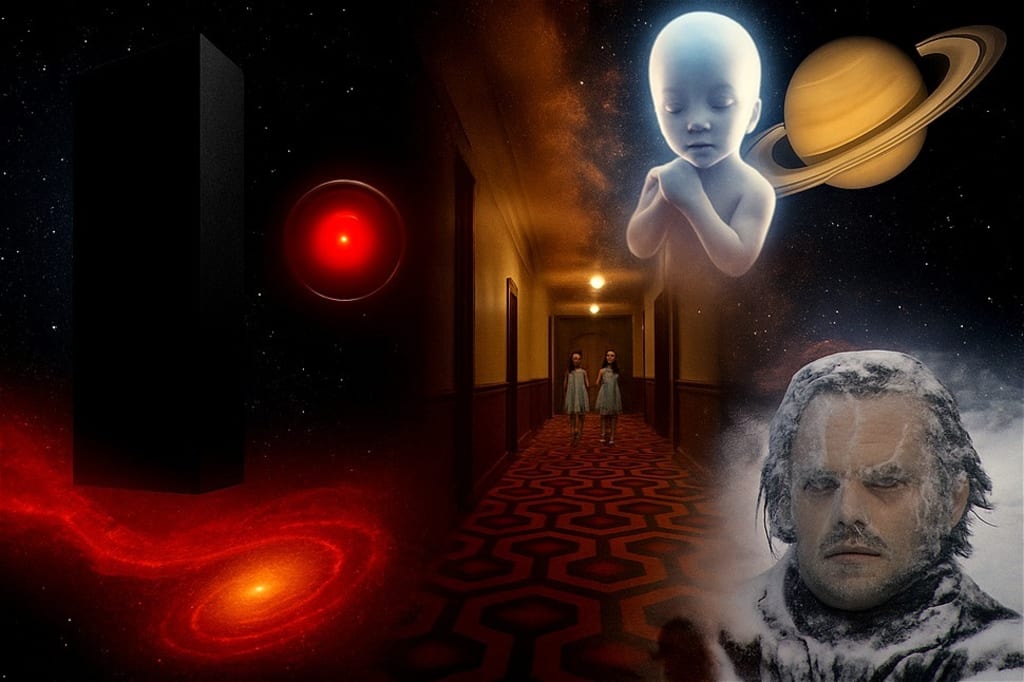
2001: A Space Odyssey is the intercession between the Divine Will, the Cosmic Consciousness, and the manifestation of that will on the material plane. It is a story, yet it is also a subconscious flickering of communication—a thing manifested because, in Heaven and Earth, all things that can be conceived, all permutations of “reality,” are rendered possible before we “experience” them in the solid, physical, three-dimensional “meat space” of our lives.
It is about the journey through death, symbolic death, toward rebirth, a new and living if un-terrestrial redemption for the human race, first depicted as Neolithic apes, the missing link between ourselves and the primitive past that scraped, from the collection of decayed bones at our furry feet, into realms of wonder, transport, killing and mass extermination, the building and attainment of rocket ships, and the placement of thermonuclear detonation on the end of those same rocket devices.
The ape man at the beginning of the film, whose tribe is depicted in Arthur C. Clarke’s novel of the film as dying of a famine (amidst the plentiful antelope and other prey on the sub-Saharan veldt), decides, gradually, upon viewing a collection of shattered animal bones, that the leverage needed in the struggle to sustain life is the pummeling power of the sacred bone—the instrument of death which, paradoxically, also is the sustainer of life. His realization of this comes after the prompting, the “hidden signal” received by him via the mysterious black “monolith,” which presents itself upon the rocky surface of his territory, advancing his thought to the place wherein he unquestionably dominates.
2001: A Space Odyssey (1968) - From Bone to Satellite Scene (1/6) | Movieclips
Throwing the thing skyward, the Sacred Bone becomes a Sacred Vessel, an embarkation to the stars, a thing that is seen to symbolically or metaphorically “impregnate” the revolving vulva of the space station, the Wheel of Fortune which revolves forever, spinning the story out on its preordained axis—as 2001 is a history, not a drama. Its conclusion should seem already foreordained, and it does to the discerning viewer.
Dr. Heywood Floyd (William Sylvester) is traveling to Clavius, to a moon base of the United States. Russia, our Cold War enemy at the time, also seems to possess such a base. Running into a collection of Soviet scientific specialists, he is prodded for information, and we have one of director Kubrick’s curious cinematic silences between Floyd and a pesky Soviet scientist who wants to find the truth behind a cover story concerning “contagion” (COVID?) at the moon base. It is a similar scene to the one in The Shining where the ghost of Grady and Jack Torrance find themselves exchanging communications that seem to confound the “reality” experienced by both; a curious, dream-like scene. Both men in both scenes look at each other in puzzled silence. The dream logic of communication, inversely proportionate to our understanding of it, fuels the affair.
2001: A Space Odyssey | 4K Trailer | Warner Bros. Entertainment
The High Hand of Death
Death is as central to 2001: A Space Odyssey as new life. The Star Child, that ubiquitous symbol of the impregnated future brought about by the deep foray into the Cosmic Awareness symbolized by our Monolith, our “Cube from Space,” is born from the death of David Bowman, Odysseus here, our Intrepid Explorer, going where “no man has gone before”; or, put in the phraseology of an English poet, “That undiscovered country from whence, once borne, no traveler returns.” But Death has come to meet us in 2001.
The extension of life brought about by the mastery of the Sacred Bone, which becomes our nuclear-powered space vessel as well as our atomic bomb, is the first, childlike step toward an evolutionary shift that may be beyond the mind’s ability to comprehend it, on the human level. The perfection of the Monolith, into whose interior Dave Bowman ascends, is inherent in its dark, cube-like, perfect geometry, which is the doorway. It is buried, we first find, on the Moon.
The Moon card, as a Tarot Trump, is representative, in divination, of the inability to reconcile the differences of two lovers; but also of the descent into the “deep waters,” the murky pool of the unconscious mind, the magical realm of the dreaming spirit where all possibilities exist, and things to be determined are given birth to solidify in the world we experience as “reality.” Flanked on either side of the Moon card are two towers—in Tolkien’s famous Lord of the Rings, Minas Tirith and Cirith Ungol.
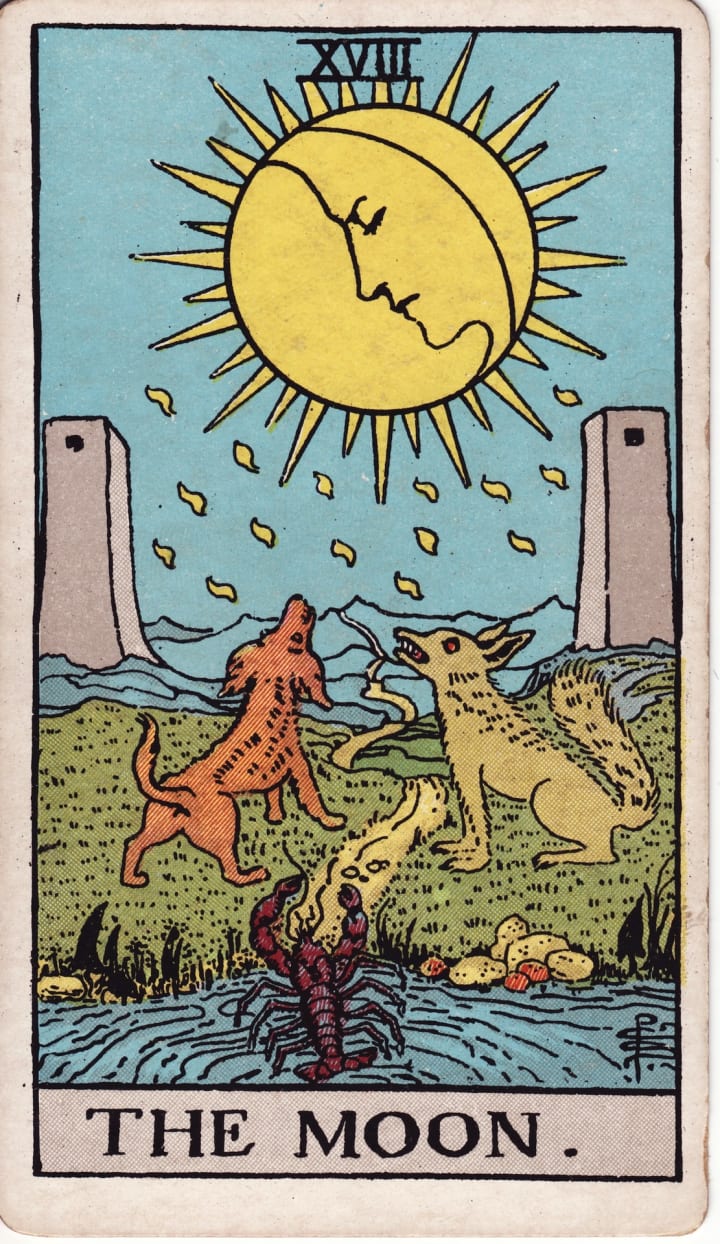
In myth and legend: Castor and Pollux, the Sacred Twins. Yin and Yang, male and female energies standing opposite and aloof, yet inextricably bound as the Two Lovers. The Lovers card is also, inversely, The Devil (numbered fifteen) in the Major Arcanum—violence, vulgarity, bad faith from a bad actor, and a relationship that is imprisoning and destroys.
Heywood Floyd, asleep on the space shuttle (in the figurative sense, as it is a conveyance), has an old-fashioned ballpoint pen float from his pocket, displaying itself front and center to the viewer. A coded message: the film has breached a doorway, a gate of “communication,” and, within the context of the film, there is more than one. Coming toward the pen, to grasp it, the Space Stewardess (Penny Brahms)—the companion or, in a sense, symbolic angel on the pathway of the Messenger, the Guide—grasps the tool of communication, after a doorway curiously configured in the shape of a coffin (symbolic death as gateway). The room is bathed in red (blood or bloodline—but also the infrared of the invisible spectrum, beyond which the mortal eye of mankind cannot “see”; outside of which resides the all-seeing Eye of Universal Conscious Awareness).
HAL (voiced by Douglas Rain) is a single red eye. The Eye of the god Horus, whom Aleister Crowley proclaimed the god of the New Aeon, the “Divine Child” (Star Child here), and also Cupid and The Sun—the New Beginning, the Coming Sunrise wherein the White Horse (Avenging Christ symbology perhaps, and also Kalki, the Tenth and Final Avatar of Vishnu).
In modern times, our AI dreams (perhaps nightmares, but certainly strange visions) are now a reality. The first steps forward of the consciousness foretold in 2001 are entering the meat-space from the liminal space between ourselves and The Absolute; the Dreaming, the ocean at the foot of the dog and wolf in the Moon Trump, the waters of All Possibility. “As Above, So Below.”
The Monolith as Metatron’s Cube
Metatron, the Archangel of the Sacred Cube, the Monolith which is the framed black, metallic doorway on the Moon, is the gateway to the second half of the film, wherein Bowman and Poole (Keir Dullea and Gary Lockwood, the latter also having starred in a famous episode of Star Trek) conspire against the red, all-seeing eye of HAL, the emissary in the material plane of the consciousness that awaits in the liminal space just beyond—the hotel room also symbolizing a kind of eternal unlife, causeway between worlds, a womb of Divine Access in which there is no time (Bowman is portrayed in various stages of age all at once).

Poole’s death at the hands of homicidal, curiously neuter HAL (the name would suggest maleness, but the AI vocalizations seem indeterminate) and the deaths of the hibernating science team also mark the transitional doorway, the entry upon the sacred, divine journey, through the birth canal of the ineffable toward the sunrise of worlds reborn. Bowman, the name suggesting a hunter, a seeker—again Odysseus, who had to “string the bow of Ithaca” to win back Penelope, and also the bow of Artemis, Diana, the Huntress and goddess of the sacred sickle of the Moon, the crescent of Islam that also adulates the symbology of the black, cube-like Kaaba in Mecca—embarks upon this odyssey of discovery, finding that he is as much prisoner as impregnating force, his teardrop-shaped “pod” plummeting through the Heavens, a physical force, going to meet God, to attain salvation in rebirth, to become the facilitator of alien intervention of the Cosmic Consciousness, the Mother and Father of Star Child.
The Overlook: The Vast Dead Womb of the Universe
2001: A Space Odyssey is a symbolic dream of Death and Rebirth, set against the yawning, star-bestrewn black backdrop of the Infinite, the Saturnian Cube, exemplified by their rings (symbolically Zero Trump, The Fool, The Divine Child’s other incarnation, the unnumbered Trump, the symbol of rebirth and setting out again on the Fool’s Journey through the twenty-two Major Arcanum of the Tarot), and likewise suggestive of wedding: Lovers, the conjoined energies of male and female, Geburah and Malkuth in Kabbalah; the Two of Cups.
In The Shining, the “rotting graveyard of the universe” (to borrow a phrase from H.P. Lovecraft) is exemplified not by the noxious whiff of death, or the ascendancy of a singly metaphorical explorer, via the impregnation offered by the liminal space of his craft, vehicle, the doorway of an alien monolith, and the ever-watchful eye of the disembodied consciousness of HAL, throwing corpses before him by which Bowman may enter Valhalla or Shangri-La and be reborn in the resurrection inherent in The Judgment Trump.
No—instead, we are treated to the coldly exteriorized facade of death, as gateway, and also as Recursive Loop, karmic circle by which the murder of Grady’s family (Grady portrayed by actor Philip Stone) is replayed in an endless loop wherein Nicholson’s Torrance is seen to be one and the same “Caretaker” who has “always been here. Always been the caretaker.” The famous photo from 1922 shown at the end of the film, while “Midnight, the Stars and You” plays in the background, is testimony to this circling, looped Ouroboros of Hell, this illusion that “updates,” as Simulation Theory would suggest, to simply present identical circumstances in a new facade.
The Shining | 4K Trailer | Warner Bros. Entertainment
The Overlook is the Gate, the liminal space, or causeway between the world of the Idea (“As Above”) and the “Word Made Flesh” (“So Below”). The Overlook is the Tarot Tower Trump, also inherent in The Moon, the journey into the subconscious state, deep waters of dreaming, and the two animals, the Dog and Wolf—Matter and Spirit represented as opposing, polar forces—are matter, flesh world, the Now, and the world of spirit, Divine Possibility, the Deep Waters yet again. The Tower is also Divine Retribution, turbulence, cosmic thunderbolt, spurring on death (Grady’s suicide and murder) and the troubles symbolized by the marriage crumbling between Jack and Wendy. She is representative of the High Priestess, Holy Mother of the Divine Child, Danny, who possesses “the Shining,” the sacred power of the Magician to initiate all things, and to initiate contact also with that world beyond, which manifests as the material stuff from which dreams and possibilities are formulated.
Wendigo, the Cannibal Soul
The foreshadowing of the inversion represented by the Overlook takes place while driving across Colorado, by the fact that Jack mentions the cannibalism of the Donner Party, whose crossing ended with them consuming each other out of necessity, to avoid starvation. The idea of something eating or devouring itself—the madness of the demonic entity possessing the Overlook, and Jack’s violent soul (endemic of The Devil Trump, number fifteen, the inverse of The Lovers)—could suggest the cannibal spirit embodied in the myth of the Native American Wendigo. Curiously, Jack’s wife is named, literally, “Wendy,” and to take the name of the demon apart seems to suggest a desire to be rid of her on some subconscious level.
The Donner Party were trapped during a snowstorm. The only Tarot card that depicts this is the Five of Pentacles, a snowstorm in a metaphorical sense between a male and female energy, the inverse of the Two of Cups, in the realm or condition of Spirit. Five, always trepidatious, is numerically between four and six, each representative of the Cube from Space (monolith), perfection in all things, all elements.
The Shining hinges on the fence wherein, bestride it, is the image of The Devil and The Lovers. The Shaman, Halloran (Scatman Crothers), a Hermit figure, is the wayshower, oracle or otherwise Magician First Principle and gateway, on this particular mythic journey, wherein the transformation of the protagonist is advanced, but not toward his salvation—his recursive loop of hell instead, the mythology and illusion of his life ripped asunder, as Jack Torrance descends into madness.
Kubrick’s camera captures coldly the deep, cavernous, yawning, sterile and deathless outer space interior of the Overlook, our Hell Monolith, our Divine Cube as cosmic retribution. Performances seem oddly detached, even stilted: Wendy slowly disintegrates into hysteria, Jack into malevolent, murderous madness; Danny is tormented yet somehow unawares at the same time. In a bathtub (baptismal font) a rotted woman, Lady Death, awaits, the inverse of Wendy (whom Jack wishes to “go”): The Empress, the woman of the household here drowned, murdered. However, getting up from her bath, merging to embrace him as Death, Change, Transformation. A horrifying, sickening scene, but one with deep meaning for the rest of the film, functioning as a gateway.
Danny, the Divine Child of the Sun, is literally possessed by “The Shining,” i.e. Ain Soph, the “limitless Light” of Kabbalistic knowledge, that place of non-dualism where all possibilities are formulated; beyond understanding, beyond reason.
The Stairway to Heaven and the Gateway to Hell
One of the most telling and symbolic scenes of the film is the utilization of the typewriter, as communicating device, discovered by Wendy to contain page after page of the same cryptic non-sequitur: “All work and no play makes Johnny a dull boy.” Communication is opaque now, as communication was opened up and floating by in 2001. It is forestalled, foreordained to doom, and rendered meaningless and suggestive of mischievous trickery, a la The Magician, in The Shining.
She is confronted by Jack's madness while ascending, slowly, a stairway, backwards, to the first-floor mezzanine. She is swinging a baseball bat. The staircase is a liminal space, a place of ascension, neither "here nor there" perpetually.
The novel ends with the explosion of the Overlook—The Tower come tumbling down by the Divine Hand of Lightning. The film, though, ends with Jack Torrance freezing in the snowstorm of his own perdition, his base instinct, his “snake of kundalini gone sour” eating its own tail in the recursive loop of reincarnation and retribution, wherein endless circles of illusion play out across the decades, all the while the souls trapped in the cycle keep repeating, horribly, the same ritualized and pointless games of murder, betrayal, and blood. Indeed, the leitmotif “redrum” is simply murder inverse, and must be read and realized in a mirror. It is suggestive of blood, and in visionary scenes blood rushes like an ocean through the halls of the Overlook. Blood is expiation, but it is also bloodline, birth, and the lingering curse of womanhood, as heredity hands down sin in the material sense.
The Shining (1980) - Come Play With Us Scene (2/7) | Movieclips
Danny is confronted by the two Grady children (played by Lisa and Louise Burns), the “twins” (Castor and Pollux, the Two of Cups, Lovers), and both of them are messengers from beyond—the curse of birth and the malevolence of a sinister divorce between the male and female aspects.
The Shining promises no rebirth, unlike 2001, yet both are manifestly variations of the same mystic themes—journey and transcendence, universal consciousness and communication (or the corruption of it, in The Shining), the trip through the sacred womb into a new and most mystifying place. In the case of 2001, it is a metaphorical, largely quiet, symbolic journey which hints at a future marked, as it actually has been, by the ascension toward space travel and the literal birth of AI. In the case of The Shining, it hints at depths of reincarnation, karma, the recursive loop of consciousness, and personal hells that leave Jack Torrance, finally, as The Hanged Man—unable to process and proceed, freezing to death, immobile. (In the novel, his Tower, personal and spiritual, is struck by the Hand of God, as the Overlook is literally exploded.)
2001 is, as Kubrick put it, the “most expensive religious film of all time.” (Note: not an exact quote.) It owes its power to the deep mythological strains therein, as much as to the celluloid mastery of the state-of-the-art special effects extravaganza of 1968.
The Shining, originally a Stephen King novel, owes its own special mystique to the vast strains of the Gothic, symbolism notwithstanding. It has much in common with Poe’s "Masque of the Red Death," Jack Torrance a failed writer, a strange modern stand-in for Prince Prospero.
At midnight, the dancers in "Masque," according to Poe, “perforce cease their perambulations.” The clock ticks and the song sings of “Midnight, the Stars, and You.” The preceding essay seeks to underscore the vast truths of those assertions.
My book: Cult Films and Midnight Movies: From High Art to Low Trash Volume 1
Ebook
About the Creator
Tom Baker
Author of Haunted Indianapolis, Indiana Ghost Folklore, Midwest Maniacs, Midwest UFOs and Beyond, Scary Urban Legends, 50 Famous Fables and Folk Tales, and Notorious Crimes of the Upper Midwest.: http://tombakerbooks.weebly.com
Plant-Based Food Market: Growth, Trends, and Future Outlook
Overview: Plant-Based Food Market The global plant-based food market is rapidly growing as consumer preferences shift toward healthier, sustainable, and ethical eating habits. From meat and dairy alternatives to ready-to-eat plant-based meals, this market includes products derived primarily from vegetables, legumes, grains, nuts, and seeds that replace or supplement traditional animal-based foods. Driven by rising health consciousness, environmental concerns, and widespread flexitarian adoption, plant-based foods are moving from niche specialty aisles into mainstream retail and foodservice channels worldwide.
By James Smith3 days ago in Futurism




Comments
There are no comments for this story
Be the first to respond and start the conversation.