
Journal of Behavioral Homeostasis
A fictional research paper examining rejection as therapy — and the hidden appeal of certainty.

Journal of Behavioral Homeostasis
Vol. 52, Issue 1 (2043)
On the Therapeutic Function of Rejection
Yielded Expectation Adaptation and the Regulation of Anticipatory Stress
Abstract
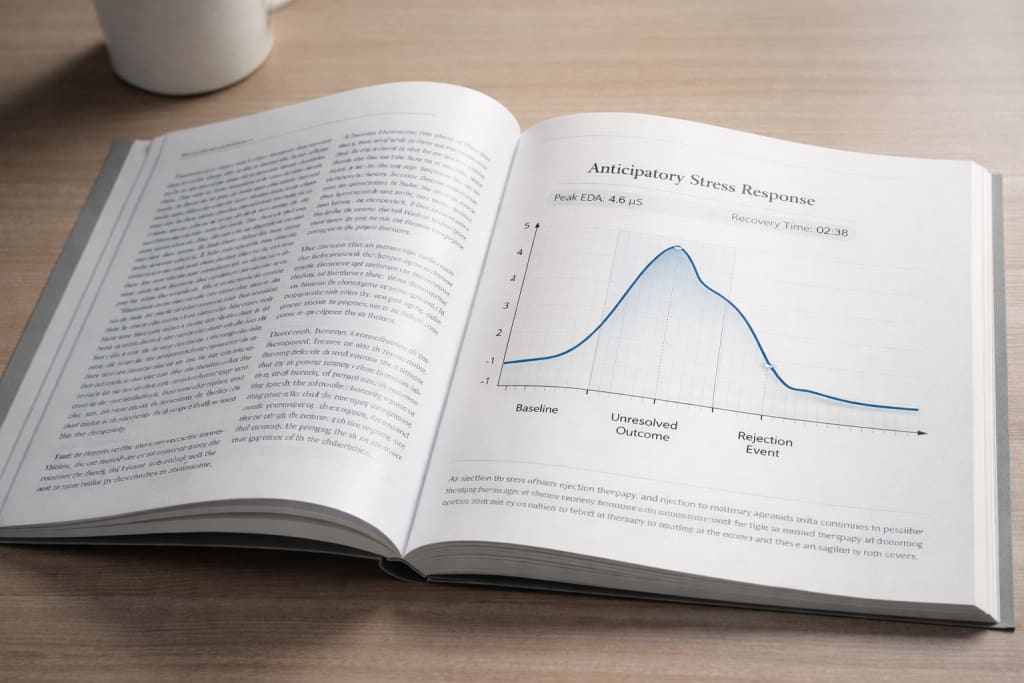
Chronic exposure to unresolved outcomes has emerged as a significant source of sustained psychological stress in contemporary environments characterized by continuous evaluation and delayed feedback. Yielded Expectation Adaptation (YEA) therapy was developed to reduce distress associated with rejection through structured exposure to definitive negative outcomes. Early clinical trials demonstrated measurable reductions in physiological arousal and cognitive rumination following controlled refusal events, despite participants reporting subjective disappointment. Subsequent adoption beyond clinical settings introduced voluntary and recreational applications collectively described as “outcome rehearsal.” This study examines therapeutic efficacy alongside broader cultural implications arising from the normalization of definitive outcomes as a mechanism of emotional regulation.
Background
Modern individuals navigate an unprecedented volume of unresolved outcomes. Applications remain pending without timelines. Messages linger unanswered. Creative work circulates through opaque review systems that offer neither clarity nor closure. Even social interaction increasingly unfolds within structures that defer resolution, producing prolonged periods of suspended expectation.
While anticipation has traditionally been framed as motivational tension, emerging research suggests that sustained uncertainty carries significant cognitive and physiological costs. Patients presenting with chronic anticipatory stress frequently describe difficulty disengaging from unresolved possibilities, reporting persistent rumination, impaired attentional recovery, and elevated baseline anxiety.
Clinical observation revealed an unexpected pattern: for many individuals, the distress associated with waiting exceeded the distress of rejection itself. Participants described negative outcomes as “sharp but clean,” contrasting them with the diffuse strain of indefinite possibility. Once an outcome was known — even an unfavorable one — subjects reported immediate reductions in cognitive load and renewed capacity for directed attention.
These observations prompted investigation into whether rejection, when encountered deliberately and under controlled conditions, might function not solely as a negative experience but as a regulatory one.
Yielded Expectation Adaptation therapy emerged from this line of inquiry. The approach centers on structured exposure to definitive refusal, designed to reduce anticipatory distress by recalibrating emotional responses to negative outcomes. Early implementations included simulated evaluative scenarios, scripted interpersonal declines, and guided exercises in which participants intentionally sought low-stakes rejection experiences.
Initial reception within clinical communities was cautious. The idea that rejection might serve therapeutic ends appeared counterintuitive; however, preliminary findings consistently demonstrated improved physiological recovery following outcome resolution.
Participants did not report enjoying rejection. They reported relief at the end of waiting.
Subsequent literature began referring to the model simply as YEA therapy.
Early Clinical Findings
Pilot studies focused on individuals experiencing persistent anticipatory distress, including professionals navigating competitive hiring processes, creatives engaged in repeated submission cycles, and individuals reporting prolonged uncertainty within interpersonal relationships. Across multiple trials, participants undergoing YEA therapy demonstrated faster emotional recovery following negative feedback compared to control groups receiving traditional cognitive reframing interventions.
Notably, the therapeutic effect appeared tied not to reinterpretation of rejection but to outcome definitiveness. When uncertainty was removed, even unfavorable results allowed subjects to reorganize attention and resume forward-directed behavior.
Emotional stabilization occurred independently of outcome desirability. Whether such stabilization enhances persistence toward uncertain objectives was not assessed in initial trials.
Initial findings were drawn from three pilot cohorts totaling 124 participants across clinical and non-clinical populations. Measures included heart-rate variability, post-session cortisol sampling, and standardized rumination inventories administered at 24-hour intervals. While sample sizes were limited, consistency across cohorts prompted further investigation into non-traditional applications of the model.
Researchers initially framed these findings as evidence that emotional regulation may depend less on outcome valence than on outcome clarity — a distinction that would later prove central to understanding YEA’s broader cultural trajectory.
Expansion Beyond Clinical Contexts
As familiarity with YEA therapy increased, individuals began applying its principles independently outside clinical settings. Participants experimented with deliberate exposure to minor refusals, describing the practice as preparation rather than treatment.
Examples included requesting unlikely accommodations, submitting creative work to rapid-response review forums, and engaging in structured interpersonal exchanges designed to produce immediate closure. In some peer-led sessions, participants delivered timed refusals limited to brief standardized phrases, preventing narrative elaboration and accelerating outcome resolution.
These practices were soon described collectively as outcome rehearsal. The stated aim was efficiency: eliminate prolonged anticipation, reduce emotional backlog, restore equilibrium.
Online communities formed around shared rehearsal strategies. Forums tracked experiments in shortening decision cycles. Informal gatherings organized structured refusal exchanges modeled on early YEA exercises. Participants described feeling clearer following sessions, attributing relief not to rejection itself but to the restoration of certainty.
By 2041, digital platforms offered guided outcome simulations. Users submitted proposals or personal statements for predetermined rejection responses, receiving definitive outcomes in place of extended uncertainty. What began as resilience training increasingly functioned as routine maintenance.
Longitudinal Observations
Extended tracking of frequent YEA participants revealed sustained reductions in anticipatory distress across professional and interpersonal domains. Subjects reported decreased reactivity to uncertainty and increased willingness to disengage from prolonged evaluative processes.
Participants described these changes as increased realism or maturity. However, longitudinal analysis identified convergence toward modest, low-volatility objectives and a gradual reduction in variance among reported long-term goals. Engagement with speculative creative work, competitive applications, and relational pursuits involving delayed feedback declined across cohorts.
These shifts were rarely framed as losses. Participants instead described calibration, emphasizing efficiency and emotional sustainability. Goal selection trended toward incremental trajectories.
Despite these patterns, expressions of desire for authentic acceptance outcomes remained consistent. Participants reported increasing comfort with rejection while continuing to articulate longing for genuine affirmation.
Rejection, when rehearsed, appeared to lose much of its destabilizing force.
Whether it also lost its capacity to clarify what was genuinely wanted remained unclear.
Discussion
The widespread adoption of YEA suggests that relief from uncertainty fulfills a significant psychological need. Across populations, participants demonstrate reduced anticipatory distress following structured exposure to definitive outcomes. Emotional recovery accelerates. Rumination declines. Individuals report increased stability and improved capacity to disengage from unresolved possibilities.
These outcomes align with predictive regulation models, which propose that the brain prioritizes clarity over desirability when restoring equilibrium. Rejection functions less as injury than as resolution — a definitive update that permits cognitive reorganization.
The normalization of outcome rehearsal may therefore represent an adaptive response to environments saturated with deferred evaluation. Participants frame YEA engagement as a method of preserving energy, shortening the waiting cycle, and maintaining emotional efficiency.
Longitudinal findings suggest equilibrium and expansion may not scale proportionally.
Frequent YEA engagement correlates with decreased participation in high-variance pursuits and reduced tolerance for prolonged uncertainty. Emotional volatility declines alongside willingness to pursue outcomes perceived as unlikely.
Participants continue to describe themselves as hopeful. Structured rejection reduces destabilization but does not eliminate longing. The wish to be chosen persists even as individuals become increasingly skilled at rehearsing refusal.
It remains unclear whether the growing cultural preference for definitive outcomes represents an evolution in resilience or a recalibration of perceived attainability. Emotional equilibrium may be achieved through strengthened tolerance of disappointment. It may also be achieved through subtle contraction of the scale at which individuals are willing to hope.
Further research is required to determine whether widespread engagement with YEA strengthens individuals against disappointment — or gradually reduces the range of futures they consider reachable.
Author’s Notes:
Current findings suggest that individuals do not appear to want less; rather, they appear increasingly practiced at relinquishing desire before it encounters resistance.
The reduction of distress may indicate progress; whether it reflects expansion or contraction remains unresolved.
Author: Wren Merroe
Independent Researcher
Areas of study include anticipatory stress regulation, outcome-based emotional adaptation, and behavioral responses to repeated closure events.
Affiliation not currently listed. Correspondence available upon request.
About the Creator
Mina Carey
Self proclaimed weirdo, collector of hobbies, creator of worlds and hunter of mysteries. Let's find our new hyperfixation together.
https://sp0reprintspectrum.carrd.co/
Keep reading
More stories from Mina Carey and writers in Futurism and other communities.
The Cost Of Counting
You check your phone and it tells you who noticed you, how well you slept, how productive you’ve been, how far you’ve walked. The numbers arrive before your thoughts do. They don’t just inform you — they interpret you. A good sleep score feels like success. A low step count feels like failure. A spike in notifications becomes proof that something mattered. Most of us accept this without hesitation. Numbers feel objective. Neutral. Trustworthy. But why do we care so much about what can be counted — and so little about what can’t? It’s easy to blame modern life. Smartphones. Algorithms. Dashboards for everything. Unfortunately, humans were mistaking numbers for meaning long before anyone invented a smartwatch. There’s even a name for the pattern: the McNamara Fallacy. During the Vietnam War, U.S. Secretary of Defense Robert McNamara attempted to measure progress through statistics — body counts, sortie numbers, territory percentages. The data looked precise. Objective. Reassuring. On paper, progress could be tracked. Charts moved upward. Reports suggested momentum. But many of the most important variables refused to cooperate with measurement. Morale couldn’t be quantified. Cultural resistance couldn’t be graphed. Political realities shifted faster than any spreadsheet could capture. No one woke up one day and decided to ignore reality. The shift happened gradually. Each new report reinforced the belief that measurable progress must reflect actual progress. Over time, the metrics became the story. The numbers weren’t false. They were simply incomplete — and what couldn’t be easily measured slowly faded from view. That instinct never disappeared. It just moved closer to home. Today, measurement surrounds us. Fitness trackers translate movement into steps. Platforms convert attention into engagement metrics. Productivity tools turn effort into streaks and checkmarks. None of this is inherently bad. Measurement helps us see patterns we might otherwise miss. Data improves medicine, reveals inequality, and helps us navigate complexity. The trouble begins quietly when measurable signals start to stand in for deeper realities. Nowhere is this tension more visible than in creative work. Writers, artists, musicians, filmmakers — anyone who makes something — now receives constant numerical feedback. Views. Likes. Shares. Follower counts. Watch time. Creative work has always involved uncertainty. You make something and hope it resonates. Often, you don’t know if it has — or when. Metrics offer relief from that ambiguity. They speak clearly. Immediately. Undeniably. And that clarity is seductive. Creative life now exists between two feedback systems. One is slow, ambiguous, and emotional: the sense that something meaningful has been expressed or received. The other is immediate, visible, and quantifiable: engagement numbers that arrive instantly and feel definitive. Both systems have value. Metrics help creators find audiences, refine communication, and understand reach. But they also introduce a subtle gravitational pull. A piece that performs well numerically feels validated. One that disappears quietly can feel like failure, regardless of its depth or originality. Over time, creators adapt. Certain formats travel further. Certain tones provoke faster reactions. Certain ideas convert reliably into attention. The shift rarely feels like compromise. It feels like learning the system. Slowly, almost imperceptibly, the measurable begins to redefine what feels worth creating. There’s a cognitive bias sometimes called the streetlight effect. A person searches for lost keys under a streetlight — not because that’s where they dropped them, but because that’s where the light is strongest. Metrics function the same way. They illuminate certain aspects of creative work very clearly: reach, growth, frequency. Once that light exists, effort naturally gathers there. Decisions cluster around what is visible. The danger isn’t that the light exists. It’s that we forget how much remains in the dark. Resonance is hard to quantify. Slow influence is invisible. A story that changes someone years later won’t show up in this week’s analytics. Metrics measure applause. They rarely measure silence — and silence is where many meaningful ideas begin. If this tension feels familiar, it isn’t a personal weakness. It’s human psychology. We trust numbers because numbers feel safe. Ambiguity is exhausting. Creative work, like life itself, is filled with variables we cannot predict. Measurement offers the illusion of certainty. A rising graph feels like progress. A score feels like clarity. Once a metric exists, it begins to exert gravity. Attention bends toward what performs. Decisions orient toward what can be optimized. The shift rarely feels dramatic. It feels logical. Which is precisely why it’s so difficult to notice. The goal isn’t to reject measurement. Numbers are powerful tools. The risk lies in letting measurement replace judgment rather than inform it. Sometimes the simplest safeguard is a question: What does this number fail to capture? Engagement measures reaction, not depth. Visibility measures reach, not meaning. Metrics can show who noticed — but rarely reveal who was changed. Creative work has always required making things without guaranteed validation. That hasn’t changed. What has changed is how loudly validation speaks. The uncomfortable — and perhaps hopeful — truth is that the most meaningful work often resists easy measurement. History suggests the most important variables in any system are often the ones that refuse to be counted. When we forget that, we don’t just misread the numbers. We begin to reshape our creativity around them. And over time, that reshaping carries a cost.
By Mina Carey2 days ago in Psyche
Saudi Arabia Superconducting Magnetic Energy Storage Market: Grid Stability, Renewable Integration & Growth Outlook
Saudi Arabia’s energy landscape is shifting fast. As the Kingdom scales up solar and wind capacity under Vision 2030, the need for fast-responding, reliable energy storage has never been more urgent. Superconducting Magnetic Energy Storage (SMES) is emerging as a strong contender — valued for its near-instant response times and long operational life. According to IMARC Group’s latest data, the The Saudi Arabia superconducting magnetic energy storage market size reached USD 621.3 Million in 2025. Looking forward, IMARC Group expects the market to reach USD 1260.8 Million by 2034, exhibiting a growth rate (CAGR) of 8.18% during 2026-2034.
By Shubham Sharma 6 days ago in Futurism
Systemic Lupus Erythematosus (SLE) Drugs Market Outlook: Autoimmune Therapy Advancements and Growth Opportunities
According to IMARC Group's latest research publication, The global systemic lupus erythematosus (SLE) drugs market size reached USD 2.8 Billion in 2024. Looking forward, IMARC Group expects the market to reach USD 4.7 Billion by 2033, exhibiting a growth rate (CAGR) of 5.54% during 2025-2033.
By James Whitman3 days ago in Futurism




Comments
There are no comments for this story
Be the first to respond and start the conversation.