
How Small Businesses Are Actually Using AI in 2026?
Beyond hype and headlines, small companies are quietly reshaping daily operations with artificial intelligence in ways that are practical, measurable, and often surprisingly simple.

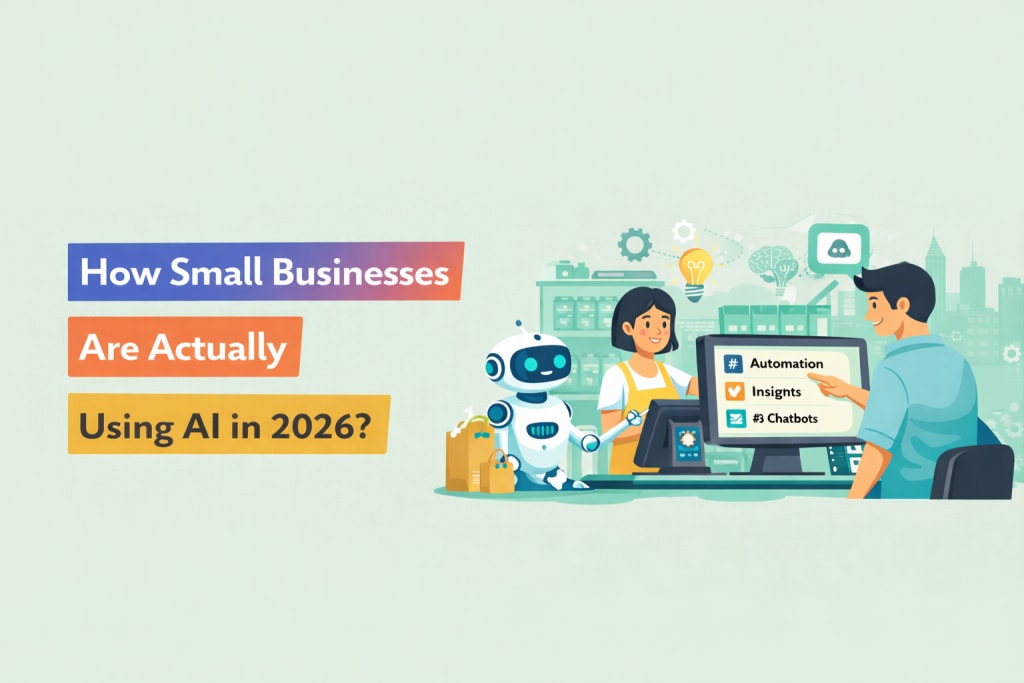
A bakery owner in Toronto recently described how artificial intelligence changed her weekly routine — not through futuristic robots or complex analytics dashboards, but through a simple forecasting tool that predicts demand based on weather patterns and local events. She used to guess how much to bake each morning. Now she checks a dashboard that suggests production quantities with around 90% accuracy. Waste has dropped. Staffing decisions feel less stressful. Profit margins have improved.
Stories like this reveal something often overlooked in discussions about AI: small businesses are not chasing spectacle. They are adopting tools that solve narrow problems, reduce friction, and save time.
The narrative around AI frequently centers on tech giants or venture-backed startups, yet a quieter shift is happening among small and mid-sized organizations. According to a 2025 survey by the U.S. Chamber of Commerce, more than 48% of small businesses reported experimenting with AI tools in at least one area of operations, compared to less than 15% just a few years earlier.
The question is no longer whether small businesses will use AI. The real question is how they are integrating it into everyday work.
The Move From Experimentation to Practical Adoption
Early conversations about AI focused on potential. Small companies observed from a distance while larger organizations invested heavily in research.
That phase has passed.
The availability of pre-built AI tools, subscription-based software, and low-code platforms has lowered barriers dramatically. Instead of hiring specialized engineers, many businesses now subscribe to tools that embed AI capabilities directly into familiar workflows.
Gartner reports that by mid-decade, more than 80% of enterprise software vendors will include AI features as standard components. Small businesses benefit indirectly because the tools they already use — email platforms, CRM systems, accounting software — increasingly contain automated intelligence.
This shift transforms AI from a standalone initiative into an invisible layer across daily tasks.
Customer Support: The First Major Entry Point
One of the earliest areas where small businesses adopted AI is customer support.
Chatbots and conversational agents have evolved beyond scripted responses. Modern systems can interpret intent, retrieve knowledge base articles, and escalate complex issues to human agents when necessary.
Zendesk research indicates that businesses implementing AI-assisted customer service tools report faster response times and improved customer satisfaction metrics. For small teams managing high volumes of inquiries, automation reduces pressure without eliminating human interaction.
The goal is not replacing staff but extending capacity.
A small e-commerce retailer, for example, may deploy an AI assistant that answers shipping questions, processes returns, and recommends products based on previous purchases. Employees then focus on nuanced or high-value interactions.
Marketing Automation With Smarter Targeting
Marketing represents another area where AI adoption has accelerated.
Small businesses historically struggled with data analysis due to limited resources. AI-driven marketing platforms now automate tasks such as audience segmentation, email personalization, and performance analysis.
HubSpot’s marketing trends report suggests that companies using AI-assisted personalization see higher engagement rates compared to static campaigns. Rather than sending identical messages to every customer, businesses tailor content dynamically.
The shift reduces guesswork.
Instead of manually analyzing spreadsheets, business owners receive recommendations about timing, messaging, and targeting. These tools democratize capabilities once reserved for large marketing teams.
Inventory Management and Forecasting
Retailers and service-based businesses increasingly use AI for forecasting demand.
Predictive analytics tools analyze historical sales data, seasonal patterns, and external factors like weather or local events. For small companies operating on tight margins, accurate forecasting can make the difference between profit and loss.
McKinsey research highlights that AI-driven demand forecasting improves accuracy significantly compared to traditional methods. For small businesses, even modest gains translate into real financial impact.
Reducing excess inventory lowers storage costs. Avoiding shortages protects revenue. Decision-making becomes less reactive.
Financial Management and Risk Assessment
Accounting and financial planning tools increasingly integrate AI capabilities.
Automated categorization of expenses, anomaly detection, and predictive cash flow analysis allow small business owners to monitor financial health more effectively. QuickBooks and similar platforms now provide forecasting features that suggest potential cash shortages before they occur.
PwC research suggests that small businesses adopting AI-driven financial tools experience improved planning accuracy and reduced manual workload.
Financial clarity supports better strategic decisions.
Hiring and Workforce Management
Recruitment represents another growing application area.
AI-powered platforms assist with resume screening, scheduling interviews, and identifying candidate patterns. While concerns about bias remain, many small businesses find these tools helpful for managing hiring processes efficiently.
LinkedIn data indicates that organizations using AI-assisted hiring workflows reduce time-to-hire while improving candidate matching.
Workforce management also benefits. Scheduling tools predict peak demand periods and recommend staffing adjustments, helping owners allocate labor more effectively.
Product Development and Customer Insight
AI-driven analytics tools analyze customer feedback, reviews, and social media sentiment to identify patterns.
Small businesses can uncover insights about product performance without conducting expensive research studies. For example, sentiment analysis may reveal recurring complaints about delivery speed or product durability.
These insights inform product improvements.
The accessibility of natural language processing tools allows even non-technical teams to explore customer feedback at scale.
AI in Mobile Applications and Digital Experiences
Another growing trend involves integrating AI features directly into customer-facing applications.
Companies involved in mobile app development Austin and similar tech ecosystems increasingly embed AI into apps to personalize experiences, recommend products, and automate support. Small businesses adopting custom apps benefit from these capabilities without building AI systems from scratch.
AI-powered recommendation engines and predictive search functions enhance usability while gathering valuable behavioral data.
This integration reflects a broader shift: AI becoming part of user experience design rather than an isolated feature.
The Challenge of Trust and Ethical Use
Despite growing adoption, small businesses remain cautious.
Concerns about data privacy, transparency, and algorithmic bias influence decision-making. Regulatory developments and public scrutiny encourage companies to evaluate tools carefully before deployment.
Edelman’s Trust Barometer indicates that consumers value transparency regarding AI use. Businesses that communicate clearly about automation often maintain stronger customer relationships.
Ethical considerations are becoming part of everyday operational decisions, not just theoretical discussions.
Cost Efficiency and the Economics of AI
One reason AI adoption among small businesses is accelerating involves cost structure.
Cloud-based subscription models eliminate large upfront investment. Pay-as-you-go pricing allows companies to experiment without major risk.
IDC research suggests that declining infrastructure costs and increased availability of pre-trained models significantly lower barriers to entry.
The result is a democratization of AI capabilities.
Small companies that once lacked access to advanced analytics now deploy tools comparable to those used by larger organizations.
What AI Adoption Looks Like in Practice
The reality of AI adoption rarely matches cinematic expectations.
It often looks like:
- Automated email responses
- Predictive inventory alerts
- Smart content suggestions
- AI-assisted bookkeeping
- Chat-based customer support
- Dynamic pricing tools
Each implementation may seem small individually. Together, they reshape how businesses operate.
AI becomes less about revolution and more about incremental improvement.
Looking Ahead
As AI continues evolving, small businesses will likely deepen adoption rather than pursue radical change overnight.
The trend suggests a gradual layering of intelligence into existing workflows. Instead of replacing systems, AI augments them.
Future adoption may focus on:
- Deeper personalization
- Advanced forecasting
- Real-time operational analytics
- Autonomous workflow automation
The trajectory reflects practical necessity rather than technological fascination.
Closing Reflection
Small businesses are not adopting AI because it sounds futuristic. They are adopting it because it solves specific problems.
The transformation happening in 2026 is subtle but powerful. Artificial intelligence is moving from experimental novelty into everyday infrastructure — quietly reshaping operations without dramatic headlines.
The most successful small businesses are not those chasing the newest tools. They are those identifying where automation reduces friction, improves decisions, and frees human attention for creative and strategic work.
In that sense, AI is becoming less about machines and more about how people choose to work.
About the Creator
Keep reading
More stories from Mary L. Rodriquez and writers in Futurism and other communities.
Why Charlotte Is the Next Big Hub for Mobile App Development?
For years, conversations about technology growth followed predictable geography. Silicon Valley dominated headlines, New York symbolized finance-driven software, and Seattle represented cloud-driven expansion. Yet beneath that familiar narrative, another pattern has been forming — technology ecosystems rising in cities that combine affordability, industry diversity, and strategic positioning rather than historic tech reputation.
By Mary L. Rodriquez7 days ago in Futurism
Veil of Subconscious Awakening
Images slide behind my eyelids like film cadres, bursting with meanings. In one moment, I’m speeding down the highway, making the speedometer swing wildly like a frantic pendulum. The next moment, I’m plunging from a falling plane, slowly crashing earthward. At home, I meet black cat’s green, googly eyes staring at me from the cavernous hollowness of the kitchen. When I turn for a moment, it disappears, and all I can see is a pair of blue suede shoes set up against the wall. I pick them up and put them on. When I glimpse at them again, they’ve become black as night, making me blink and flinch.
By Moon Deserta day ago in Fiction



Comments
There are no comments for this story
Be the first to respond and start the conversation.