
General Purpose vs. Medical AI for HealthTeach Companies
Learn how to choose between general and medical Artificial Intelligence systems for building top-notch Healthcare Apps

Nowadays, Artificial Intelligence is booming, but not every solution is interchangeable, especially in a clinical setting. General-purpose models are trained on broad data and excel at versatile tasks, but healthcare has unique demands. Founders should note that while general-purpose AI can automate many workflows, they lack the built-in safeguards and domain focus that medical applications require.
In this article, we compare general-purpose models with specialized medical ones to help HealthTech founders and decision-makers understand when each approach makes sense. We also highlight key compliance and technical trade-offs involved, and discuss how to build a practical strategy that aligns with real-world healthcare requirements.
Difference Between Medical AI and General AI
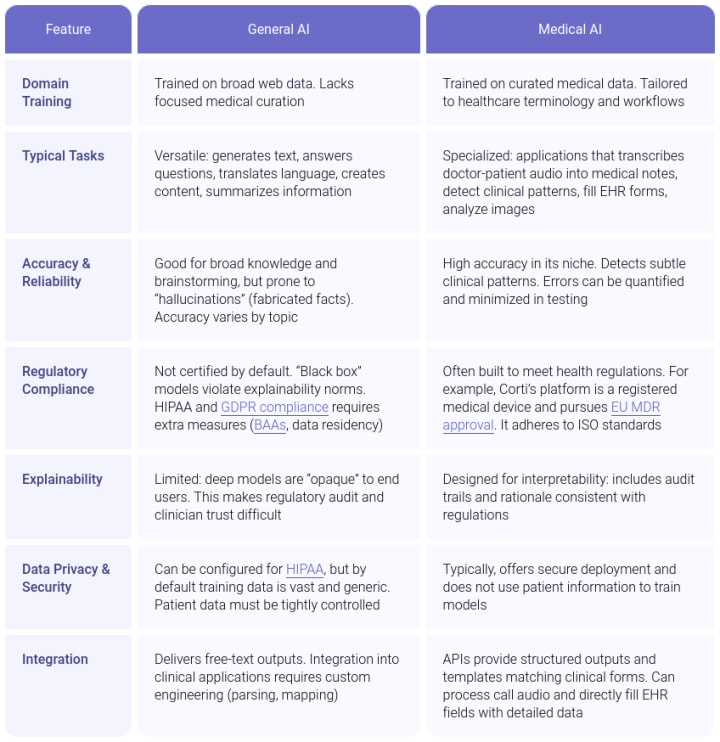
General-purpose models are designed for breadth rather than depth. They excel at handling a wide range of tasks, from building applications that generate text and summarize information to assisting with administrative workflows, because they are trained on vast, diverse datasets that span many industries. This flexibility makes them an appealing choice for general automation and early prototyping in healthcare software development.
Medical Artificial Intelligence systems are purpose-built for the complexities of modern healthcare applications. They are often fine-tuned on clinical data and designed to understand medical terminology, comply with strict regulatory frameworks, and integrate into clinical workflows with explainable insights. This specialized focus enables higher accuracy and safety in clinical contexts.
What General Artificial Intelligence Does Well for Healthcare Software
General-purpose solutions offer a ready-made “AI brain” without massive R&D. Key strengths include:
- Administrative Automation. Applications that rely on AI chatbots and virtual assistants can handle patient FAQs, appointment scheduling, billing questions, claims inquiries, and follow-up reminders;
- Documentation and Templates. Healthcare startups can use general-purpose tools to generate or refine clinical content, such as discharge summaries, patient instructions, referral letters, etc. This frees clinicians from retyping routine text;
- Content and Research. General Artificial Intelligence in healthcare excel at summarizing articles or extracting key information from large text sources. Healthcare software might use it to parse medical literature, generate patient education materials, or synthesize research findings;
- Prototype Flexibility. Building applications with intelligent features using one of many options available is relatively easy and fast. Startups love its “plug-and-play” approach where they don’t need to collect huge domain datasets.
General-purpose AIs can fill gaps in many non-critical areas. It’s cost-effective and can accelerate product development. The trade-off is that they’re aides for humans and admin processes, and none of these are approved diagnosis tools.
Practical Example: Automating Clinical Notes with General AI
Here’s a practical example that illustrates the effective use of general-purpose AI for healthcare workflows. A clinic management application owner needed to enhance its digital consultation functionality. The challenge was to automate clinical note-taking without building a specialized medical AI from scratch. Our developers used the ChatGPT API for natural language processing to create a system that transcribes doctor-patient conversations in real time, identifies key medical terms, and structures them into searchable notes. As a result:
- Doctors could focus entirely on patients, not documentation;
- Note-taking accuracy improved by capturing exact terminology;
- Clinical data became automatically organized and retrievable.
This application modernization example shows how general-purpose solutions in healthcare help work with unstructured data. By embedding real-time analysis, we helped turn consultation dialogue into structured information, slashing operational costs.
Why Healthcare Companies Often Needs Specialized AI Infrastructure
To assist clinicians safely, healthcare applications must be purpose-built, with verified accuracy, explainability, and regulatory clearance. General Artificial Intelligence is powerful for administrative or creative work, but can lead to errors if used blindly in patient care. Patient safety and privacy impose strict requirements that general models does not automatically meet:
- Data Confidentiality. Healthcare applications work with highly sensitive information, and they’re regulated by HIPAA (Health Insurance Portability and Accountability Act) in the US and GDPR (General Data Protection Regulation) in the EU. Specialized AIs are designed to handle PHI (Protected Health Information) by default, keeping all patient data secure and private;
- Regulatory Accountability. Intelligent healthcare applications intended for medical purposes often qualify as medical devices under regulators like the FDA (Food and Drug Administration) in the US or MDR (Medical Device Regulation) in the EU when used for diagnosis or treatment. These require rigorous validation and certification. A generic LLM has no FDA approval for AI software. Building an FDA-cleared or CE-marked (a product that meets EU health, safety, and environmental standards) application “from the ground up” is onerous. Partnering with a specialized provider can shortcut that;
- Clinical Accuracy and Context. Medical decisions demand extreme accuracy. A general model trained on internet text may not distinguish subtle details or keep up with the latest guidelines. Specialized models are fine-tuned on clinical data (doctor‑verified records, clinical guidelines) and can detect patterns that generic models miss;
- Explainability and Trust. The EU’s AI Act classifies medical AI as “high-risk,” requiring transparency and human oversight, making “black box” AIs unacceptable in healthcare. Clinicians must understand the reasoning behind any decision that healthcare applications make. Specialized medical AI frameworks incorporate explainability (e.g. highlighting which symptoms or data led to a suggestion) to satisfy auditors and doctors alike. This reduces legal risk and increases trust;
- Integration with Clinical Workflows. Healthcare software lives in complex ecosystems (EHRs, medical devices, billing systems). Specialist platforms often provide connectors or templates that plug into these workflows. For instance, APIs that can consume an audio recording of a doctor-patient encounter and output a filled-out medical form or draft discharge summary.
If an AI application touches patient diagnosis, treatment, or legally sensitive data, a general-purpose model (treated as a “black box”) may not be appropriate. In those cases, a specialized platform or partnership is the safer path. This critical focus on compliance and clinical safety is reshaping the entire AI landscape. Recognizing this imperative, even leading general-purpose AI developers like OpenAI now offer OpenAI for Healthcare, a HIPAA-compliant suite, featuring models evaluated for clinical workflows.
Corti as an Example of Specialized Healthcare AI
As a concrete example, Corti illustrates the specialized approach. It’s a platform built for healthcare from the ground up that enables the following key features:
- Medical-Grade Compliance. Corti Assistant MD is already registered as an EU/UK medical device, and its development follows ISO 13485 (medical QMS), ISO 14971 (risk management), IEC 62304 (software lifecycle) and other standards. This means every model update, risk analysis, and user workflow is documented for auditors;
- Healthcare-Tailored Models. Corti offers multiple specialized models trained exclusively on medical data. For example, its “Solo” model is optimized for fast, accurate transcription of clinical conversations. Its “Ensemble” model excels at turning conversations into structured documentation. These models are integrated into developer-friendly APIs and “agentic” frameworks that let you define healthcare-specific tasks for your application (e.g. filling out a cardiology note, checking discharge instructions);
- Developer Support. Because navigating healthcare AI regulation is complex, Corti also provides documentation and support. Integrating Corti’s API comes with risk-management files, test reports, and even an AI impact assessment aligned to EU law.
The Hybrid Approach: Combining General and Specialized AI
In practice, many healthcare software solutions use a hybrid strategy, blending general AI and specialized modules. For instance:
- A telehealth application might use general-purpose Artificial Intelligence to generate patient education materials or answer billing questions, but use a certified clinical model to analyze vital signs or lab results;
- An EHR startup could integrate generic Artificial Intelligence to help with free-text note-entry and coding, while routing any diagnostic suggestions through a specialized API for verification;
- A medical device maker might use a general model behind the scenes for language translation or voice interface, and a trained vision model for image interpretation.
This modular approach takes the best of both worlds. General-purpose intelligent tools accelerate development of ancillary application features, while specialized solutions ensure core clinical tasks meet healthcare standards.
Your Strategy Must Follow Healthcare Reality
HealthTech founders should align their strategy to the realities of medicine. General-purpose Artificial intelligence is a valuable tool for wide-ranging tasks, rapid prototyping, and augmenting clinicians’ administrative work. Specialized medical AI is essential for anything that touches patient safety, compliance, or decision-making.
About the Creator
Keep reading
More stories from Sergey Laptick and writers in Futurism and other communities.
How Spec-Driven Development Brings Structure to AI-assisted Software Engineering
AI coding assistants have made developers incredibly fast since the start of the AI boom, but this new speed often comes at a hidden cost. The IT industry is realizing that generating code is the easy part. The real challenge is building systems that are coherent, maintainable, and actually do what they were supposed to do.
By Sergey Laptick3 days ago in Futurism
Large Language Model (LLM) Market to Reach USD 82.1 Billion by 2033
Large Language Model (LLM) Market Overview The Global Large Language Model (LLM) Market is projected to grow significantly, reaching approximately USD 82.1 Billion by 2033, rising from USD 4.5 Billion in 2023, with a CAGR of 33.7% during the forecast period from 2024 to 2033. This rapid expansion is supported by the rising adoption of generative artificial intelligence technologies across enterprises, research institutions, and digital platforms. Organizations are increasingly deploying LLM systems to automate knowledge processing, customer interactions, and content generation.
By Roberto Cruma day ago in Futurism
Food Preservatives Market: Antimicrobial & Antioxidant Solutions, Food Safety Focus & Industry Growth Ahead
The food preservatives market is experiencing robust growth, primarily driven by the increasing demand for convenience foods and longer shelf life. Rising concerns regarding food safety, alongside a global mandate to reduce food waste, are stimulating the uptake of robust antimicrobial systems across complex distribution networks. According to latest data, the global food preservatives market size was valued at USD 3.32 Billion in 2025. Looking forward, the market is projected to reach USD 5.18 Billion by 2034, exhibiting a CAGR of 5.07% from 2026-2034. North America currently dominates the market, holding a market share of over 31% in 2025.
By sujeet. imarcgroup4 days ago in Futurism
"Scream 7" (2026): Running out of Fresh Screams
This is the seventh time we’ve had a Ghostface crisis. Scream 7 is the latest edition of the Scream franchise. Sydney Prescott and her family are under attack by another anonymous killer dressed in a Ghostface costume. While having issues with her daughter, Tatum, they run from the bloody murders, trying to determine who is behind it all.
By Marielle Sabbag5 days ago in Horror




Comments
There are no comments for this story
Be the first to respond and start the conversation.