
From Concept to Code: A Seattle Founder’s Guide to Building Apps
Why the "Silicon Valley North" label is wrong—and how to survive the unique challenges of the Emerald City's tech ecosystem.


The rain was coming down in sheets against the window of a coffee shop in Capitol Hill—standard operating procedure for a Tuesday in November. I sat across from a founder who had just burned through $50,000 on an app that didn't work.
He wasn't an amateur. He was a seasoned logistics manager who had tried to outsource his complex supply-chain tool to a "budget-friendly" agency he found online. The result? A spaghetti-code mess that collapsed the moment more than ten users tried to log in simultaneously.
"I thought I was saving money," he told me, staring into his latte. "Now I have to scrap it and start over."
This is a story I hear constantly in the Pacific Northwest. Seattle isn't just a rainy city with good coffee; it is arguably the most sophisticated cloud computing market on the planet. Home to Amazon, Microsoft, and a startup ecosystem valued at over $90 billion in 2025, this city plays by a different set of rules.
If you are looking to enter the mobile app development Seattle arena, you need to understand that "good enough" doesn't cut it here. Here is my field guide—from concept to code—on how to build a digital product that actually survives in the shadow of the tech giants.
Phase 1: Validation in the "Cloud Capital"
Before you write a single line of code, you need to understand the market you are entering.
Seattle is often lazily called "Silicon Valley North," but the culture here is distinct. While the Bay Area loves consumer social apps (think TikTok or Snapchat), Seattle is the fortress of B2B and Enterprise SaaS. We build the plumbing that runs the internet.
The Stat You Need to Know: According to 2025 data, 61.8% of Seattle’s AI talent works directly in the tech sector, the highest concentration of any major U.S. city.
The Lesson: Your app needs to be "smart" from Day 1. If you are pitching a simple utility app to investors in South Lake Union, you will be laughed out of the room. The local market expects intelligent automation. Ask yourself: Does my app just display data, or does it use data to make decisions for the user? If it’s the former, you are already behind.
Phase 2: The "Amazon Premium" on Talent
The biggest shock for most non-technical founders in Seattle is the cost of labor. You aren't just competing with other startups for developers; you are competing with Amazon Web Services (AWS) and Azure.
When I first started building teams, I was floored by the salary expectations. I’d offer a competitive rate, only to lose the candidate to a Big Tech offer that included restricted stock units (RSUs) and a signing bonus worth more than my car.
The Financial Reality: Recent market research indicates that the median salary for a software engineer in Seattle hovered around $165,000 in 2025, with specialized AI engineers commanding upwards of $200,000.
If you decide to hire in-house, burn rate will be your biggest enemy. This is why many successful local founders turn to a hybrid model—keeping the product management and architecture local (to maintain that "Seattle quality") while leveraging distributed teams for the heavy lifting of coding.
Phase 3: Budgeting for the "MVP" (Minimum Viable Product)
"How much will it cost?" is the question every founder asks. The answer depends entirely on who you ask, but in Seattle, the floor is higher because the quality standard is higher.
In 2025, the average cost to build a "feature-rich" business app in this region ranges from $50,000 to $120,000. If you are looking to integrate generative AI or complex real-time data processing, you are looking at $120,000 to $250,000+.
The "100x Rule" of Technical Debt: Why is it so expensive? Because fixing a bug after launch costs 100 times more than fixing it during the design phase. Seattle developers know this. We don't just slap code together; we build scalable architecture. You are paying for the assurance that your app won't crash when you hit 10,000 users.
Phase 4: The Retention Reality Check
Launching the app is only the starting line. The real battle is keeping people on it.
The mobile market is brutal. Research shows that the average mobile app sees a Day 1 retention rate of only ~25%. By Day 30? That drops to a terrifying 5.7%.
The Seattle Strategy: To beat these odds, you need to focus on "Time to Value." In our fast-paced tech culture, users give you about 20 seconds to prove your app is useful.
I advise all my clients to strip their MVP down to the single most valuable feature. If you are building a dog-walking app, don't build a social feed or a photo gallery for the launch. Build the button that gets the dog walked. Everything else is distraction.
Phase 5: Navigating the "Seattle Freeze" in Business
You’ve likely heard of the social "Seattle Freeze." It exists in business, too.
In other cities, you can win deals with charisma and a shiny pitch deck. Here, the business culture is deeply engineering-driven. Investors and partners are skeptical of fluff. They want to see the metrics. They want to know your Customer Acquisition Cost (CAC) and your Lifetime Value (LTV).
My Advice: When you network, lead with data, not dreams. Don't tell them your app will "change the world." Tell them your app "reduces supply chain latency by 14%." That is the language this city speaks.
Conclusion
Building an app in Seattle is a trial by fire. The costs are high, the competition is elite, and the tolerance for mediocrity is zero.
But if you can make it work here, you can make it work anywhere. The rigorous standards of the mobile app development Seattle scene force you to build better products. You aren't just building an app; you are building an enterprise-grade solution from the ground up.
So, grab a coffee (make it a double), open your laptop, and let’s get to work. The code isn't going to write itself.
About the Creator
Keep reading
More stories from Samantha Blake and writers in Futurism and other communities.
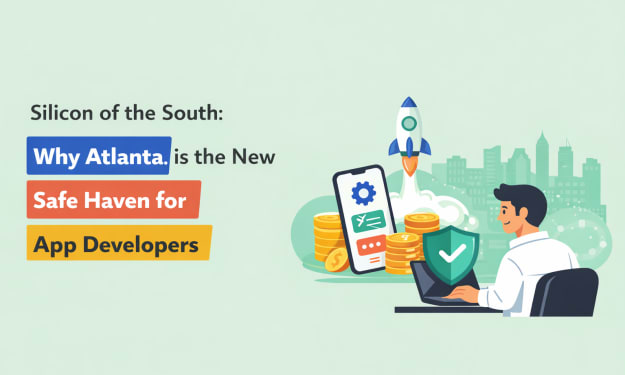
Silicon of the South: Why Atlanta is the New Safe Haven for App Developers
I used to have a very specific image of a tech hub. It involved overpriced toast, a constant fog rolling over a bridge, and an underlying sense of anxiety that if you didn't raise ten million dollars by Tuesday, you were already behind. For a long time, I assumed that being a developer meant accepting a certain kind of "grind"—the kind where you earn a six-figure salary but still need three roommates to afford a kitchen.
By Samantha Blake4 days ago in Futurism
GCC Personal Luxury Goods Market Analysis: Industry Overview, Key Players & Future Outlook
According to IMARC Group's latest research publication, GCC personal luxury goods market size reached USD 10.3 Billion in 2024. The market is projected to reach USD 14.7 Billion by 2033, exhibiting a growth rate of 3.82% during 2025-2033.
By Abhay Rajput5 days ago in Futurism
Saudi Arabia Reinsurance Market: Regulatory Reforms, Risk Diversification, Capital Strength & Market Expansion
According to IMARC Group's latest research publication, Saudi Arabia reinsurance market size was valued at USD 3.3 Billion in 2025. Looking forward, IMARC Group estimates the market to reach USD 5.2 Billion by 2034, exhibiting a CAGR of 5.35% from 2026-2034.
By Jeffrey Wilson7 days ago in Futurism



Comments
There are no comments for this story
Be the first to respond and start the conversation.