
Cryptocurrency Market Trends: Central Bank Digital Currencies, Policy Reforms & Industry Forecast to 2034
How blockchain scalability solutions, layer-2 adoption, and interoperability advancements are enhancing transaction efficiency and ecosystem integration across the cryptocurrency market.

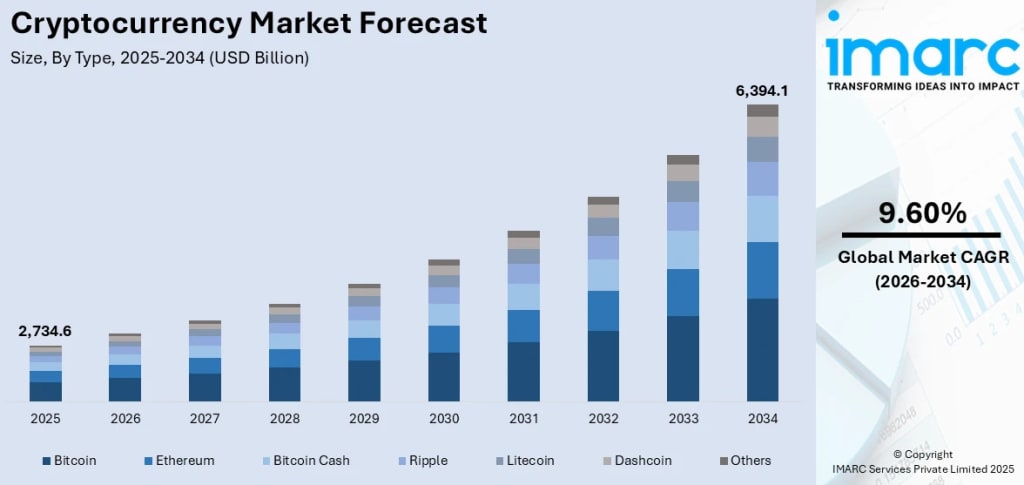
Rising adoption of decentralized finance (DeFi) solutions, the proliferation of innovative blockchain platforms, and heightened interest from institutional investors are driving cryptocurrency market demand, supported by evolving regulatory frameworks, enhanced transaction transparency, and increased digitization of financial services. According to IMARC Group’s latest data, The global cryptocurrency market size was valued at USD 2,734.6 Billion in 2025. Looking forward, IMARC Group estimates the market to reach USD 6,394.1 Billion by 2034, exhibiting a CAGR of 9.60% from 2026-2034.
Cryptocurrency now represents a multi-trillion-dollar global market exceeding USD 2 trillion and exhibiting steady year-on-year expansion. Demand is driven by rising public awareness, the need for efficient cross-border transactions, and increased interest in digital assets as alternative investment vehicles. Technological advancements in blockchain scalability and security, the integration of real-world assets (RWAs), and the development of centralized exchange infrastructure are further accelerating uptake. Major segments include Bitcoin, Ethereum, Ripple, and Litecoin, with consumers and enterprises prioritizing fast settlement times, low fees, and robust security protocols.
Cryptocurrency Market Growth Drivers:
- Rising Adoption of DeFi Solutions
The demand for decentralized finance (DeFi) platforms is surging as users seek financial services without traditional intermediaries like banks. These platforms offer lending, borrowing, and trading directly through blockchain protocols, providing greater accessibility and efficiency. Global market reports value the industry at approximately USD 2.7 trillion currently, with strong demand for platforms that offer high transparency and lower transaction costs. As consumers and businesses increasingly prioritize financial autonomy and innovative digital tools, the reliance on DeFi ecosystems to manage assets and execute contracts without conventional barriers continues to grow significantly.
- Institutional Interest and Financial Integration
Traditional financial institutions, including major asset managers and banks, are increasingly incorporating digital assets into their portfolios and offering crypto-based products. This shift validates cryptocurrencies as a legitimate investment class, enhancing market liquidity and stability. The global cryptocurrency market stands at around USD 2.7 trillion, supported by the approval of spot ETFs and the development of compliant custody services. As institutions seek portfolio diversification and leverage blockchain technology for asset management, their active participation drives mainstream adoption and fosters long-term market trust among retail and corporate investors.
- Technological Advancements and Scalability Improvements
Continuous innovations in blockchain technology, such as Layer 2 solutions and improved consensus mechanisms, are addressing previous limitations regarding speed and transaction costs. These advancements make digital assets more practical for daily transactions and commercial applications. Industry data shows tokenization initiatives surging notably in key markets, with platforms enhancing transaction throughput while reducing energy consumption. The sector, valued at about USD 2.7 trillion globally, sees expansion through these technical improvements, which make digital currencies increasingly competitive with traditional electronic payment systems in terms of efficiency and overall usability.
Cryptocurrency Market Trends:
- Integration of Real-World Assets (RWAs)
Tokenization is bridging the gap between traditional finance and blockchain by bringing real-world assets like real estate, bonds, and commodities onto the digital ledger. This trend increases liquidity, enables fractional ownership, and streamlines the transfer of high-value assets. Regulatory advancements are fostering a safer environment for these activities. Leading companies are launching tokenized investment funds and developing platforms to manage diverse asset portfolios securely. Global market reports value the industry at approximately USD 2.7 trillion currently, with tokenization influencing asset management strategies in key financial hubs.
- Regulatory Clarification and Compliance Frameworks
Governments and regulatory bodies worldwide are establishing clear guidelines for digital asset trading, custody, and taxation, reducing uncertainty and increasing investor confidence. Comprehensive regulations ensure consumer protection, prevent illicit activities, and promote market stability. Proactive jurisdictions are implementing frameworks that encourage innovation while maintaining robust oversight. The global market stands at around USD 2.7 trillion, where regulatory clarity is a major factor driving institutional participation. Real-world applications include secure exchange operations, compliant custody services, and enhanced reporting standards for financial institutions.
- Growth of Stablecoins in Cross-Border Payments
Stablecoins are gaining traction as efficient alternatives to traditional banking for cross-border remittances and commercial settlements due to their price stability and speed. They facilitate instant transactions with lower fees, addressing inefficiencies in the legacy financial system. Companies are increasingly using stablecoins for vendor payments and payroll in international operations. Industry data shows the global market valued at approximately USD 2.7 trillion currently, with stablecoin transaction volumes driving significant utility growth. Businesses apply these digital assets to streamline international treasury operations and reduce currency conversion costs.
Recent News and Developments in Cryptocurrency Market
- October 2025: Citigroup announced plans to launch a cryptocurrency custody service by 2026, targeting institutional clients and asset managers. The offering, in development for 2–3 years, will support native cryptocurrencies like Bitcoin and Ethereum. Citi also revealed ongoing exploration into stablecoins and tokenized deposits as part of its broader digital asset strategy.
- October 2025: JPMorgan announced plans to offer crypto asset trading services to clients, expanding its presence in blockchain. This move reflects growing institutional interest and changing attitudes toward digital assets within traditional finance.
- October 2025: Cryptocurrency exchange Gemini launched its Australian arm, Gemini Intergalactic Australia, to offer localized crypto exchange services. The firm, led by the Winklevoss twins, aims to tap into Australia's rising crypto adoption, which reached 31% this year. The move follows Gemini's Nasdaq debut and $425 million IPO.
Note: If you require specific details, data, or insights that are not currently included in the scope of this report, we are happy to accommodate your request. As part of our customization service, we will gather and provide the additional information you need, tailored to your specific requirements. Please let us know your exact needs, and we will ensure the report is updated accordingly to meet your expectations.
About the Creator
Andrew Sullivan
Hello, I’m Andrew Sullivan. I have over 9+ years of experience as a market research specialist.
Keep reading
More stories from Andrew Sullivan and writers in Futurism and other communities.
Polybutadiene Rubber Market Trends: Green Tires, Low Rolling Resistance & Industry Outlook to 2034
Rising demand from the automotive sector, particularly for high-performance tires, and the increasing use of synthetic rubber in industrial goods are propelling the polybutadiene rubber market. Supported by advancements in polymerization technology and a shift toward sustainable, low-rolling-resistance materials, the industry continues to expand across key manufacturing hubs. According to IMARC Group’s latest data, the global polybutadiene rubber market size reached 4.7 Million Tons in 2025. Looking forward, IMARC Group estimates the market to reach 6.9 Million Tons by 2034, exhibiting a CAGR of 4.31% during 2026-2034.
By Andrew Sullivana day ago in Futurism
Glamping Market Report: Revenue Insights, Regional Growth & Future Outlook
According to IMARC Group's latest research publication, the global glamping market size was valued at USD 3.6 Billion in 2025. Looking forward, IMARC Group expects the market to reach USD 9.3 Billion by 2034, exhibiting a growth rate (CAGR) of 11.16% during 2026-2034.
By sujeet. imarcgroup4 days ago in Futurism
Dark Space
It Felt Like Heaven Somewhere in the past lurking. The darkness prevailed and began to manifest. The tendrils of black and jade formulated and brought forth anew. For ‘SYN’ had arisen and all the guilt and darkness of Deep Space phenomena and noumena came forth in a human form. Or was it just a dream. A clouded memory from deep with in my mind. Welcome ‘SYN’ to the space voyage. May your travels bring you to the light.........
By Nigel Sandersa day ago in Futurism



Comments
There are no comments for this story
Be the first to respond and start the conversation.