
Choosing the Right Software Development Partner
Software Development

When Maya, the founder of a growing tech startup, first considered outsourcing part of her software development, she felt overwhelmed. The market was crowded with countless companies claiming to deliver the “best solutions” at low costs. But she knew that picking the right partner wasn’t just about money—it was about finding a team she could trust to bring her vision to life.
After some research, Maya realized that evaluating a potential partner required more than scanning portfolios or reading testimonials. She needed a framework—a way to understand whether a company truly had the skills, experience, and credibility to support her ambitious goals. That’s when she came across the principles behind experience, expertise, authoritativeness, and trustworthiness—commonly known as E-E-A-T. These ideas offered her a lens to assess software development companies, including specialized teams like an AI development company, which she considered for integrating intelligent features into her product.
Experience: Learning From Real-World Projects
Maya’s first step was to look for real-world experience. She understood that theory is one thing, but practical knowledge—gained by handling actual projects—was what mattered most. A company with a robust portfolio would have faced unexpected challenges, managed shifting requirements, and delivered functional solutions.
She examined whether potential partners had worked across industries similar to hers. Did they understand regulatory requirements in sensitive sectors like healthcare or finance? Could they handle complex workflows? Experience, she realized, was like a map showing which paths had worked before and which pitfalls to avoid.
Expertise: More Than Just Coding Skills
Next, Maya looked at expertise. A strong team would not only write clean code but think strategically about the product. Could they anticipate user needs? Build scalable systems? Suggest solutions that aligned with her business goals?
For the intelligent features she envisioned, partnering with an AI development company became essential. She needed a team capable of customizing AI models, implementing predictive analytics, and enhancing her product in ways that went beyond standard software development. This level of technical depth could turn her ideas into something truly impactful.
Authoritativeness: Gauging Reputation and Credibility
Maya also considered how a company was perceived in the industry. Authoritativeness wasn’t about flashy awards—it was about consistent recognition and respect from peers and clients. Companies that had successfully supported multiple organizations, delivered complex projects reliably, and maintained a positive track record earned this credibility.
This gave Maya confidence that if challenges arose, the team would know how to navigate them. It wasn’t about hype; it was about proven ability to deliver results in real-world scenarios.
Trustworthiness: The Foundation of a Strong Partnership
Even with experience and expertise, Maya knew that trust was crucial. Could she rely on them to communicate clearly? To handle sensitive data responsibly? To maintain transparency about timelines, costs, and project updates?
A trustworthy partner would ensure that processes were clear, security protocols were followed, and she could stay informed every step of the way. Ethical practices, honest communication, and knowledge sharing became essential criteria for her decision.
Specialized Expertise: Matching Skills to Needs
Maya also learned that some companies had specialized knowledge in certain industries. For her startup, she needed solutions that combined software development with AI capabilities, logistics optimization, and scalable cloud architecture. Partnering with teams familiar with these domains meant fewer misunderstandings, faster development, and solutions tailored to her exact requirements.
She discovered that experienced partners often focused on areas like:
- SAAS development services with scalable cloud infrastructure
- AI-based automation and analytics
- Enterprise software including ERP and CRM solutions
- Logistics systems with real-time tracking and optimization
- Marketplace and property platforms connecting multiple user groups
By choosing a partner whose expertise matched her needs, Maya could feel confident that her vision would be executed efficiently.
The Outcome: A Partnership That Works
After careful evaluation, Maya partnered with a development team that met all her criteria. The result wasn’t just a completed product—it was a smooth journey from idea to delivery. Communication was clear, timelines were met, and the final solution exceeded expectations.
She realized that outsourcing, when approached thoughtfully, could become a strategic advantage rather than a gamble. Experience, expertise, authoritativeness, and trustworthiness were not abstract concepts—they were the guiding principles that made her decision successful.
Conclusion: Making the Right Choice
Maya’s story illustrates a larger lesson for anyone navigating software development outsourcing. Partnering with a software development outsourcing company or a similarly skilled team can transform ambitious ideas into real, functional products. By focusing on proven experience, deep expertise, credibility, and trust, businesses can reduce risk, improve outcomes, and foster collaboration that lasts beyond a single project.
Outsourcing doesn’t have to be daunting. With the right approach, it can become a pathway to innovation, growth, and long-term success.
About the Creator
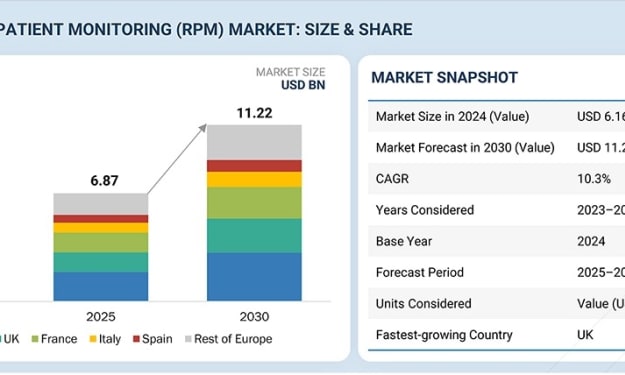
Europe Remote Patient Monitoring Market Set to Surpass USD 11.22 Billion by 2030 as Virtual Care Becomes Central to Healthcare Transformation
The Europe Remote Patient Monitoring (RPM) market is entering a decisive phase of expansion as healthcare systems pivot toward preventive, community-based, and digitally enabled care models. Valued at USD 6.87 billion in 2025, the market is projected to reach USD 11.22 billion by 2030, growing at a CAGR of 10.3% from 2025 to 2030. This growth reflects rising investment in home-based care, strengthening cross-border digital health infrastructure, and increasing demand from providers for real-time patient data to enable early intervention, reduce readmissions, and ensure continuity of care across decentralized settings.
By Juan Martinez7 days ago in Futurism
Digital Asset Management Market: AI Tagging, Fast Content Retrieval & Growth Trends
Rapid growth in digital content, remote work adoption, and omnichannel marketing is driving expansion of the digital asset management market. Organizations require centralized platforms to store, organize, and distribute media efficiently. Rising focus on brand consistency, workflow automation, and content security supports adoption. According to IMARC Group's latest research publication, The global digital asset management market size was valued at USD 7.73 Billion in 2025. Looking forward, IMARC Group estimates the market to reach USD 31.99 Billion by 2034, exhibiting a CAGR of 15.26% from 2026-2034.
By James Whitman7 days ago in Futurism



Comments
There are no comments for this story
Be the first to respond and start the conversation.