
China’s Ambitious Military Mega Project: The Largest Military Hub on Earth
China’s Ambitious Military Mega Project: Building the Largest Military Command Center

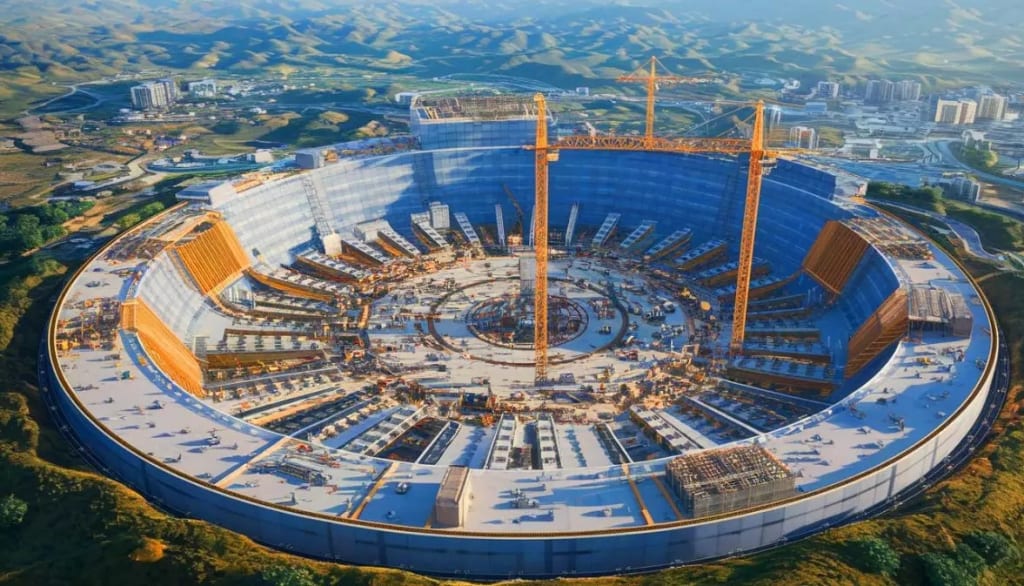
In a move that reflects China’s growing geopolitical ambitions and military modernization, the country is currently constructing what will soon be the largest military command center in the world. This vast and highly secretive military complex, located near Beijing, spans over 1,000 acres and promises to outscale even the Pentagon, making it the largest military hub on Earth once completed. Satellite images recently revealed the scale and intricacy of the construction project, which includes advanced underground bunkers and other high-tech facilities, signaling China’s strategic preparations for any future conflict—possibly even nuclear warfare.
The Beijing Military City: A Giant of Strategic Importance
China’s military mega project, referred to as the “Beijing Military City,” is being built with the intention of becoming a highly secure and robust command center for the country’s armed forces. The site is currently under construction and is expected to be operational by 2027, coinciding with the centenary of the People’s Liberation Army (PLA). Satellite imagery shows a sprawling site that is estimated to cover around 1,500 acres, which is a significant leap compared to the Pentagon's 247-acre footprint.
The sheer scale of the project emphasizes China’s intent to position itself as the foremost global military power. The construction of this site reflects President Xi Jinping’s vision of creating an impenetrable and capable military force that can defend China’s interests and project power across the globe. This new military hub will reportedly replace the current Western Hills complex as China’s main wartime command center.
The Secretive Nature of the Project
The construction site is being closely guarded, with extensive security measures in place to prevent unauthorized access. Authorities have placed strict restrictions on drone flights and photography in the area, which indicates the sensitive nature of the project. These security measures are likely a result of the highly confidential nature of the work being done. The facility’s design includes deep underground bunkers, sophisticated communication systems, and other military technologies that are not readily available to the public or international community.
The fact that such a project is being developed in complete secrecy raises several questions about China’s future military capabilities. What is the country preparing for? And why is it building such a large-scale, highly secure facility in the first place?
Advanced Military Features of the Complex
While specific details about the complex are still scarce, satellite images and reports have provided some insight into its features. According to analysts, the Beijing Military City will include extensive underground bunkers designed to protect China's leadership in the event of a nuclear conflict or any other catastrophic events. The ability to shield top military and political figures during a crisis reflects China’s commitment to ensuring continuity of command under extreme conditions.
In addition to these bunkers, the complex will feature a variety of high-tech communication and monitoring systems that will help the Chinese military coordinate its forces during wartime. This cutting-edge infrastructure underscores China’s increasing reliance on technology to enhance its military efficiency and effectiveness.
The scale of the complex also suggests that it will be a central hub for military planning and operations. Analysts believe that the Beijing Military City could become a focal point for the PLA in times of conflict, enabling the country to mobilize its military resources quickly and efficiently. The facility will serve as a command center not only for China’s domestic security forces but also for its growing influence on the global stage.
A Military Power Play
China’s investment in such a massive military hub is indicative of its broader strategy to surpass the United States as the world's leading military superpower. This ambition is not just about securing China’s borders but also about asserting its power and influence in global affairs. The development of the Beijing Military City is just one part of a larger trend of modernization in China’s military forces. Over the past several years, the country has invested heavily in upgrading its military technologies, including its naval fleet, missile systems, and air force.
This military complex could serve as a linchpin in China’s efforts to expand its global military footprint. By establishing a military command center of this scale, China is signaling to both regional and global powers that it is ready to defend its interests and counter any external threats with unparalleled force. This move is likely to have significant implications for the balance of power in Asia and beyond, especially considering the rising tensions between China and its neighbors, including Taiwan and the South China Sea disputes.
What Does This Mean for Global Geopolitics?
The construction of the world’s largest military command center has far-reaching implications for global geopolitics. China’s expanding military capabilities are becoming a central issue in international relations, particularly with the United States and its allies. The Beijing Military City signals to the world that China is committed to becoming a more formidable force in global affairs, and its strategic posture is evolving accordingly.
China’s growing military presence could potentially alter the security dynamics of the Asia-Pacific region. As Beijing asserts its power in key areas like the South China Sea and Taiwan, the Beijing Military City will likely play a pivotal role in coordinating military operations and directing China’s defense strategies. The facility’s construction could also be seen as a response to U.S. military activities in the region, including the presence of U.S. bases and military alliances with countries such as Japan, South Korea, and Australia.
Moreover, the completion of such a significant military hub could spark an arms race in the region, with neighboring countries like India, Japan, and South Korea potentially ramping up their military capabilities to counterbalance China’s growing power. This development could lead to an escalation of tensions, especially if the military complex is used as a launching pad for further expansionist policies by China.
The Strategic Timing of the Project
The timing of the Beijing Military City’s construction is also noteworthy. The project is set to be completed by 2027, a milestone that aligns with the centenary of the PLA. This timing reflects China’s long-term vision for its military capabilities and its desire to project strength as it celebrates a century of the PLA’s formation. The completion of the military hub will undoubtedly coincide with a period of heightened Chinese nationalism and a growing desire to assert its dominance in the global order.
As the geopolitical landscape continues to shift, the world will be watching closely to see how China’s new military center impacts regional security and global power dynamics. The construction of the Beijing Military City is not just about building a military facility—it is a statement of China’s rising influence and its commitment to ensuring that it remains a dominant force on the world stage.
Conclusion
China’s construction of the world’s largest military command center near Beijing is a clear indication of its growing military might and strategic ambitions. The Beijing Military City, with its vast scale and advanced features, represents a bold step in China’s efforts to modernize its military and enhance its global influence. As tensions continue to rise in the Asia-Pacific region, this complex will play a crucial role in coordinating military operations and defending China’s interests.
The geopolitical implications of this development are significant. The Beijing Military City is not just a symbol of China’s power; it is also a signal to the world that China is preparing for a future where it will assert itself as a dominant military force. As the project nears completion, the international community will undoubtedly be paying close attention to how this ambitious military hub shapes the future of global security and China’s role in the world order.
About the Creator
Tech Horizons
Exploring the future of technology, AI, gadgets, and innovations shaping tomorrow. Stay updated with Tech Horizons!
Keep reading
More stories from Tech Horizons and writers in Futurism and other communities.
Google’s One-Tap AI Mode Redefines Mobile Search: Faster, Smarter, and Sleeker
Google has launched one-tap AI Mode access for Android and iOS, streamlining mobile search with a minimalist design, enhanced animations, and broader availability. Discover how this update is changing the way users interact with AI in 2025.
By Tech Horizons9 months ago in Futurism
Smart Card IC Market: Digital Payments Expansion & Semiconductor Advancements
Rising adoption of contactless payments, expanding digital identity programs, stricter data security regulations, and increased use across banking, telecom, and transportation sectors are accelerating market growth. According to IMARC Group's latest research publication, the global smart card IC market size reached USD 3.3 Billion in 2025. Looking forward, IMARC Group expects the market to reach USD 4.8 Billion by 2034, exhibiting a growth rate of 4.32% during 2026-2034.
By Andrew Sullivan6 days ago in Futurism
Baby Food and Infant Formula Market: Early-Life Nutrition Focus, Fortified Formulas & Growth Ahead
According to IMARC Group's latest research publication, The global baby food and infant formula market size reached USD 53.73 Billion in 2024. Looking forward, IMARC Group expects the market to reach USD 84.06 Billion by 2033 exhibiting a growth rate (CAGR) of 4.58% during 2025-2033.
By Olivia Smith2 days ago in Futurism




Comments
There are no comments for this story
Be the first to respond and start the conversation.