
Carbon, Not Silicon, Is the Endgame
Carbon > silicon

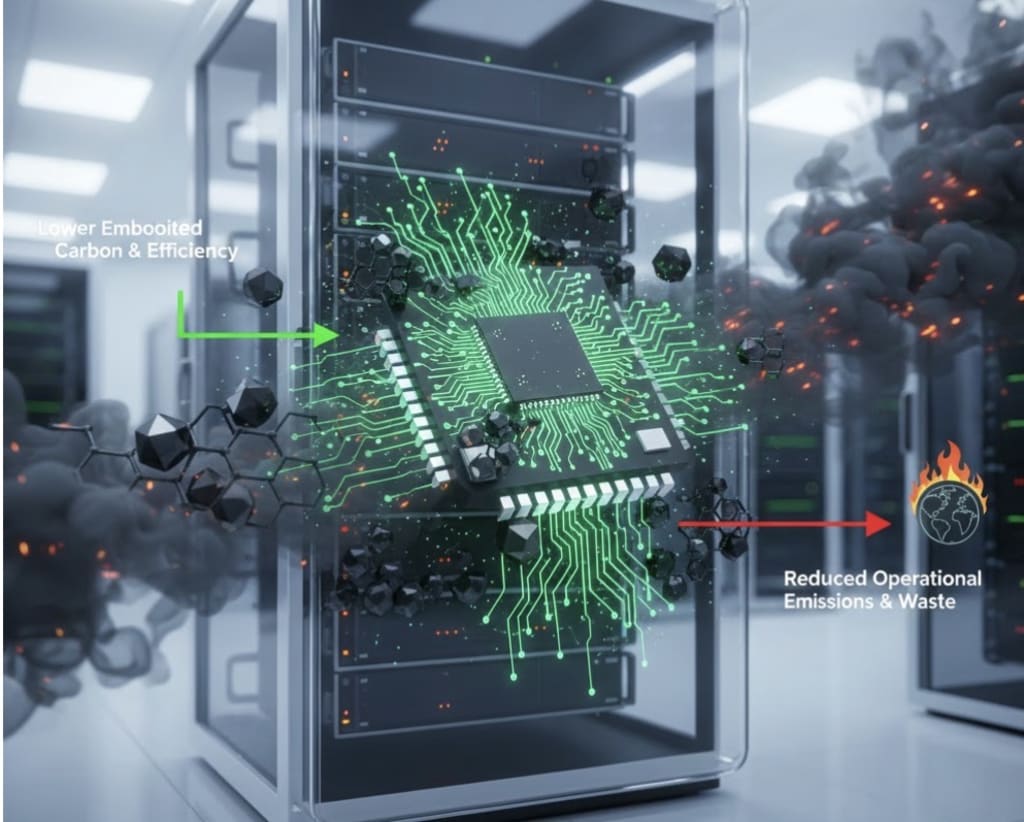
Intro
Silicon has been a heroic material. For seven decades it carried the world’s computing dreams from room-sized ENIAC racks to the pocket computers we carry today. But silicon’s reign is now a story of diminishing returns. Transistors have shrunk to a scale where quantum tunneling, heat, and interconnect loss are the real blockers, not clever circuit tricks. That doesn’t mean computing dies — it means the stack changes. For the next chapter, carbon is not just an alternative; it’s the material logic of a radically different kind of computing.
The physics that broke Moore’s momentum
Traditional scaling relied on making transistors smaller and faster. At the few-nanometer scale, leakage currents increase, gates leak, and chips produce heat by the kilowatt in a server rack. Energy, not design, becomes the bottleneck. You can manufacture denser transistors, but you can’t get rid of the heat they produce or the energy cost of moving data. Silicon at its limits still computes, but it does so at growing financial and environmental cost. That’s the opening carbon steps through.
What carbon brings to the table
Carbon is not a single thing — it’s an entire family with extraordinary properties. Graphene, carbon nanotubes (CNTs), diamond, and novel carbon allotropes each offer distinct advantages:
Ballistic transport and mobility. Electrons move through graphene and high-quality CNTs with far less scattering than in silicon, enabling higher current at lower voltage and potentially orders of magnitude better energy efficiency for certain workloads.
Thermal performance. Diamond and graphene are some of the best thermal conductors known; they solve the heat problem at the material level, not just with bigger fans or liquid cooling.
Mechanical flexibility. Carbon materials can be formed into flexible, stretchable electronics — opening new form factors where computation is embedded into materials, clothing, or biological interfaces.
Strength and density. Carbon nanotubes are stronger than steel by weight. That allows denser, lighter structural electronics and novel packaging that integrates mechanical and electrical functionality.
Carbon abundance and sustainability. Carbon feedstocks are globally available and can be sourced from biomass or waste streams, which—paired with the right manufacturing—offers a more sustainable long-term path than rare semiconductor chemicals.
How carbon rewrites the architecture
This is not about swapping silicon transistors for carbon transistors one-to-one. It’s about re-architecting the stack:
Near-memory and in-memory computing. Carbon’s energy advantages make computation adjacent to memory cheaper. Instead of hauling bytes across a board, some processing happens where the data lives—dramatically reducing energy per operation.
Heterogeneous specialization. Expect chips that combine silicon control logic with carbon analog compute fabrics and photonic interconnects. Carbon can excel at specialized roles—signal transduction, analog optimization, neuromorphic layers—while silicon handles legacy orchestration.
3D and embedded compute. Carbon enables dense vertical integration and materials that are both structure and compute—sensors that are the skin of a device, circuits that are the backbone, materials that adapt.
Real progress, real problems
The carbon dream is already real in labs: carbon nanotube transistors and graphene interconnects have demonstrated superior metrics in controlled settings. Startups and university groups are shipping early arrays and prototype wafers. But there are hard, practical hurdles:
Uniformity and chirality. For CNTs, controlling which tubes are semiconducting vs metallic across a wafer is a manufacturing puzzle. Commercial chips demand near-perfect uniformity at scale.
Contacts and interfaces. Making a reliable, low-resistance contact between carbon structures and metal pads at scale requires new materials chemistry and packaging methods.
Integration with current fabs. The existing supply chain is optimized for silicon lithography. Carbon approaches often require different tools—chemical vapor deposition, directed self-assembly, or bottom-up growth—which will force new factory designs.
Standards and tools. The EDA (electronic design automation) ecosystem is built around silicon models. Carbon-based design flows need new simulation, verification, and physical-design tools.
None of these are show-stoppers—only they are expensive, time-consuming, and organizationally awkward. The path forward will be hybrid: silicon for control and compatibility, carbon for the heat- and energy-sensitive layers.
Where carbon first wins
Expect carbon to win in domains where energy per operation, heat, or mechanical integration are the primary constraints:
Edge AI and low-power inferencing. Devices that must run on batteries, harvest power, or live in harsh conditions benefit hugely from the energy profile of carbon devices.
Wearables and biointerfaces. Flexible, biocompatible carbon electronics enable sensors that operate on the skin, inside the body, or in fabrics—places silicon cannot comfortably go.
High-density memory and in-memory compute. When moving bits dominates cost, carbon’s local computing paradigms shine.
Specialized analog accelerators. Optimization problems, spiking neural nets, and physics emulation map elegantly onto analog carbon fabrics.
The geopolitical and industrial angle
Shifting the base material of chips isn’t just a technical decision; it’s an industrial one. New fabs, new supply chains, and new tool vendors will be required. That means corners of the world that are currently peripheral in semiconductor supply chains might find new opportunities. Because carbon materials can be grown with different facility footprints than massive EUV fabs, innovation could be more geographically distributed—if the capital and expertise follow.
A realistic timeline
We’re not saying CPUs will be replaced overnight. Silicon will remain dominant for at least one architecture cycle because of existing investment and compatibility. But the paradigm shift is already underway: carbon components at module or chiplet level within five years, meaningful hybrid systems in a decade, and broader industry adoption over two decades—especially as energy constraints tighten and the cost of cooling and power delivery becomes prohibitive.
What this means for engineers and creators
If you build chips, software, or systems today, think hybrid. Design teams must learn materials science language. Software architects need to design for locality and specialized accelerators. Product teams must evaluate energy budgets not just performance metrics. The future stack is interdisciplinary: chemists, materials scientists, device physicists, and software engineers working in the same rooms.
Final note — it’s about reshaping what “compute” is
Silicon gave us universality: general-purpose, cheap, and reliable. Carbon gives us something different: efficiency, density, and physical integration. The question isn’t whether carbon will replace silicon in every context, but whether carbon will define the new places where computation happens—the skin, the structure, the low-energy edge, and the physical world itself.
About the Creator
Sebastian De Lima
Dot…com?
Keep reading
More stories from Sebastian De Lima and writers in Futurism and other communities.
UAE Luxury Hotel Industry Overview: Market Share, Leading Brands & Future Projections
According to IMARC Group's latest research publication, UAE luxury hotel market size reached USD 597.3 Million in 2024. The market is projected to reach USD 950.7 Million by 2033, exhibiting a growth rate (CAGR) of 5.3% during 2025-2033.
By Abhay Rajputabout 8 hours ago in Futurism




Comments
There are no comments for this story
Be the first to respond and start the conversation.