
Between the Algorithm and Inspiration: Can a Writer Be a Good AI Trainer? 🤖✍️
From System Glitches to Literary Bridges: My Journey Between Algorithms and Authorship

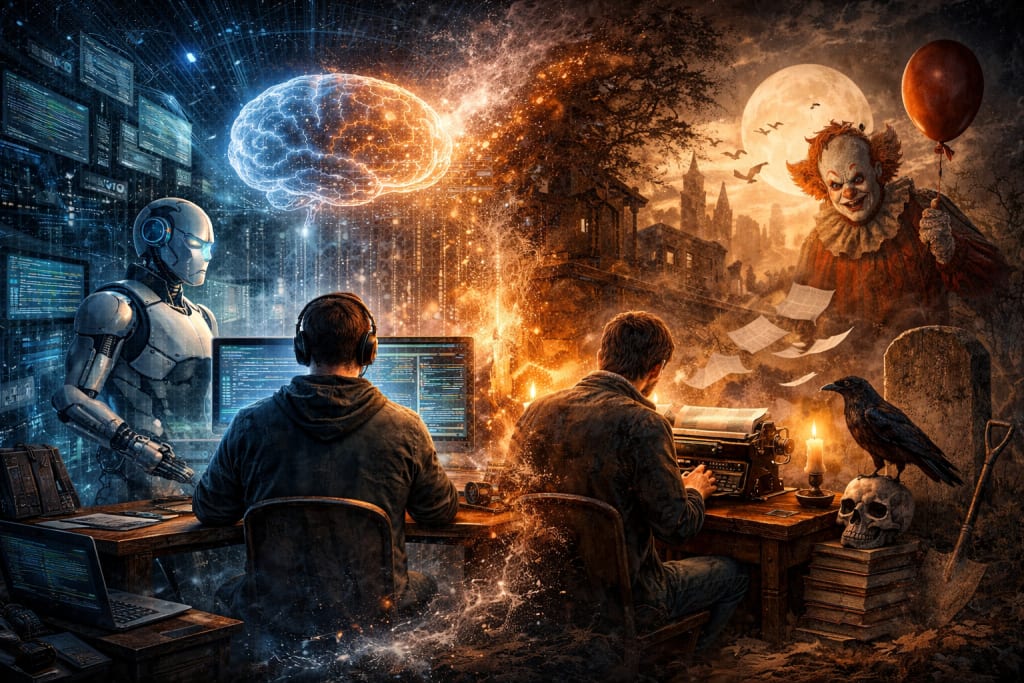
Working in AI training while being a writer is a combination that, at first glance, sounds like being a part-time clown and a part-time gravedigger. 🤡⚰️ Absurd, seemingly contradictory, and yet, in my life, inseparable. Choosing AI was a conscious move, driven by a curiosity about tomorrow, but writing... that came a moment earlier, almost as an act of survival.
Back in the UK, while I was meticulously ruining my life with addiction, my partner threw out a short, motivating line: "Just write something." 🇬🇧🥃 That was the spark I needed to step out of the shadows. Six months later, I was holding my debut novella – 404: Reality Not Found. Today, looking back, I see that these two worlds don’t just coexist; they feed off each other, creating a unique professional symbiosis. 🔄
The Architecture of Commands: Prompting as a New Grammar 💻
In the world of AI, everything revolves around prompting. It’s a term that has entered the mainstream in recent years, but it’s still often understood too superficially. It’s not just "talking to a computer." It is an advanced process of instruction design that requires almost surgical linguistic precision. 🩺
When I train a model, I operate with two currencies: precision and context.
Precision: In prompting, every word carries weight. Using a term that is too general causes the model to "drift" into hallucinations or drown us in a stream of clichés. I must define the role (persona), the objective (task), and the strict limitations (constraints). 🎯
Context: This is the absolute king. AI possesses no intuition or default knowledge of my intentions. I have to build a "stage" for it – provide historical background, specify the desired tone, and set the output format. Prompting is, in reality, sculpting raw logic using the chisel of natural language. 🏛️
The Literary World: The Same Struggle, Different Tools 📚
When I switch into writer mode, I experience the exact same processes, though they are served in a much more emotional, "gritty" sauce. My experiences with AI have taught me to look at a text as a system of interconnected vessels. 🧪
Context in a Novel: This is nothing other than world-building. If I don’t establish the emotional context of a character for the reader, their scream at the climax will be nothing but a dead mark on paper. Just as an AI model needs input data to generate a meaningful response, a reader needs cognitive layers to believe in the fiction. In 404: Reality Not Found, every glitch in reality had to have its logical roots – otherwise, it would just be a cheap special effect. 🎥
The Economy of the Word: As an AI trainer, I learn to eliminate noise. As a writer, I fight for that one, perfect sentence. Choosing the wrong adjective in a key scene can destroy a painstakingly built atmosphere of dread or melancholy. In both professions, I act as a "guardian of meaning" – ensuring that a word doesn't just fill space, but performs exactly the job I assigned to it. 💂♂️
The Ethics of Code, the Ethics of Conscience ⚖️
In AI training, we often deal with ethics – placing "guardrails" on models to prevent them from echoing harmful biases. It’s a fascinating process that has forced me to reflect on my own creative work. As a writer, during my "404 error" period in the UK, I was filled with my own biases against the world and myself. Today, as I train algorithms, I see how difficult it is to define objective "good." However, in literature, I don’t want "clean" models. I want characters who stumble, who are politically incorrect in their agony, and who haven't been passed through a safety filter. It is precisely there, in the gray zone between correctness and instinct, where true art is born.
Symbiosis Instead of Rivalry 🤝
I am often asked: "Will AI replace writers?" My answer is: it will replace those who write like machines. If your texts are merely a statistical average of popular phrases, you have reason to worry. But if you pour your unique "error code" into your sentences – the things you experienced at rock bottom and what allowed you to bounce back – you are safe. AI has become my most demanding editor. It shows me what is predictable, forcing me to search for metaphors that no probability-based algorithm would ever conceive. This isn't an arms race; it's a training in mindfulness.
The Trap of Mechanization and the Gift of Imagination ✨
Does working with AI kill creativity? That’s the question I hear most often. The truth is subversive: training models makes me realize how powerful human unpredictability really is. AI operates on statistics – it chooses the most probable next word. A writer, however, thrives on the improbable. 🎲
My work with algorithms is a constant communion with the "averageness" of language, which paradoxically forces me to seek something in my own texts that a machine cannot (yet) fake: authentic pain, the grit of my UK experiences, and that specific human tendency to wander. AI gives me discipline and technical clarity; literature gives me the freedom to be illogical. 🕊️
Today, these two professions are two sides of the same coin. On one side, cold calculation and the optimization of communication with a machine; on the other, the feverish pouring of emotions onto paper. Both paths, however, require humility toward language. Because regardless of whether the recipient is a processor or another human being, the word remains the most powerful tool we have ever created. 🌍🔥
About the Creator
Piotr Nowak
Pole in Italy ✈️ | AI | Crypto | Online Earning | Book writer | Every read supports my work on Vocal
Keep reading
More stories from Piotr Nowak and writers in Futurism and other communities.
The Fear of Success is a Myth. We’re Simply Afraid of Becoming Someone New. 🇮🇹💻
We often hear the thesis that people are afraid of success. While it sounds intriguing, I believe this terminology doesn’t fully capture what’s happening in our heads. In reality, we aren't afraid of the moment we collect the trophy 🏆. We are afraid of what happens "in between." We fear that we won’t measure up to the bar we’ve set for ourselves, that our incompetence will be exposed, and that we will ultimately fail in front of everyone. This paralysis has a name—it is the fear of losing our safe, familiar "self" in favor of someone we have yet to become. 👤
By Piotr Nowakabout 9 hours ago in Futurism



Comments
There are no comments for this story
Be the first to respond and start the conversation.