
Bancassurance Market Trends: Wealth Management Integration & Forecast to 2034
How integration of wealth management services, cross-selling strategies, and digital banking platforms is reshaping growth dynamics in the global bancassurance market

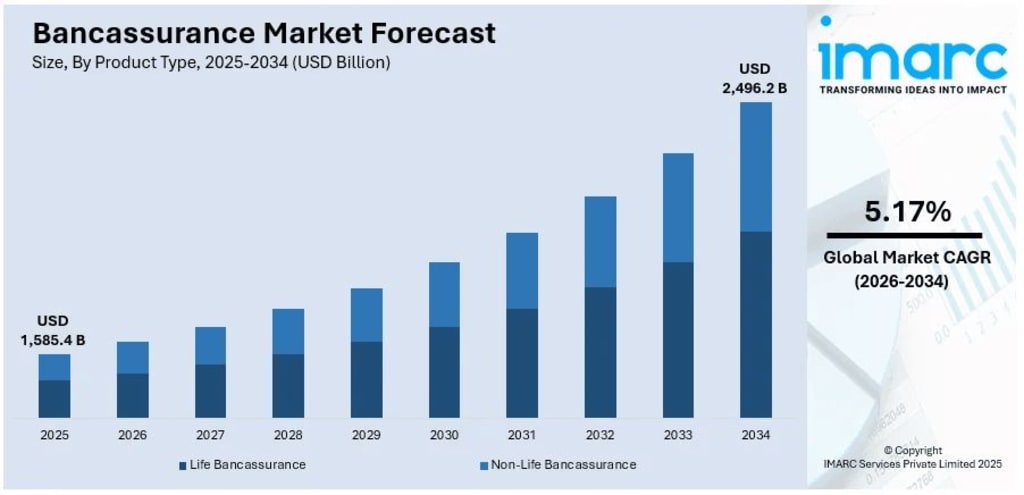
Growing demand for integrated financial services, digital transformation across banking channels, and strategic partnerships between banks and insurers are driving steady expansion in the bancassurance market, supported by AI-powered personalization, embedded insurance models, and rising financial literacy in emerging economies. According to IMARC Group's latest data, the global bancassurance market size was valued at USD 1,585.4 Billion in 2025. Looking forward, IMARC Group estimates the market to reach USD 2,496.2 Billion by 2034, exhibiting a CAGR of 5.17% from 2026-2034. Asia-Pacific currently dominates the market, holding a market share of over 45.9% in 2025.
Bancassurance has become a core distribution channel for insurance products worldwide. Banks leverage their customer relationships, branch networks, and digital platforms to sell life, health, and general insurance alongside traditional banking services. Life bancassurance accounts for 75.1% of the market by product type, driven by demand for retirement planning, investment-linked policies, and term insurance. The pure distributor model leads by model type with 38.9% share, where banks act solely as distributors without taking underwriting risk keeping operational costs low and compliance simpler.
Bancassurance Market Growth Drivers:
- Financial Inclusion and Low Insurance Penetration in Emerging Markets
Asia-Pacific remains the largest and fastest-growing region for bancassurance, driven primarily by low insurance penetration and expanding banking infrastructure. In rural areas across India, Indonesia, and the Philippines, mobile banking platforms have enabled a 26% increase in bancassurance penetration between 2022 and 2025. Banks are reaching customers who have never purchased insurance before, offering micro-insurance and short-term coverage embedded directly into banking products like loans and savings accounts. In Africa, mobile banking bancassurance distribution grew 29% in 2024 alone, opening entirely new customer pools. This represents a genuine shift in how financial services reach underserved populations, with banks acting as the primary access point for both savings and protection products.
- Digital Transformation Enabling Seamless Product Integration
Digital channels are reshaping how insurance is sold. In the U.S., 44% of new insurance sales in 2024 came through bank apps rather than physical branches, according to industry reports. About 60% of banking executives in developed economies now use AI and advanced analytics for customer profiling and cross-sell identification. Mobile apps have become the leading method for U.S. consumers to manage bank accounts, with 55% relying primarily on mobile devices making embedded insurance a natural extension. In Asia, 44% of new policies were distributed digitally via bank channels. These are not experimental features they represent the new standard for how bancassurance operates, with customer journeys designed around convenience rather than forcing in-person branch visits.
- Strategic Partnerships Diversifying Revenue Streams for Banks and Insurers
Both banks and insurers are under pressure to diversify revenue and improve customer retention. Bancassurance addresses both needs. Banks earn fee-based income without taking underwriting risk, while insurers gain access to large customer bases without building their own sales forces. In January 2025, Northwestern Mutual announced a strategic partnership with Sixth Street to manage USD 13 billion in assets, enhancing investment capabilities tied to insurance products distributed through banking channels. In Southeast Asia, a major bank-insurer partnership recorded a 31% increase in new bancassurance policies in 2023. These deals are structured as long-term relationships rather than transactional arrangements, reflecting institutional confidence in the model's sustainability.
Bancassurance Market Trends:
- Embedded Insurance Growing as Default Option in Banking Products
Embedded insurance where coverage is automatically offered at the point of sale for banking products like loans, credit cards, and mortgages is becoming standard practice. About 33% of African bancassurance channels adopted embedded insurance in 2024, particularly in mobile-first markets where customers access financial services entirely through apps. In India and Southeast Asia, 26% of banks now operate multi-tie models, partnering with multiple insurers to offer broader product choice within a single banking platform. This shift reflects a move away from one-size-fits-all offerings toward customized, context-specific insurance that feels natural rather than forced.
- AI and Predictive Analytics Driving Personalized Product Recommendations
Technology is fundamentally changing how banks identify which customers need which insurance products. AI-powered chatbots now offer personalized support to policyholders, reducing processing times and improving satisfaction. Predictive analytics enable banks to tailor policies based on individual customer behavior, life stage, and financial profile. In 2024, insurance companies increasingly used AI for precise risk evaluation and underwriting, allowing them to refine policies dynamically. A European bank launched a digital bancassurance platform that cut policy-issue time by 42% during 2024 a tangible efficiency gain that directly impacts both cost structure and customer experience.
- Regulatory Evolution Opening Markets and Defining Boundaries
Regulatory frameworks continue shaping how bancassurance operates across regions. In February 2024, the EU adopted new anti-money laundering laws to strengthen financial crime protection, directly impacting how banks and insurers structure partnerships and share customer data. In the U.S., where regulatory restrictions historically limited bancassurance, alternative models like referral partnerships and wealth management integration have become the norm. Approximately 33% of bancassurance pilot program failures stem from inadequate training of bank branch staff in explaining insurance products, highlighting that regulation is not just about legal compliance but operational readiness. As governments recognize bancassurance as a tool for financial inclusion, regulatory support is gradually expanding, particularly in emerging markets.
Recent News and Developments in Bancassurance Market
- January 2025: Northwestern Mutual announced a strategic partnership with Sixth Street to manage USD 13 billion in assets, aimed at enhancing investment capabilities tied to insurance products distributed through banking channels. The deal reflects the growing institutional appetite for integrated asset management and insurance distribution models, particularly as insurers seek to diversify capital strategies and banks look for fee-based revenue opportunities beyond traditional lending.
- November 2024: One Inc, a payments platform focused on the insurance sector, partnered with U.S. Bank to offer seamless payment experiences for Property & Casualty and Life insurance providers. The collaboration integrates U.S. Bank's banking and money movement services with One Inc's ClaimsPay and PremiumPay technologies, enhancing the efficiency of claims disbursements and premium collections for insurers and their policyholders addressing a critical pain point in insurance payment infrastructure.
- March 2024: BNP Paribas acquired a 51% majority stake in BCC Vita, the life insurance division of Italian holding company BCC Iccrea Group, to expand its bancassurance footprint in Italy. The acquisition broadened BNP Paribas's distribution channels and strengthened BCC Iccrea Group's product offerings, reflecting the ongoing consolidation trend in European bancassurance as major banks seek scale and market share in high-value insurance markets.
- February 2024: Segura Bank International (SBI) partnered with Temenos to launch a new digital bank targeting mid-to-high earners in Latin America. Powered by Temenos' cloud-native core banking platform, SBI will offer USD-denominated financial products, enabling customers to protect savings from currency fluctuations and facilitating easier international transactions a model that positions bancassurance as a hedge against economic instability in emerging markets.
Note: If you require specific details, data, or insights that are not currently included in the scope of this report, we are happy to accommodate your request. As part of our customization service, we will gather and provide the additional information you need, tailored to your specific requirements. Please let us know your exact needs, and we will ensure the report is updated accordingly to meet your expectations.
About the Creator
Suhaira Yusuf
I specialize in Consumer Insights, focusing on transforming detailed market data into strategic business solutions that accelerate growth and improve customer engagement.
Keep reading
More stories from Suhaira Yusuf and writers in Futurism and other communities.
Soft Skills Training Market Trends: Communication Skills Demand & Forecast to 2034
Growing demand for workforce development, rising adoption of digital learning platforms, and increasing recognition of soft skills as essential for career success are driving steady expansion in the soft skills training market, supported by remote work acceleration, AI-powered personalized learning tools, and corporate investment in employee retention strategies. According to IMARC Group's latest data, the global soft skills training market size was valued at USD 37.2 Billion in 2025. Looking forward, IMARC Group estimates the market to reach USD 97.4 Billion by 2034, exhibiting a CAGR of 11.29% during 2026-2034. North America currently dominates the market, holding a significant market share of over 32.9% in 2025.
By Suhaira Yusufabout 2 hours ago in Futurism
China’s Seedance 2.0 AI Video Model Sends Shockwaves Through Hollywood
What Happened A new artificial intelligence video-generation model developed by ByteDance, the parent company of TikTok, has triggered alarm across Hollywood and the wider creative industry.
By Behind the Tech4 days ago in Futurism
Air Pollution Control Systems Market: Power Plant Emission Control, Scrubber Demand & Market Forecast
According to IMARC Group's latest research publication, the global air pollution control systems market size reached USD 94.9 Billion in 2025. Looking forward, the market is expected to reach USD 158.0 Billion by 2034, exhibiting a growth rate (CAGR) of 5.66% during 2026-2034.
By sujeet. imarcgroup7 days ago in Futurism




Comments
There are no comments for this story
Be the first to respond and start the conversation.