
Australia Digital Payment Market: Consumer Adoption, Fintech Innovation & Regulatory Frameworks
How growing consumer adoption of digital payments, rapid fintech innovation and evolving regulatory frameworks are shaping Australia’s digital payment market

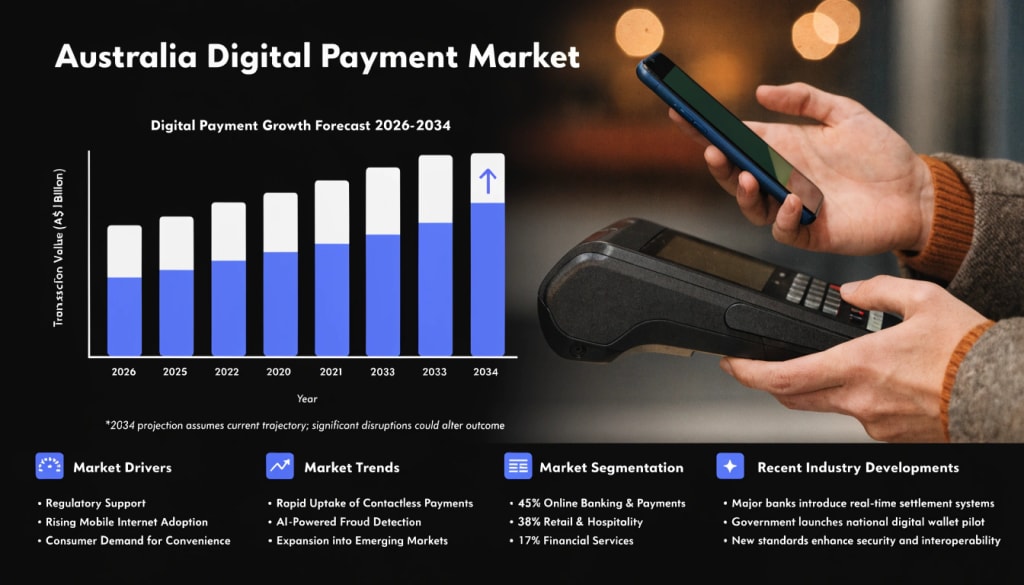
According to IMARC Group, the Australia digital payment market was valued at USD 142.7 Billion in 2025 and is projected to reach USD 728.1 Billion by 2034, exhibiting a robust compound annual growth rate (CAGR) of 19.86% during 2026–2034. Notably, Victoria & Tasmania dominate the market, accounting for a significant 38.3% share in 2025, reflecting strong regional digital infrastructure and consumer adoption trends. The rapid transition toward cashless transactions across Australia underscores a fundamental transformation in financial behavior, driven by smartphone penetration, mobile wallet usage, expanding e-commerce activity and increasing demand for peer-to-peer (P2P) and buy now, pay later (BNPL) services.
Why Should Smart Buyers and Investors Know About the Australia Digital Payment Market?
Exceptional Growth Potential
With a projected CAGR of 19.86%, the market represents one of the fastest-growing financial technology segments in Australia.
Structural Shift in Consumer Behavior
Digital-first payment habits are becoming deeply embedded across demographic groups.
Regional Innovation Leadership
Victoria & Tasmania’s 38.3% dominance highlights strong digital infrastructure and fintech ecosystem maturity.
Expanding Cross-Industry Applications
Digital payments support retail, travel, healthcare, education and subscription-based services.
Security and Technology Investment Cycle
Ongoing advancements in cybersecurity and AI create sustained demand for payment technology upgrades.
Recent Trends & Developments in the Australia Digital Payment Market
September 2025:
Mobile wallet usage surpassed traditional card transactions in metropolitan retail environments.
June 2025:
Fintech firms expanded AI-driven fraud detection capabilities across digital payment platforms.
December 2024:
Regulatory updates strengthened consumer protection measures in BNPL and P2P payment services.
Australia’s digital payment market is undergoing a transformative expansion, driven by consumer adoption, fintech innovation and regulatory modernization. With market value expected to grow from USD 142.7 Billion in 2025 to USD 728.1 Billion by 2034, the sector reflects a decisive shift toward mobile-first, secure and technology-enabled transaction systems. Regional leadership in Victoria & Tasmania underscores infrastructure readiness and innovation momentum, while nationwide smartphone penetration and BNPL popularity accelerate growth. As regulatory frameworks evolve alongside technological advancement, digital payments will continue to redefine Australia’s financial landscape. For fintech innovators, financial institutions and strategic investors, Australia’s digital payment market presents a high-growth opportunity anchored in digital transformation, secure infrastructure development and sustained consumer demand for frictionless financial experiences.
Australia Digital Payment Market Vision 2050
1. Cashless Retail Ecosystems
Physical cash usage may decline further as QR codes, biometric authentication and digital wallets dominate retail transactions.
2. AI-Driven Financial Personalization
Artificial intelligence may enable predictive spending insights, automated budgeting and adaptive fraud prevention.
3. Embedded Finance Integration
Payments could seamlessly integrate into non-financial platforms such as social media, ride-sharing and e-commerce ecosystems.
4. Blockchain-Based Transaction Systems
Decentralized technologies may enhance transparency and cross-border transaction efficiency.
5. Central Bank Digital Currency (CBDC) Development
Government-backed digital currencies could redefine monetary systems and payment infrastructure.
What Are the Key Growth Drivers in the Australia Digital Payment Market?
Growing Smartphone and Mobile Wallet Adoption
Smartphones have become the central hub for financial transactions. Australians increasingly prefer mobile wallets for convenience, speed and security. Contactless payments via NFC-enabled devices have significantly reduced reliance on physical cash and cards, reinforcing the shift toward digital ecosystems.
Expansion of E-Commerce and Online Retail
The rapid growth of online shopping platforms has accelerated digital payment volumes. Consumers expect seamless checkout experiences, secure payment gateways and instant transaction confirmations. Subscription-based services, food delivery apps and digital marketplaces further contribute to rising transaction frequency.
Rising Demand for Peer-to-Peer (P2P) Payments
P2P payment applications allow instant money transfers between individuals, supporting everyday financial interactions such as shared expenses, freelance payments and small business transactions. The simplicity and immediacy of these platforms have made them highly popular, particularly among younger demographics.
Buy Now, Pay Later (BNPL) Penetration
Australia remains one of the leading markets for BNPL adoption. Flexible installment payment options encourage consumer spending while offering retailers improved conversion rates and customer retention. Integration of BNPL services within online and in-store checkout systems continues to reshape purchasing behavior.
Fintech Innovation and Competitive Ecosystem
A dynamic fintech landscape is fueling innovation in digital payment infrastructure. Startups and established financial institutions are investing in AI-powered fraud detection, blockchain integration and advanced authentication systems. Open banking initiatives are also promoting interoperability and customer-centric financial services.
Regulatory Frameworks and Compliance Evolution
Supportive yet structured regulatory oversight strengthens market credibility. Compliance with anti-money laundering (AML) standards, data privacy regulations and cybersecurity mandates ensures stability while encouraging responsible innovation. Regulatory clarity enhances investor confidence and long-term scalability.
Increasing Demand for Secure Transactions
With growing digital activity comes heightened security concerns. Financial institutions are deploying encryption technologies, biometric authentication and AI-based anomaly detection systems to protect consumer data and minimize fraud risks.
About the Creator
Kevin Cooper
Hi, I'm Kavin Cooper — a tech enthusiast who loves exploring the latest innovations, gadgets, and trends. Passionate about technology and always curious to learn and share insights with the world!
Keep reading
More stories from Kevin Cooper and writers in Futurism and other communities.
Australia Mobile Cloud Market: Enterprise Mobility, Digital Transformation & 5G Integration
According to IMARC Group, the Australia mobile cloud market was valued at USD 1,807.15 Million in 2025 and is projected to expand to USD 6,757.36 Million by 2034, exhibiting a strong compound annual growth rate (CAGR) of 15.78% during 2026–2034. This rapid growth highlights the accelerating convergence of cloud computing, mobile technologies and next-generation connectivity across Australia. Mobile cloud computing enables data storage, processing and application access via cloud infrastructure optimized for smartphones, tablets and connected devices. As enterprises embrace hybrid work models and 5G networks expand nationwide, mobile cloud solutions are becoming integral to digital business strategies.
By Kevin Cooperabout 11 hours ago in Futurism
Organic and Natural Pet Food Market Expands as Health-Conscious Pet Owners Drive Premium Nutrition Trends
Organic and Natural Pet Food Market Overview The global organic and natural pet food market has evolved from a niche segment into a mainstream premium category. Pet humanization trends—where pets are considered family members—are reshaping purchasing behavior. Consumers are increasingly seeking high-quality, ethically sourced, and sustainably produced food options for their pets.
By James Smithabout 7 hours ago in Futurism
Hair Care Market: Men’s Grooming Surge, Product Diversification & Industry Growth
The global hair care market is experiencing strong growth as consumers increasingly prioritize scalp health, personalized solutions, and natural ingredients. Growing awareness about hair wellness, coupled with innovations in product formulations and the influence of social media trends, is reshaping consumer preferences across all demographics. According to IMARC Group's latest data, the global hair care market size was valued at USD 93.9 Billion in 2025. Looking forward, IMARC Group estimates the market to reach USD 183.1 Billion by 2034, exhibiting a CAGR of 7.70% from 2026-2034. North America currently dominates the market, holding a market share of over 35.0% in 2025.
By sujeet. imarcgroupa day ago in Futurism
No Word Comes Near Enough
The English language has its limits. I learned this when I became a student of the Bible and looked up the Greek and Hebrew definitions behind the Scriptures I loved. Some languages have so much more depth and power than the one I use to convey my thoughts. But, even so, I don't think any word could ever come close to describing this void and pain I am journeying through. I don't know how to swim through its murky waters.
By Shirley Belka day ago in Poets




Comments
There are no comments for this story
Be the first to respond and start the conversation.