

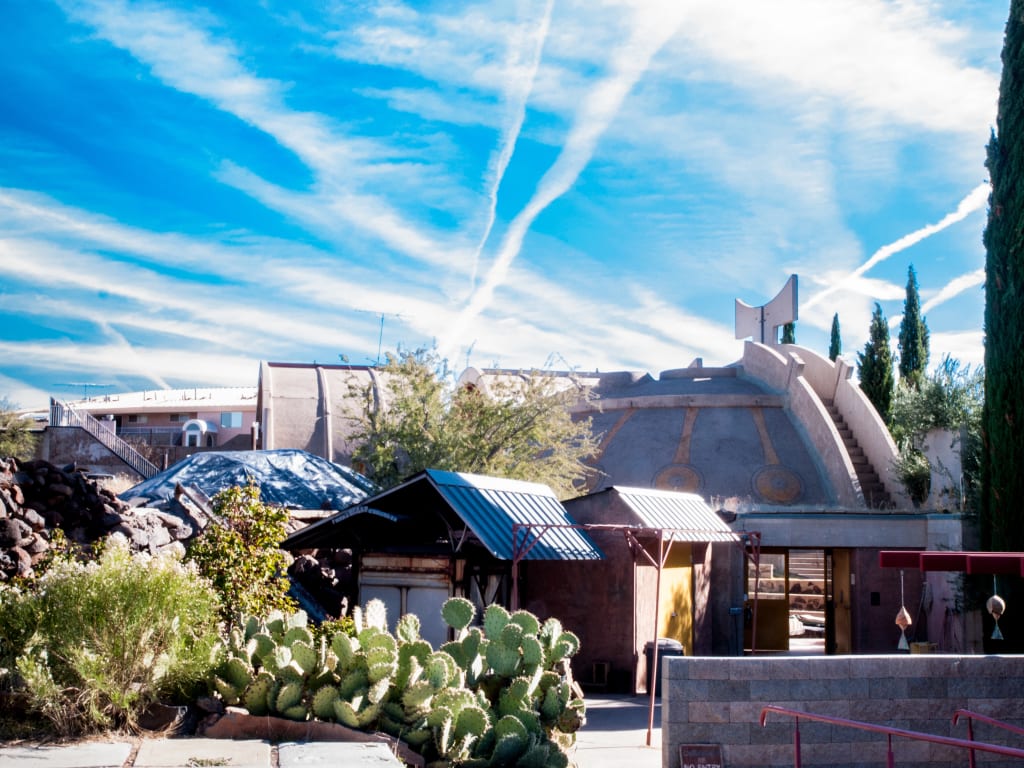
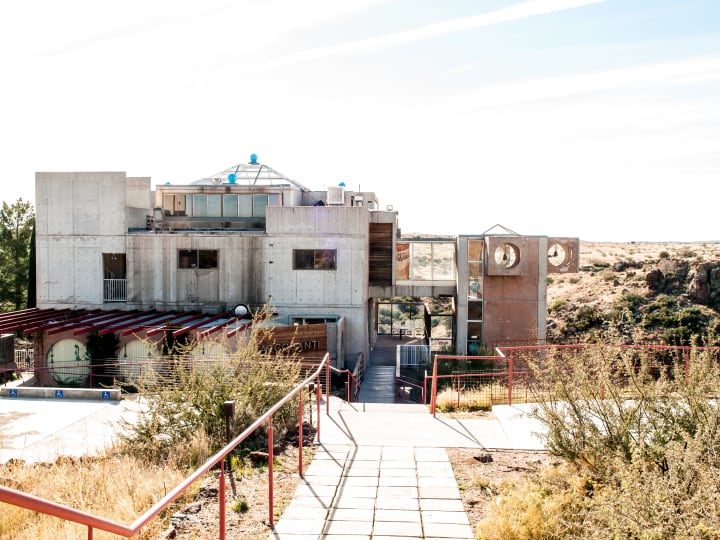
Driving through the desert of central Arizona, I came across a rather futuristic-looking structure.
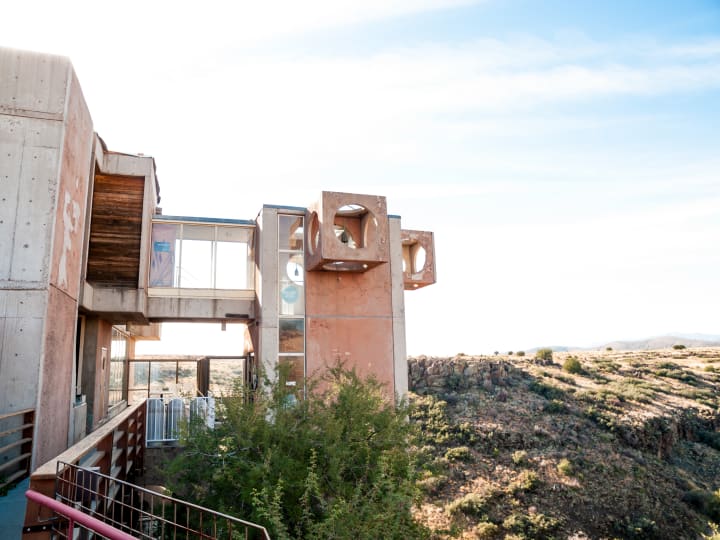
From the road, it looks like a habitat on Mars. Upon closer inspection, the ultramodern structures are part of an urban experiment– in arcology, the blending of architecture with ecology.
My curiosity got the best of me, and I drove up the driveway to be greeted by a sign that reads, “Welcome to Arcosanti–An Urban Laboratory?”
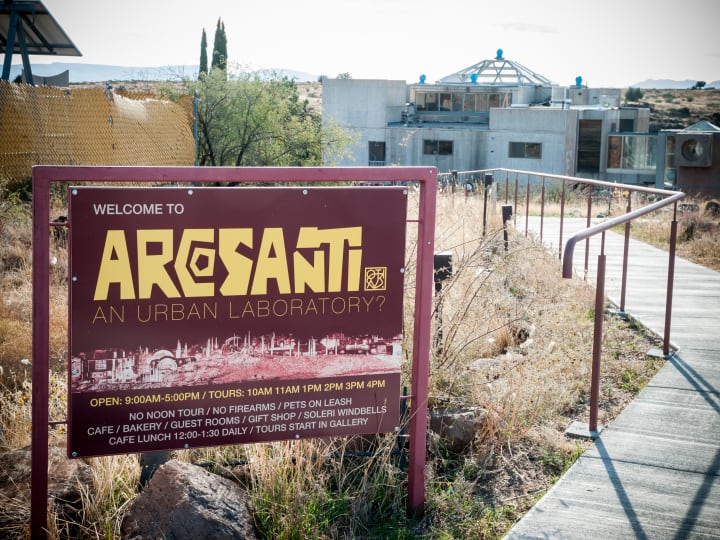
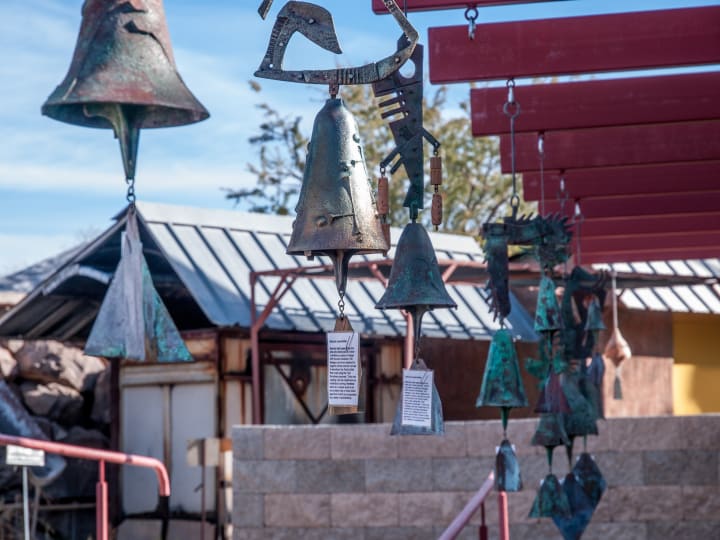
Not knowing what to expect, I continued along the concrete pathway, following an orange railing to the main building. A series of patina-covered windchimes led the way.
I entered the stark but inviting foyer. Inside, the sun greeted me through round porthole windows casting interesting shadows on the walls and floor.
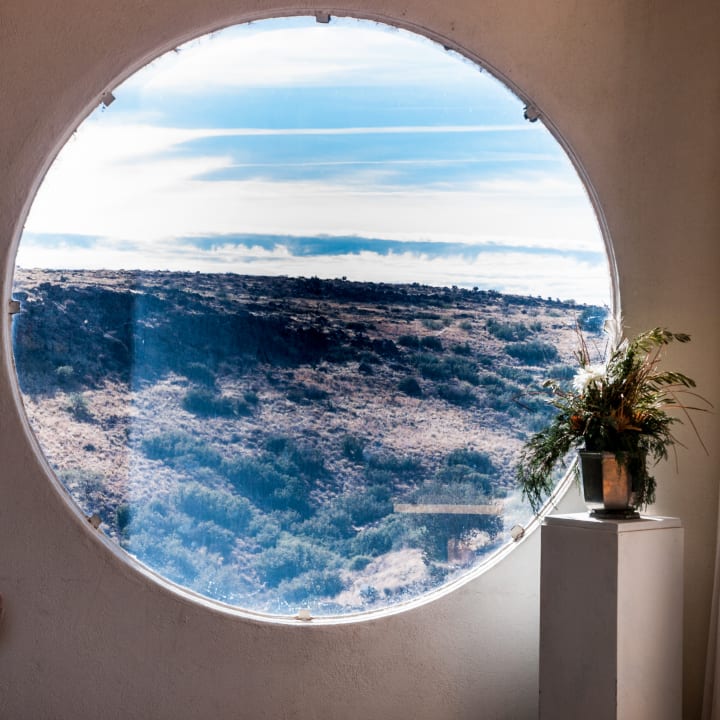
The Italian architect Paolo Soleri envisioned an experimental community of tomorrow where humans can live in an urban environment without upsetting the ecology. This concept of arcology, coined by Soleri, is increasingly important today as the planet faces cumulative stresses from human habitation. This is most evident in climate change and the severe weather events being experienced worldwide.
His dream was to build a city that could sustain itself while minimizing the impact it has on earth’s resources. This dream to build a working arcology has not yet been accomplished. Soleri died in April 2013, and his students and followers carry on his life-long work.
Soleri started the desert town, located about an hour’s drive north of Phoenix, in 1970.
“The problem I am confronting is the present design of cities only a few stories high, stretching outward in unwieldy sprawl for miles. As a result, they literally transform the earth; turning farms into parking lots, wasting enormous amounts of time and energy transporting people, goods, & services over their expanses. My solution is urban implosion rather than explosion.” –Paolo Soleri, 1977
The website explains:
The Arcosanti Project
In 1970, The Cosanti Foundation began building Arcosanti, an experimental town in the high desert of Arizona, 70 miles north of metropolitan Phoenix. An ambitious project envisioned as an experiment in living frugally and with a limited environmental footprint, Arcosanti is an attempt at a prototype arcology, integrating the design of architecture with respect to ecology. Based on a set of four core values that include Frugality and Resourcefulness, Ecological Accountability, Experiential Learning, and Leaving a Limited Footprint. The Cosanti Foundation operates Arcosanti as a counterpoint to mass consumerism, urban sprawl, unchecked consumption of natural resources, and social isolation.
The iconic structures at Arcosanti are designed to be multi-use to extend their utility and usefulness in facilitating the many performances, workshops, and cultural programming that happen year in and year out. Throughout its 50-year history, thousands of volunteers have participated in constructing Arcosanti through intensive six-week-long workshops where they learned by doing and developed a uniquely specialized set of skills. Close to 8,000 people have given their time and talents by taking part in building Arcosanti.
You can stay in one of the guest rooms on-site and even make reservations for three suites by reserving a suite on Airbnb. The suites are central to the Urban Laboratory, giving you the opportunity to intimately experience Arcosanti.
https://www.arcosanti.org/stay/
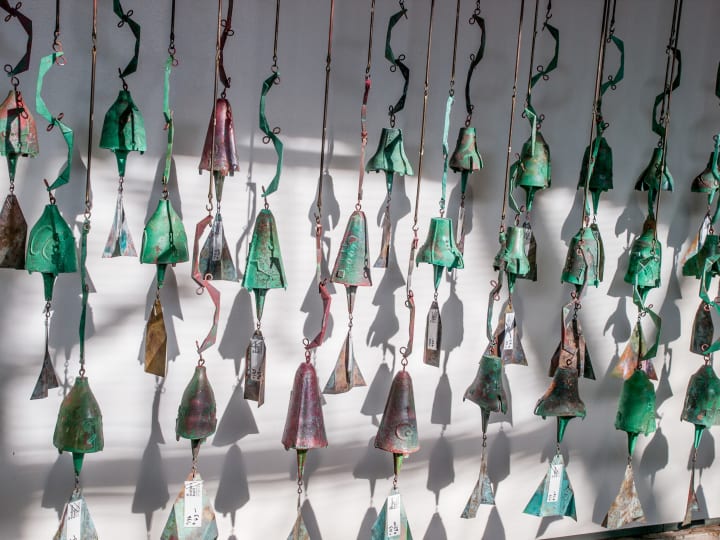
The reason for all the windchimes and bells hanging throughout the exhibit becomes apparent as Arcosanti depends on the sales of those bells made and cast from clay and bronze on site.

Arcosanti is a projected experimental town with a molten bronze bell casting business in Yavapai County, central Arizona, United States, 70 mi north of Phoenix, at an elevation of 3,732 feet. Its arcology concept was proposed by the Italian-American architect Paolo Soleri. Wikipedia
About the Creator
Jim DeLillo
Jim DeLillo writes about tech, science, and travel. He is also an adventure photographer specializing in transporting imagery and descriptive narrative.
Keep reading
More stories from Jim DeLillo and writers in Futurism and other communities.
Intelligent Virtual Assistant Market: Voice Technology Evolution & Market Expansion Insights
Driven by enterprise automation demand, advances in natural language processing, cloud adoption, and rising need for personalized, scalable customer engagement solutions across industries. According to IMARC Group's latest research publication, global intelligent virtual assistant market size reached USD 17.1 Billion in 2025. Looking forward, IMARC Group expects the market to reach USD 124.9 Billion by 2034, exhibiting a growth rate during 2026-2034.
By Andrew Sullivan5 days ago in Futurism
One Unchecked Box
"Republished" because it was the only way to add the embed for the newly recorded audio version of this story due to the Top Story badge. Plus it serves as a nice, informal announcement of the podcast's revival for another season (go subscribe!):
By Stephen A. Roddewig7 days ago in Fiction




Comments
There are no comments for this story
Be the first to respond and start the conversation.