
AGARTHA: And the Legend of a Hidden Civilization Beneath Our Feet
How ancient myths, wartime expeditions, and modern testimonies converge on one extraordinary possibility

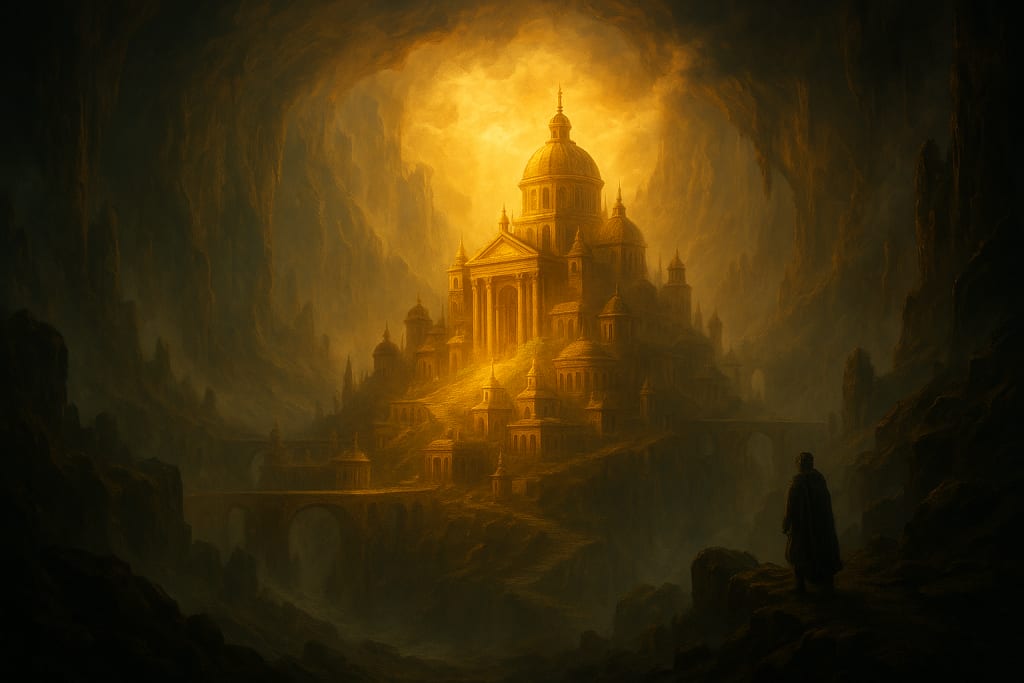
For more than a century, the idea of a hidden world beneath our feet has hovered at the edge of historical curiosity. The name Agartha appears like an old memory across cultures, resurfacing in Tibetan texts, resurfacing in European esoteric traditions, resurfacing in twentieth-century military archives, and resurfacing again in modern testimonies from explorers who claim encounters far beyond what conventional archaeology allows.
The question is not whether people believed in such a world. The record shows that they did. The question is why this belief persisted with such consistency, across thousands of years and across civilizations that had no contact with one another. My investigation into Agartha began as a casual look at recurring myths, but over time, it evolved into something deeper: a study of patterns, anomalies, coincidences, and claims that point toward a possibility that mainstream history rarely acknowledges.
The deeper I went, the clearer it became that Agartha is not merely a myth. It is a narrative anchored in the same kind of mixed evidence that often surrounds real, misunderstood history.
Ancient Sources and the Geography of the “Inner Earth”
In Tibetan Buddhism, Agartha appears under another name: Shambhala. The Kalachakra texts describe it as a physical realm, inhabited by a highly developed society, ruled by enlightened kings, and connected to the surface by extensive tunnel networks. These references are often dismissed as metaphorical, but the precision of the descriptions raises questions. The texts include geographical markers, directional routes, and structural details not typical of purely symbolic myth.
Moving west, the Greeks described something strikingly similar: a realm below, inhabited by beings that were not spirits but people, humanlike, powerful, technologically advanced. Herodotus speaks of subterranean tribes, Hesiod hints at human migrations into and out of underworld regions, and Pythagoras builds his cosmology partly around inner layers of the earth populated by “higher orders of humanity.”
These references rarely align neatly, yet they overlap enough to suggest that ancient people were describing the same concept from different angles. When such persistent myths appear in cultures separated by distance, language, and time, one of two things is usually true: either they developed independently because they reflect a common human fear, or they share a common point of origin.
Agartha seems to fall in the second category.
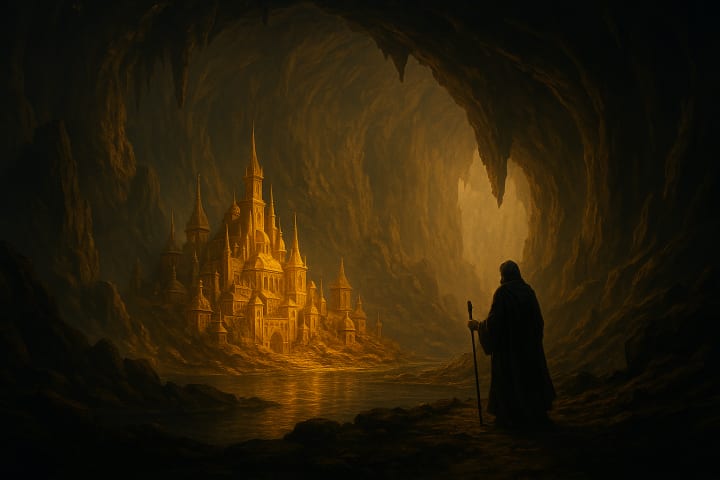
The 20th Century: Expeditions That Should Not Have Happened
During the early 20th century, especially between the two World Wars, the idea of hidden civilizations caught the attention of several governments. Germany’s Ahnenerbe dispatched expeditions to Tibet in the 1930s. The stated purpose was linguistic and cultural research, but the diaries, letters, and unofficial notes from those teams refer repeatedly to the myth of Shambhala and its relation to a “world beneath.”
This is where the story begins to shift from legend to anomaly. It is one thing for monks, mystics, or philosophers to speak of subterranean worlds. It is another reason for governments and military units to invest resources into verifying it.
Then there is Admiral Byrd, whose flight logs from the Arctic and Antarctic regions include references to unusual magnetic anomalies, unexplained geographical openings, and encounters he later described in personal writings as “events I cannot openly discuss.” Much of the controversy stems from later embellishments, but the original logs, the few pages that are verifiably his, still contain descriptions that do not fit standard polar geography.
Even if only a fraction of these accounts are accurate, they introduce a question too large to ignore: Why were high-level officials in multiple countries so focused on a myth that academic historians dismissed as superstition?
Modern Testimonies: Whistleblowers, Explorers, and Consistency
Modern claims about Agartha tend to polarize readers. Some dismiss them as fantasy, others embrace them uncritically. But the most interesting aspect is not the extremity of the claims: it is the consistency.
Over the last thirty years, independent explorers, former military personnel, and even geologists have described:
• vast tunnel systems far deeper than any known ancient excavation
• chamber complexes beneath South America and Central Asia
• evidence of heat signatures, machinery, or infrastructure buried kilometers below the surface
• unusual electromagnetic fields consistent with artificial structures
Not all are credible. Some contradict one another. But a core group of testimonies, from unrelated sources, describe remarkably similar environments: glowing caverns, large subterranean halls, and a sense of encountering something not ancient in ruins, but active and alive.
Consistency does not prove fact, but in historical research, it is a major indicator that something is worth investigating.
If Agartha Exists, Why Hide It?
This question often leads discussions into speculation, yet it is the most important question in the entire debate. If a civilization exists beneath us, why would it remain hidden?
There are several possibilities:
1. Protection: A more advanced or older civilization may choose isolation to avoid interference, conflict, or exploitation. Human history shows we are not always kind to what we do not understand.
2. Stability: Agartha, if real, would not be a small settlement. It would be a complex, functioning society. Revealing itself would risk global disruption, politically, religiously, and economically.
3. Governance: Some esoteric traditions claim that Agartha is not hidden from all governments, only from the public.
If true, this would explain sporadic references to secret treaties, unexplained military interest, and the strange silence surrounding early 20th-century expeditions.
4. Misinterpretation: It is possible that what ancient texts describe as Agartha is not a civilization in the human sense, but something older, perhaps a remnant of a pre-human or parallel epoch. If so, our frameworks for understanding it might be fundamentally inadequate.
The Human Pattern: Why We Return to the Hidden World
The persistence of the Agartha myth reveals something about human curiosity. We are drawn to the idea that history is incomplete, that our origins are deeper than textbooks suggest, that there are layers of the world we have not yet uncovered.
Throughout my research, I found myself returning to the same conclusion: the story of Agartha is not about proving or disproving a literal inner earth. It is about questioning assumptions. It is about exploring the parts of human history that never fit neatly into the academic narrative. And it is about listening to the voices, ancient, modern, and sometimes inconvenient, that point toward a world we may not yet fully understand.
Whether Agartha is a literal place, a symbolic expression of hidden knowledge, or a mixture of both, it represents a challenge: to look beyond the surface, to question the boundaries of official history, and to remain open to the possibility that humanity’s past is far stranger and far more layered than we imagined.
My Final Thoughts
In the end, the Agartha narrative continues not because people want fantasy, but because there are too many unanswered questions, too many overlapping traditions, and too many clues scattered across time for it to be dismissed. As with many great mysteries, the truth likely lies somewhere between myth and material fact.
About the Creator
The Secret History Of The World
I have spent the last twenty years studying and learning about ancient history, religion, and mythology. I have a huge interest in this field and the paranormal. I do run a YouTube channel
Keep reading
More stories from The Secret History Of The World and writers in Futurism and other communities.
Volume 7: After the Sky Opens: Life in the First Days of Disclosure
Life in the First Days of Disclosure The moment humanity has waited for will not arrive with fanfare or fireworks. It will come with silence broken by a collective gasp, a shockwave of realization that spreads not from governments or generals, but from the people who look to the sky and understand that everything has changed. Disclosure will not be the end of a mystery; it will be the beginning of a reckoning. And what follows in the days, weeks, and months after will test the very soul of humanity.
By The Secret History Of The WorldExclusive • 5 months ago
Irrigation Controllers Market: Precision Farming Demand, Automated Scheduling & Market Forecast
According to IMARC Group's latest research publication, global irrigation controllers market size reached USD 1.9 Billion in 2024. Looking forward, IMARC Group expects the market to reach USD 5.7 Billion by 2033, exhibiting a growth rate (CAGR) of 13.07% during 2025-2033.
By sujeet. imarcgroup3 days ago in Futurism
Chance AI: Is It the Best Google Lens Alternative for Visual Search in 2026?
Visual search has become a part of everyday digital life. From identifying objects to understanding images instantly, people now expect technology to “see” the world the way humans do. For years, Google Lens has dominated this space. However, growing concerns around privacy, ads, and biased results have pushed users to look for better alternatives. This is where Chance AI enters the conversation. As 2026 unfolds, many users are asking a simple but important question: Is Chance AI the best Google Lens alternative for visual search?
By Maheep Makkar2 days ago in Futurism




Comments
There are no comments for this story
Be the first to respond and start the conversation.