
The Weight of the Golden Bough
A Weaver's Account

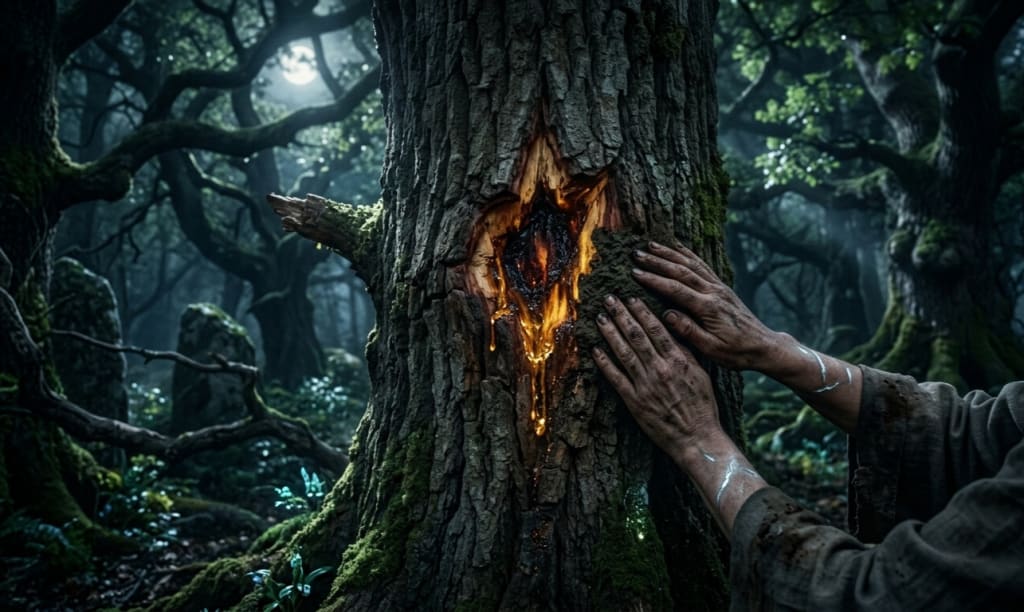
"The clock has struck three, the coffee is cold, and the shadows are beginning to speak. Welcome back to the desk of The Night Writer. Tonight, we unspool the thread of a hero’s journey to find the person left holding the tangled mess at the end."
The poets love to sing of Aeneas. They sing of his piety, his bronze shoulders, and that shimmering, fateful moment in the woods of Aricia when he plucked the Golden Bough to gain entrance to the Underworld. In the songs, the branch yields "willingly" to the touch of the destiny-chosen hero. It is a clean snap—a metallic ring in the quiet forest—and then he is gone, descending into the mist to speak with the ghosts of kings.
But myths have a habit of ignoring the debris left in the wake of divine destiny. They forget that the Bough was not a prop in a play; it was part of a living thing. And they certainly forget about Manto.
Manto was not a queen or a goddess. She was the woman who swept the temple steps and, more importantly, the one who tended the grove when the priests were too busy arguing over omens. She knew the tree that bore the Bough. To the poets, it was an abstract symbol of authority. To Manto, it was an ancient, gnarled oak that had survived three lightning strikes and a blight that should have killed it a century ago.
When Aeneas arrived, he didn't look like a hero. He looked like a man who hadn't slept in seven years, smelling of salt spray and desperation. He strode into the sacred silence of the woods with his sword drawn, as if the trees were going to ambush him. Manto watched from behind a screen of laurel. She saw him reach for the Bough.
The myth says it came away easily. The truth was much louder.
When Aeneas pulled, the tree didn't just let go. It groaned. It was the sound of ancient wood being torn from its heartwood. The Bough didn't "snap"; it resisted with a stubborn, metallic flexibility. Aeneas had to brace his foot against the trunk and heave, his face turning the color of a bruised plum, until the fibers finally gave way with a wet, splintering shriek.
He didn't stop to look at the wound he’d left behind. He tucked the gold under his arm and ran toward the cavern of the Sibyl, his mind already halfway to the fields of Elysium.
Manto stepped out from the shadows once the sound of his boots had faded. She walked to the oak and placed her hand on the jagged white scar where the gold had been. It was bleeding. Not sap, but a thin, shimmering amber ichor that smelled like ozone and old pennies.
"Destiny is a messy guest," she whispered to the bark.
For the next three days, while Aeneas was busy being lectured by his dead father about the future glory of Rome, Manto worked. The myth ignores this part—the maintenance of the sacred. If the Bough is gone, the grove is vulnerable. The balance had been tipped. The "Golden Bough" wasn't just a key; it was a seal.
Manto spent the first night hauling heavy stones to the base of the oak. She wasn't building a monument; she was trying to stabilize the roots that were now twitching in the soil. Without the weight of the gold, the tree was disoriented. It began to grow at a terrifying speed, casting out pale, sightless white shoots that reached for Manto’s throat like hungry fingers.
She had to prune them back with a silver sickle, her hands blistering from the friction. She sang to the tree—not the grand epics of heroes, but the low, repetitive humming of a woman trying to soothe a frightened animal.
On the second day, the birds stopped coming. The Bough had been their sun, a fixed point of warmth in the damp forest. Now, the woods felt hollow. Manto found a hawk grounded near the stream, its eyes clouded with the same amber mist that leaked from the oak. She sat with it until it died, wondering if Aeneas knew that his "willing" prize had cost the forest its sight.
By the third day, the Sibyl’s cave began to exhale a cold, sulfuric breath. The seal was broken, and the Underworld was leaking. Manto didn't have a magic sword or a divine mother to protect her. She had a bucket of clay and a bundle of medicinal herbs.
She climbed the oak—a dangerous feat for a woman of her years—and began to plaster the wound. She shoved the clay into the splintered wood, murmuring charms to bind the physical to the spiritual. The ichor burned her skin, leaving silver welts across her forearms, but she didn't stop. She couldn't. If the tree died, the grove would become a graveyard, and the village beyond the hills would wake up to find their wells filled with the memories of the dead.
When Aeneas finally emerged from the cave, blinking in the sunlight and looking revitalized by his visions of empire, he passed the grove once more. He saw a woman standing near the oak, her clothes stained with grey clay and her arms wrapped in bandages.
He paused, his hand on his sword hilt. "The Bough," he said, his voice booming with the self-assurance of the predestined. "It served its purpose. The gods are pleased."
Manto looked at him. She looked at the raw, pulsating scar on the tree that she had barely managed to close. She looked at the dead hawk in the bushes.
"The gods are always pleased with the result," Manto said, her voice raspy from the sulfur. "They rarely stick around for the cleanup."
Aeneas frowned, confused by this peasant woman who didn't seem to realize she was standing in the presence of a founding father. He shook his head, muttered a prayer to Apollo, and marched off toward the coast to start a war that would change the world.
Manto watched him go. She didn't hate him. You can't hate a storm for breaking a branch. But she did pick up her broom and began to sweep away the golden flakes that had fallen from his coat, clearing the path so the next hero wouldn't stumble over the debris of the last one.
The poets would never write a verse about the clay-stained woman or the tree that grew back crooked and silent. They needed the Bough to be a miracle, not a chore. But Manto knew better. She knew that every time a hero reaches for a golden future, someone else has to stay behind and tend to the roots.
‐-----‐-------------------------------------------------------------‐------------------------------
The Cost of the "Clean Snap"
In classical mythology, the "Golden Bough" is treated as a celestial key—a gift from the gods that validates Aeneas’s right to rule. But if we look at it through a biological or even a local lens, the act of removing a permanent fixture from a sacred ecosystem is an act of violence.
I wrote this story because I’ve always been bothered by the phrase "yielded willingly." Nothing in nature yields willingly to being torn apart. We love the idea of the "Chosen One" because it simplifies the mess of the world, but for every hero who fulfills a prophecy, there are a dozen "Mantos" who have to live with the environmental and spiritual fallout.
"Daylight is coming to claim the quiet, but these words stay with you. If you enjoyed this journey into the midnight hours, leave a heart or a tip to keep the candles burning. Sleep well—if you can. — The Night Writer."
About the Creator
The Night Writer 🌙
Moonlight is my ink, and the silence of 3 AM is my canvas. As The Night Writer, I turn the world's whispers into stories while you sleep. Dive into the shadows with me on Vocal. 🌙✨
Keep reading
More stories from The Night Writer 🌙 and writers in Fiction and other communities.
The Shifting Current
There’s a particular kind of ghost that haunts us, not of the dead, but of the almost-was. The following story tries to sit with that feeling, not of loss, but of the nebulous space just before it’s clear what’s even being lost. It’s about the edge of a choice, a turning point that might never fully turn, and the quiet, almost imperceptible vibrations of a connection that simply… wasn't ready.
By The Night Writer 🌙 9 days ago in Fiction
Veil of Subconscious Awakening
Images slide behind my eyelids like film cadres, bursting with meanings. In one moment, I’m speeding down the highway, making the speedometer swing wildly like a frantic pendulum. The next moment, I’m plunging from a falling plane, slowly crashing earthward. At home, I meet black cat’s green, googly eyes staring at me from the cavernous hollowness of the kitchen. When I turn for a moment, it disappears, and all I can see is a pair of blue suede shoes set up against the wall. I pick them up and put them on. When I glimpse at them again, they’ve become black as night, making me blink and flinch.
By Moon Desert5 days ago in Fiction
The Council Decides
Evallavena Tempest, the Mother of all, folded her hands in front of her, her attention on the two senior council members as they argued about the news of Sebastian Howe taking on an initiate. When there was finally a break in the debate, she said, “Sebastian is within his rights to take an initiate. Even if he hasn’t done it before, he simply needs to present her at the next Gathering.”
By Reb Kreyling4 days ago in Fiction




Comments
There are no comments for this story
Be the first to respond and start the conversation.