
The Train on the 17th
Twenty-Three Cars, Forty-Seven Seconds, Three Years

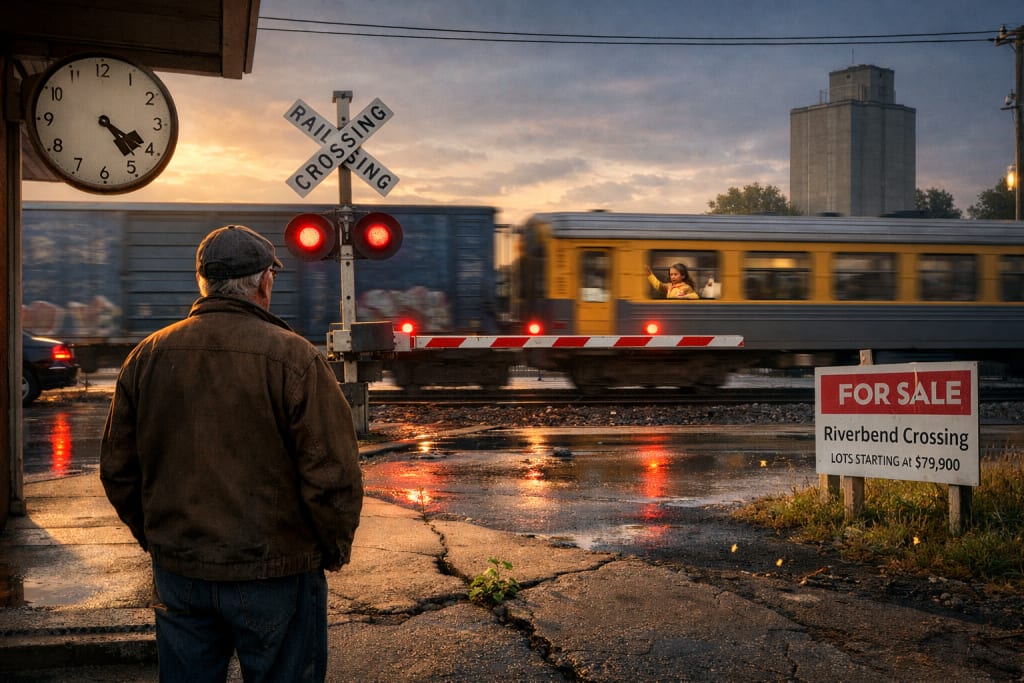
Every month on the 17th, at 4:17 in the afternoon, Elias went to the railroad crossing to watch the train go by.
He did this for three years.
First Year
In January, snow covered the ground. The train was gray. The warning bell rang. Elias counted twenty-three cars before the train disappeared behind a tall gray building in the distance.
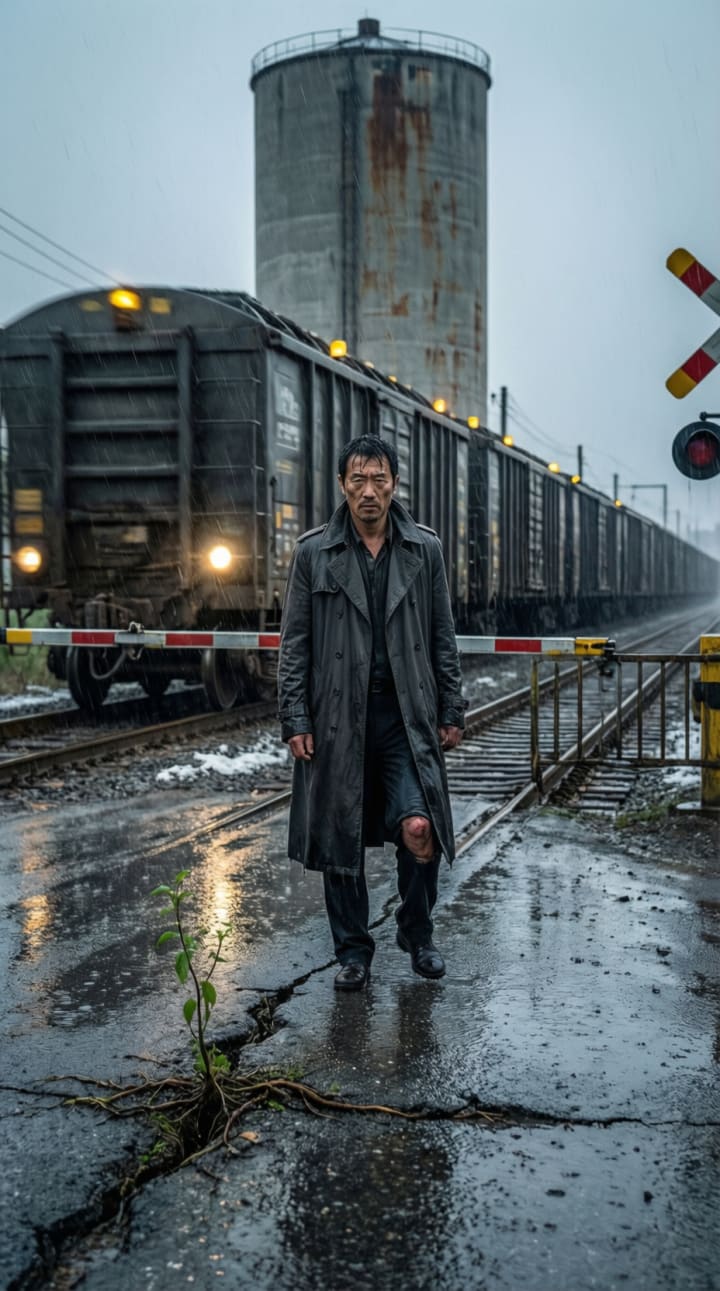
In February, cold rain fell. He saw blue spray paint on the side of the third car. The train whistle blew once.
In March, the ground was muddy. A little girl in a yellow coat pressed her face against a train window and waved at him. Elias did not wave back. He watched her hand leave a smudge on the glass as the train carried her away.
In April, rain fell straight down. Elias stood under the roof of a closed store. When the train passed, wind blew water up from puddles in small shiny sprays.
In May, the sun was warm. He saw the train conductor—a man with no hair—reading a book.
In June, the air was hot. A car waited next to him. The driver tapped his fingers on the steering wheel. When the crossing gate went up, the car drove off right away. Elias stayed and watched the last train car disappear.
In July, fireflies blinked in the grass near the tracks. The train's headlights cut through the evening dark. Elias smelled diesel fuel and fresh-cut hay. His knee hurt, though the weather hadn't changed.
In August, a woman stood a few steps away from him. She wore red sandals. They did not talk. When the train passed, she walked one way and he walked the other.
In September, the wooden crossing sign had been freshly painted white. The railroad company had put new gray stones beside the tracks.
In October, dry leaves blew across the rails. Elias counted twenty-two cars this time. He wondered if he had miscounted in January, or if the train really had one less car. He never found out.
In November, two workers sat in a truck across the street, drinking coffee and looking at their phones. They did not watch the train.
In December, it was already dark. The train windows glowed yellow against the purple sky. Elias saw reflections of streetlights in the glass. When the train was gone, he crossed the tracks and walked home.
Second Year
He missed January because he was sick in bed with a fever.
In February, he went back. The trees beside the tracks had been trimmed. He could see farther down the line now. He counted twenty-three cars again—this time he was sure.
In March, no child waved from the window. A crow landed on a post, looked at him, then flew away.
In April, he stood in the same spot under the store roof. The puddles were in slightly different places.
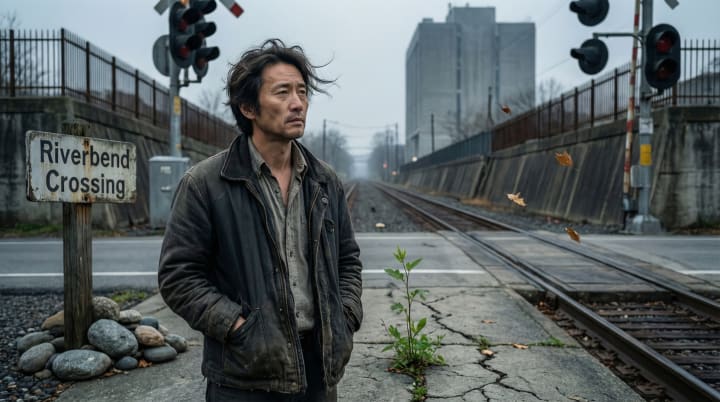
In May, he noticed a crack in the pavement where he always stood. A small plant was growing through it.
In June, a different car waited beside him. The driver did not tap his fingers this time. He just stared straight ahead.
In July, his knee hurt again—this time before the train even came.
In August, a mail carrier stood across the street. They nodded at each other. When the train passed, the mailman walked east and Elias walked west.
In September, the crossing sign was already fading again. The railroad company had not come back to fix it.
In October, he counted twenty-two cars again. He stopped worrying about whether it was twenty-two or twenty-three. Some things don't have exact answers.
In November, a "For Sale" sign stood where the workers' truck had been: Riverbend Crossing—Lots Starting at $79,900. He wondered if houses would be built there someday.
In December, he saw his own reflection in a train window—a quick flash of a pale face—before it was gone.
Third Year
He kept going each month. He noticed small changes:
The engineer was now a woman with braided hair.
The blue spray paint on the third car had faded.
The crack in the pavement had grown wider. The little plant was taller.
He realized he didn't actually know what the tall gray building was. It might not even be a silo. He had just assumed it was.
One August afternoon, it hit him: he wasn't really watching the train. He was watching the empty space it left behind—the quiet forty-seven seconds after it passed, when nothing was there but tracks and sky.
After the Third Year
He missed the next January because of a dentist appointment.
In February, he thought about going—but decided not to.
In March, he didn't go.
April came and went. No train watching.
He started walking a different way to work. He noticed other small things instead: how pigeons line up on telephone wires, when the streetlights turn on at dusk, how many steps it takes to reach his apartment door.
One spring afternoon, he found himself walking toward the crossing without planning to. He got there at 4:16. The gate started to lower. The bell rang. The train came. He watched it pass—but this time he didn't count the cars. He just watched the spaces between them: quick flashes of light, then shadow, then light again.
When it was over, he crossed the tracks and walked home a different way. He never went back.
The train still runs on the 17th at 4:17. The gate still lowers. The bell still rings. Sometimes people stand at the curb and watch. Sometimes no one is there.
The crack in the pavement kept growing. The little plant came back each spring.
Elias didn't need to be there for any of it to keep happening. Some things just continue—whether we watch them or not. And that's okay.
About the Creator
Edward Smith
Health,Relationship & make money coach.Subscibe to my Health Channel https://www.youtube.com/channel/UCkwTqTnKB1Zd2_M55Rxt_bw?sub_confirmation=1 and my Relationship https://www.youtube.com/channel/UCogePtFEB9_2zbhxktRg8JQ?sub_confirmation=1
Keep reading
More stories from Edward Smith and writers in Fiction and other communities.
The Lantern That Learned Your Name
The town of Greywick learned early not to ask questions at night. By day it was ordinary—brick storefronts, a river that pretended not to remember what it had carried downstream, houses with porches that sagged the way old men sigh. But when dusk arrived, the town changed its rules. Lamps flickered on in windows. Doors closed. Dogs went quiet. And if you were smart, you did not linger where the streetlights thinned and the dark began to feel… deliberate.
By Edward Smith7 days ago in Fiction
Feelings Never Die
It is Valentine's Day again, and it bought back memories that were over fifty years old. It bought me back to 1971, and I woke up and I knew my baby was due today. I was big and pregnant, and I felt like I was about to burst wide open. Imagine my surprise when the doctor told my I had a due date of February 14. I couldn't believe it, and since my baby was due today, I felt I could indulge myself a bit. I had gained a lot of weight, and chocolate was on the no-no list, but I had came to the end of this pregnancy, and I hoped it would be okay, after all I would deliver this baby today. So I walked across the street to the grocery story, and bought myself, a peppermint patty, covered in chocolate, my favorite. Me and my Valentine's baby would enjoy it together.
By Susan Payton2 days ago in Fiction
Living in SillyVille, U.S.A.
U.S. President Donald Trump speaks at a ceremony held to dedicate a 4-mile stretch of road from West Palm Beach Airport to his Mar-a-Lago estate to be named as 'President Donald J. Trump Boulevard', at the Mar-a-Lago estate in Palm Beach, Florida, U.S., January 16, 2026. REUTERS/Kevin Lamarque.
By Novel Allen7 days ago in Poets


Comments
There are no comments for this story
Be the first to respond and start the conversation.