
The Third Apple
The myth remembers the hero who carried the sky for a moment. It forgets the ones who understood what it meant to carry it forever.
They always said the apple was golden.
They never said how heavy it was.
Pheres knew its weight better than anyone alive, though no one alive knew his name.
He had held it only once, years ago, when his hands were still steady and his back still straight. He had carried it across a courtyard of white stone while the sky hung low and gray above the western edge of the world. The apple had rested in his palms like something that did not belong to gravity.
He had not dropped it.
He had wanted to.
But he had not.
Because Atlas was watching.
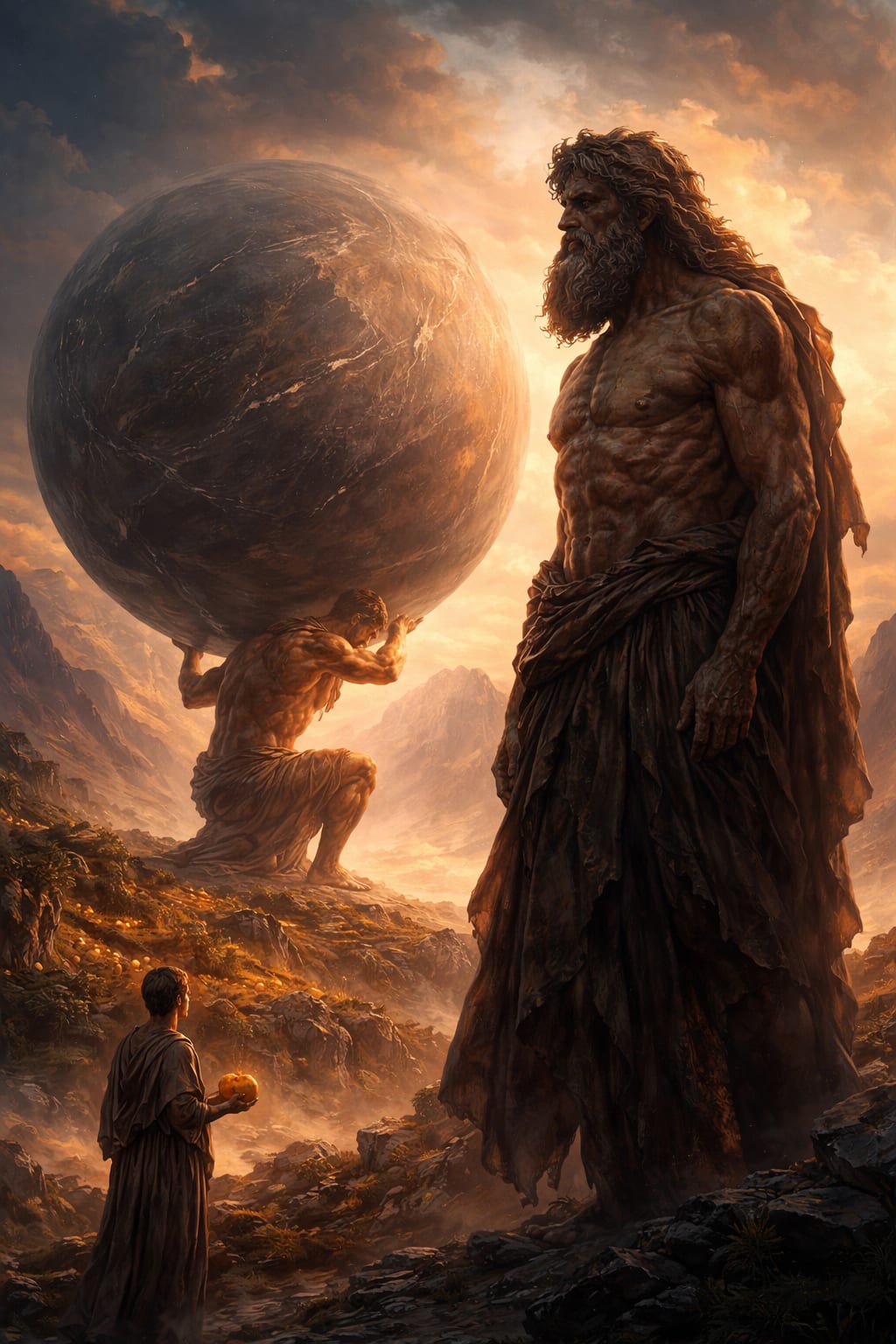
Everyone knew Atlas. The Titan condemned to hold up the sky. The giant at the edge of the world, bent beneath eternity, his knees pressed into the earth, his shoulders crushed beneath the invisible curve of heaven.
That was the myth.
The punishment was simple. The image was simple. Atlas held the sky.
What no one remembered was that sometimes, he didn’t.
Sometimes, he let someone else do it.
Pheres had been seventeen when he first came to Atlas.
He had not chosen the journey. No one chose it. He had been born into it, the son of a keeper, and his father before him, and his father before him. Their family had lived on the edge of the western sea, in a place where the land thinned into rock and wind. They tended a shrine no one visited anymore.
They waited.
They watched the horizon.
They waited for heroes.
Heroes always came eventually.
They came with questions. With weapons. With confidence that had not yet been broken by time.
And sometimes, they came with requests.
The year Heracles arrived, the wind had not stopped blowing for thirty days.
Pheres remembered the way the man walked, not like someone who belonged to the world but like someone passing through it on his way to somewhere else. He did not look at the shrine. He did not look at Pheres.
He looked only at the horizon.
“I need Atlas,” Heracles said.
He did not ask.
No one ever asked.
Pheres led him west.
It took two days to reach the place where Atlas stood. The land grew quieter the closer they came, as if sound itself hesitated there. The air pressed down harder. Breathing became work.
And then Pheres saw him.
Atlas was larger than the stories allowed. Not taller—though he was tall—but heavier. Not just in body, but in presence. He knelt with one knee buried in stone, his shoulders bowed beneath something invisible and immense. His muscles trembled with constant effort.
His eyes were open.
That was the worst part.
He was awake.
Heracles approached him without hesitation.
“I need the apples,” Heracles said.
Atlas did not answer at first.
His breathing was slow. Measured. Endless.
“You cannot reach them,” Atlas said at last.
His voice was not deep. It was tired.
“I can,” Heracles replied. “But I would rather not.”
Atlas laughed.
It was not a kind sound.
“You would rather not,” he repeated.
He turned his head slightly. His gaze passed over Pheres without stopping.
“Will you hold it?” Atlas asked.
He did not say what.
He did not need to.
Heracles nodded.
“Yes.”
Atlas studied him for a long moment.
Then, slowly, carefully, he shifted.
Pheres felt it immediately.
The pressure in the air changed. The weight above them, invisible but undeniable, shifted like a living thing adjusting its posture.
Atlas leaned forward.
Heracles stepped beneath the burden.
For a moment, nothing happened.
Then Heracles’ body stiffened.
His jaw tightened. His legs trembled.
He made no sound.
Atlas stepped away.
And the sy remained where it was.
That was the part the myth forgot.
The sky did not crash down.
The earth did not split open.
Nothing happened.
Except that someone new carried the weight.
Atlas rolled his shoulders.
He stood fully upright for the first time in longer than memory.
He did not stretch.
He did not celebrate.
He simply stood.
He looked smaller that way.
Not weaker.
Just less defined.
Like a man who had been shaped by his burden and was now unsure of his own outline.
He turned to Pheres.
“Come,” Atlas said.
Pheres followed him.
They walked west, beyond the shrine, beyond the edge of the known world, to a garden that did not belong to time. Trees grew there with branches like glass and leaves that did not move in the wind.
And at the center, the apples hung.
They were not bright.
They were dull gold. Dense. Quiet.
Atlas picked one.
He handed it to Pheres.
“Carry it,” Atlas said.
Pheres took it.
It was heavier than it looked.
Not impossibly heavy.
But heavier than something so small had the right to be.
He carried it back.
When they returned, Heracles still stood beneath the sky.
His face had changed.
He did not look heroic.
He looked afraid.
Not of death.
Of failing.
Atlas took the apple from Pheres.
He held it up.
Heracles looked at it with relief.
Atlas smiled.
“I will carry it for you,” Atlas said. “All of them. You may rest.”
Hope flickered in Heracles’ eyes.
It was brief.
“I cannot,” Heracles said.
Atlas tilted his head.
“Cannot?” he asked.
Heracles swallowed.
“I have obligations.”
Atlas studied him.
He knew the truth.
Heracles did not refuse because he could not.
He refused because he did not trust Atlas to return.
He refused because he feared what it meant to let go.
Atlas nodded.
He stepped forward.
He took the sky back.
It settled onto his shoulders as if it had never left.
Heracles took the apples.
He left.
Pheres remained.
Years passed.
Heroes came and went.
The myth spread.
Heracles had tricked Atlas, they said.
Heracles had outsmarted him.
Heracles had succeeded.
No one spoke of the moment he had held the sky.
No one spoke of how his hands had trembled.
No one spoke of how Atlas had walked, briefly, like a free man.
No one spoke of the boy who had carried the apple.
Pheres grew old.
He became his father.
He waited.
Sometimes, when the wind died and the world grew quiet, Atlas would speak.
“Do they still tell it?” Atlas asked once.
“Yes,” Pheres said.
“And?”
“They say you were fooled.”
Atlas was silent for a long time.
“Was I?” he asked.
Pheres did not answer.
He remembered the look on Heracles’ face.
The fear.
The hesitation.
The understanding.
Heracles had learned something in that moment.
Something the myth could not carry.
The sky was not impossible to hold.
It was simply impossible to hold forever.
Atlas shifted beneath his burden.
The sky did not move.
It never did.
Except, Pheres knew, when it did.
And no one remembered.
About the Creator
Lawrence Lease
Alaska born and bred, Washington DC is my home. I'm also a freelance writer. Love politics and history.
Keep reading
More stories from Lawrence Lease and writers in Fiction and other communities.
The Third Floor Stays Warm
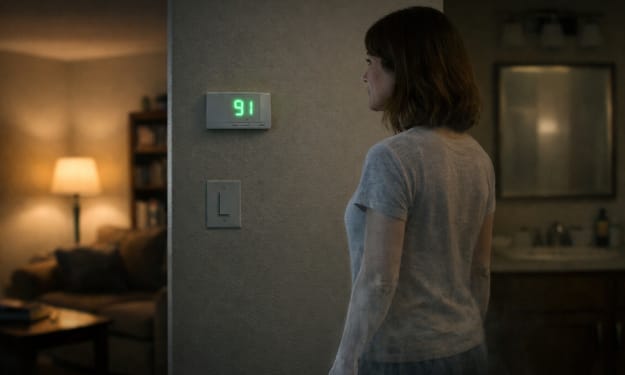
The thermostat in Apartment 3B had read 91 degrees for six weeks. It was not an aggressive heat. It didn’t press against the skin or suffocate the air. It existed the way a number exists on paper—quietly, insistently, without asking permission.
By Lawrence Leaseabout 9 hours ago in Fiction
Vanished
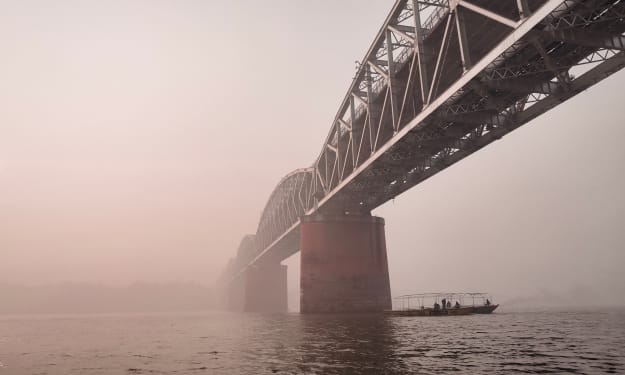
Content Warning: Mention of possible suicide Vanished D. A. Ratliff I had come to despise fog. Fog on the bridge to Cavanah Point didn’t creep in on “little cat feet,” as Carl Sandberg wrote, but arrived with a vengeance, sweeping across the bay below and enveloping the bridge in a thick gray cloud. It was a day like this one when Jason disappeared into the dense mist.
By D. A. Ratliffa day ago in Fiction


Comments
There are no comments for this story
Be the first to respond and start the conversation.