
The impact came from nowhere.
For everyone who has lost a world that was never theirs to keep.
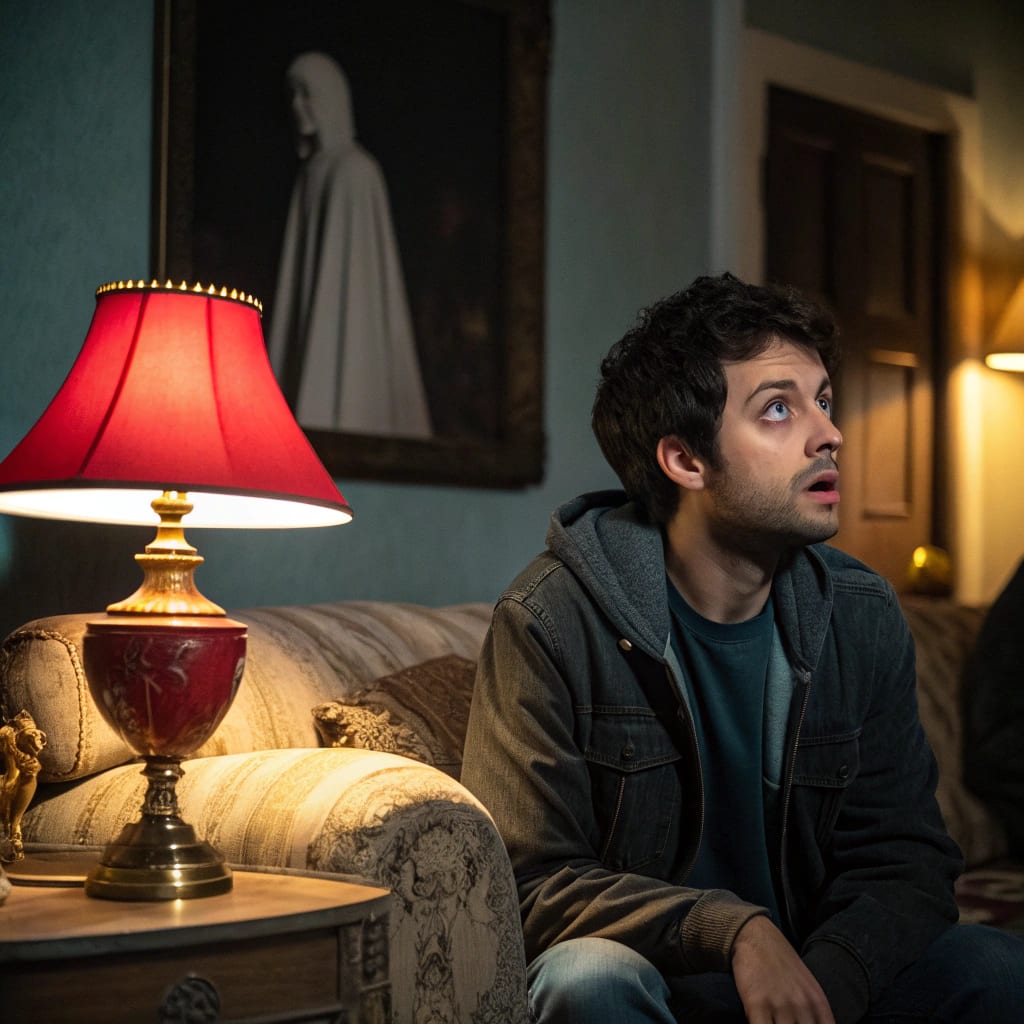
One moment, Adam was crossing the campus quad, his textbook tucked under his arm, thinking about the thermodynamics exam he hadn't studied enough for. The next moment, something hard and heavy collided with the side of his face, and the world dissolved into a spray of red and a sound like rushing water.
He was aware, dimly, of hitting the ground. Of concrete scraping his palms. Of voices, distant and muffled, as though he were hearing them from the bottom of a deep well.
Then silence.
The woman behind the coffee counter had the kindest eyes he had ever seen.
Adam didn't know why he noticed them first. Perhaps because everything else about her seemed ordinary—chestnut hair pulled back in a loose ponytail, a smattering of freckles across her nose, fingers quick and practiced as she pulled espresso shots. But her eyes were the colour of warm honey, and when she smiled at him, something in his chest tightened.
"You're here every morning now," she observed, setting his usual order on the counter. "Black coffee. No sugar. You never change it."
"I like what I like," Adam replied, and immediately felt foolish.
Her name was Elena.
Eleven months later, he proposed on the same bench where he'd first mustered the courage to ask her name. She said yes, and her laughter when he fumbled the ring box was the most beautiful sound he had ever heard.
Their wedding was small. His mother cried. Her father, a quiet man who repaired vintage motorcycles for a living, shook Adam's hand and said, "Take care of my girl." Adam promised he would.
They bought a house with yellow curtains and a kitchen that was slightly too small. Elena planted rosemary and lavender in the garden boxes by the window. Adam built her a bookshelf from reclaimed wood, his first real carpentry project, and though it leaned slightly to the left, she insisted it was perfect.
Their daughter arrived on a Tuesday in September. Lily. She had Elena's eyes and a tuft of dark hair and lungs that announced her presence to the entire maternity ward. Adam held her in the crook of his arm, this impossibly small creature with translucent fingernails and a steady, fluttering heartbeat, and he wept.
"I didn't know it would feel like this," he whispered to Elena, her face exhausted and radiant. "I didn't know I could love someone I just met this much."
She smiled, her fingers tracing their daughter's cheek. "That's how it works. Your heart just... makes more room."
Two years later, Leo arrived.
He was quieter than his sister, a watchful infant who studied the world with serious grey eyes. Adam would walk into his room every morning before work, the pale dawn light filtering through the blinds, and find Leo already awake, gazing up at the ceiling with an expression of profound contemplation.
"There you are," Adam would murmur, lifting his son into his arms. "There's my boy."
Leo would grasp his father's thumb with astonishing strength and hold on.
Adam built him a rocking horse. It took six weekends and copious amounts of swearing at misaligned dowels, but when it was finished—painted a cheerful shade of chestnut brown, with a real leather bridle—Leo's face broke into a smile so wide and genuine that Adam felt his heart crack open all over again.
More room, he thought. She was right. There's always more room.
The life they built was unremarkable, and Adam loved it precisely for that reason.
He worked as an engineer at a firm across town. Not glamorous work, but satisfying—bridges that didn't collapse, water treatment plants that served communities, the quiet dignity of things that functioned as they should. Elena taught art history at the local community college, and sometimes she would bring home student essays that made her laugh until she cried.
Lily learned to read at four and never stopped. She would curl up in the corner of the couch with picture books, sounding out words with fierce concentration, her small finger tracing each line. Leo, at three, remained a creature of few words and deep observation. He would follow his father around the workshop, handing him tools with solemn precision, his grey eyes missing nothing.
On weekends, they drove to Elena's parents' farm. Lily chased fireflies in the twilight while Leo sat on his grandfather's lap, watching the old man's weathered hands repair a carburetor. Adam would stand on the porch with Elena, her head resting against his shoulder, the scent of hay and honeysuckle drifting through the warm summer air.
"This is it," she said once, quietly. "This is everything I ever wanted."
Adam kissed her temple. "Me too."
It was an ordinary Tuesday evening when Adam first noticed something wrong.
He was sitting on the couch, Leo asleep against his chest, Lily sprawled on the carpet with a book about dragons. Elena was in the kitchen, humming something indistinct as she stirred soup. The lamp in the corner cast its usual warm glow across the room.
Except it didn't.
Adam stared at it. The lamp was a simple thing—a square ceramic base, red with gold trim, four short legs, a white linen shade. They'd bought it at a flea market three years ago for fifteen dollars. It had always been unremarkable.
But now, something was wrong with its perspective.
It was still three-dimensional. That wasn't the issue. The issue was that the dimensions were inverted—the lines that should receded into space seemed to push forward, the angles shifted in ways his brain couldn't reconcile. It was a lamp, and yet it wasn't. It was a painting of a lamp, except the painting had depth, except the depth was wrong.
"Adam? Soup's ready."
He didn't respond. He couldn't look away from the lamp.
Elena called his name again. He heard her, distantly, but the words seemed to travel through thick water before they reached him. He tried to speak, to explain, but his tongue wouldn't cooperate.
"Honey? Are you okay?"
"Fine," he heard himself say. "Just tired."
He didn't sleep that night. He sat on the couch, Leo safely tucked in his crib, Lily dreaming of dragons, Elena breathing softly beside him, and he stared at the lamp. Its wrongness pulsed like a second heartbeat.
Something is not right, his mind insisted. Something is deeply, fundamentally not right.
The next morning, Adam didn't go to work.
He called in sick—the first time in four years—and resumed his position on the couch. Elena looked at him with worry creasing her forehead, but she had a department meeting and couldn't stay. She kissed him goodbye, promised to call at lunch, and disappeared out the door.
Adam stared at the lamp.
The hours dissolved. The light through the windows shifted from gold to white to amber, and Adam didn't move. He didn't eat. He didn't drink. His phone buzzed with messages from Elena, and later from his boss, and later from Elena again, more urgent now, and he ignored them all.
The lamp was the only thing that mattered.
He was aware, dimly, of Lily tugging at his sleeve, asking why Daddy wasn't playing with her. He heard himself answer—Daddy's not feeling well, sweetheart, go find your toys—but the words emerged from somewhere outside himself, automated, meaningless.
Elena came home early. Her face was pale. She knelt in front of him, her warm honey eyes searching his.
"Adam. Adam, look at me. Please."
He couldn't. The lamp held him.
"What's wrong? What are you looking at?"
He tried to explain. The words came out fragmented, nonsensical. The lamp. The perspective. Something's wrong. Something's not real.
Her fear was a physical thing, sharp in the air between them. She called his mother. She called a neighbour. She called someone else, and someone else, and Adam heard her voice rising, cracking, and he couldn't—he couldn't—look away from the lamp.
Three days.
He stared at the lamp for three days.
He stopped using the bathroom. He stopped blinking, almost. Elena took the children to her mother's house, her face streaked with tears, and Adam understood that this was something she was doing to protect them from whatever was happening to him, and he understood that he should care, and he didn't.
The lamp was growing.
Or perhaps he was shrinking. The distinction seemed unimportant. The inverted dimensions spread outward, consuming his peripheral vision, and within that wrong-shaped space, Adam saw something else.
A pattern. A texture. The weave of concrete.
Voices.
"Is he breathing?"
"Someone call 911!"
"Don't move him, don't move him—"
The lamp expanded until it was everything. The red base became a wash of crimson, the gold trim dissolved into harsh afternoon light. The inverted depth inverted again, snapped into terrible focus, and Adam became aware of pain.
His face. His mouth. Something missing.
He opened his eyes.
The sky above him was too blue, achingly blue, the blue of a November afternoon rather than the soft gold of his living room lamp. Faces peered down at him, strangers with wide eyes and open mouths. A woman was crying. A man in a university security uniform was shouting into a radio.
Adam tried to speak. What came out was, "I'm missing teeth."
He raised his hand to his mouth. Three of his front teeth were gone, their edges jagged against his tongue. The coppery taste of blood filled his throat.
He was lying on concrete. His textbook was scattered across the ground beside him, pages crumpled. The autumn air was cold against his exposed skin.
Ten years.
He had lived ten years.
The policeman helped him to the sidewalk. An ambulance arrived, then a hospital room, then a series of doctors with clipboards and penlights and questions he couldn't answer. He gave them his mother's phone number. He submitted to X-rays and stitches and a surgical consultation for his missing teeth. He nodded when they told him he had been unconscious for approximately four minutes.
Four minutes.
His mother arrived, her face haggard with worry, and Adam looked at her and thought: You never met Elena. You never held Lily. You never rocked Leo to sleep while I fixed the garbage disposal.
"How are you feeling, sweetheart?" she asked, smoothing his hospital gown with trembling fingers. "The doctors said you might have a concussion. You need to rest."
"I'm fine," he said. "I'm fine."
He was not fine.
The depression arrived quietly, like a fog rolling in from the sea.
Adam returned to his apartment. He resumed his classes. He took his exams and passed them with grades that were adequate but uninspired. His professors noted his distraction; his classmates assumed he was still recovering from his injury. No one knew that every morning, Adam woke up and reached for a woman who wasn't there.
Elena.
He could still feel the weight of her hand in his. He could still hear her laugh, that particular breathless sound she made when Lily did something unexpectedly precocious. He could still smell the rosemary and lavender from her garden boxes, still taste the slightly-too-salty soup she always insisted on making from scratch.
None of it was real.
He understood this, intellectually. He had never met Elena. He had never held Lily or Leo. Their faces, their voices, the precise warmth of their small bodies against his chest—all of it was a fiction generated by four minutes of electrochemical activity in a traumatised brain.
But understanding did not stop the grief.
He cried at odd moments. Standing in the grocery store aisle, confronted by a jar of honey that matched the exact shade of Elena's eyes. Walking past the campus coffee shop, catching a glimpse of a woman with chestnut hair. Hearing a child laugh somewhere behind him, high and bright, so like Lily's delighted squeal when he pushed her on the swings.
He dreamed of them, sometimes. Not often enough, and never long enough. His son appeared in flashes—a glimpse of grey eyes over the edge of a picture book, a small hand reaching for his, the sound of his voice, perpetually five years old, saying something Adam could never quite hear.
He would wake from these fragments gasping, his hand outstretched toward empty air.
Three years.
He grieved for three years.
It was spring when Adam finally returned to the campus quad. He wasn't sure why he came. Perhaps some residual impulse, some unconscious desire to confront the place where his other life had ended before it began.
The quad was crowded with students, their backpacks bright splashes of colour against the greening grass. A Frisbee sailed past his head. Someone was playing a guitar, badly, near the fountain.
Adam sat on a bench and watched the sunlight filter through the new leaves.
He thought about the lamp. He had read, somewhere, that the human brain constructs reality continuously—that every moment of perception is an act of creation, a best-guess interpretation of electrical signals and sensory data. There was no such thing as objective experience. There was only the story each mind told itself, moment by moment, about what was real.
His story had included a wife and two children, a house with yellow curtains, a slightly-leaning bookshelf he had built with his own hands. That story was over now. This story—this bench, this sunlight, this quiet ache that had settled into his chest like a permanent resident—was the one he had to continue.
He didn't know if he would ever stop missing them.
He didn't know if he wanted to.
A shadow fell across his face.
Adam looked up. A young woman stood in front of him, her hands clasped nervously behind her back. She had chestnut hair pulled back in a loose ponytail and a smattering of freckles across her nose.
"Excuse me," she said. "I'm sorry to bother you. But you dropped this."
She held out his student ID card. He must have left it on the bench beside him.
Adam took it. His fingers brushed hers, and for a moment—just a moment—he saw honey-coloured eyes in a different face, heard a different voice saying you're here every morning now, felt the phantom weight of ten years of love and loss pressing against his ribs.
"Thank you," he said.
She smiled. It was not Elena's smile. It was its own thing, warm and slightly uncertain, the smile of a stranger who had performed a small kindness.
"You're welcome," she said. "Have a good day."
She turned and walked away, disappearing into the crowd of students. Adam watched her go.
The sun continued its arc across the sky. The Frisbee players continued their game. Somewhere, a child laughed, and the sound faded into the ambient noise of a thousand ordinary lives intersecting and diverging.
Adam sat on the bench for a long time.
Then he stood, slipped his ID card into his pocket, and walked toward his next class.
Sometimes, late at night, Adam still sees him.
Just a glimpse, always in his peripheral vision. A small boy with grey eyes, standing at the edge of the lamplight. He never speaks. He never comes closer. He is perpetually five years old, and Adam can never hear what he says.
But he is there.
And sometimes, that is enough.
About the Creator
Keep reading
More stories from mohamed hasan and writers in Fiction and other communities.
Ancient Egyptian civilization
Northeast African civilization gave rise to ancient Egypt. It was located within what is now modern-day Egypt, specifically in the lower sections of the Nile River. Following prehistoric Egypt, ancient Egyptian civilization came together in 3100 BC (based on traditional Egyptian chronology)[1] with the governmental unification of Upper and Lower Egypt under Menes (often identified with Narmer).[2] Ancient Egypt's history was characterized by a succession of stable kingdoms spaced out by "Intermediate Periods" of comparatively high volatility. The Old Kingdom of the Early Bronze Age, the Middle Kingdom of the Middle Bronze Age, or the New Kingdom of the Late Bronze Age are the three groups into which the numerous kingdoms are divided.
By mohamed hasanabout a year ago in BookClub


Comments
There are no comments for this story
Be the first to respond and start the conversation.