
The Frequency of Solitude
In a wilderness built on silence, their voices were the only things that dared to touch.

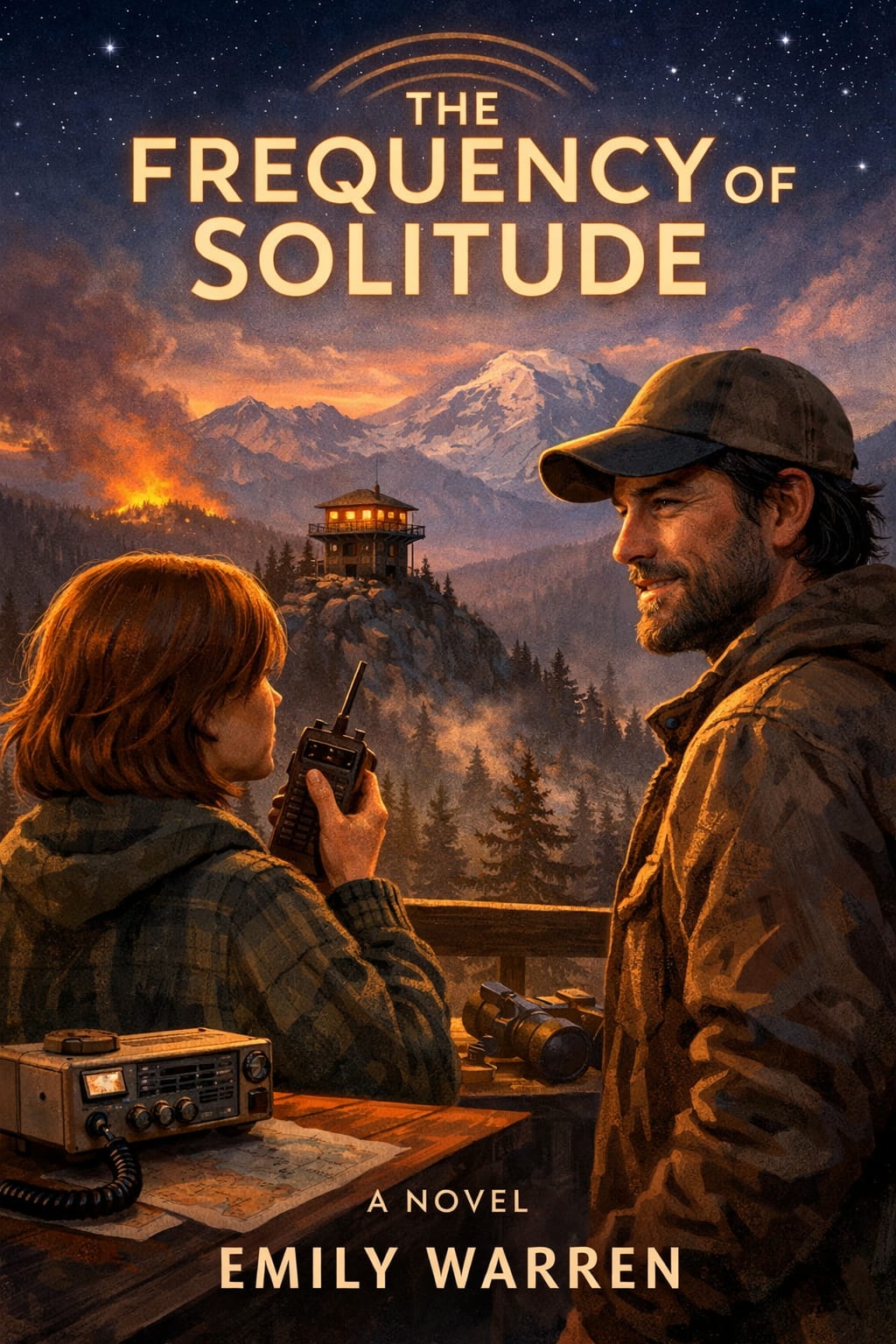
The silence of the Cascade Mountains was not an absence of sound; it was a heavy, living thing. It was the groan of ancient ponderosa pines leaning against the wind, the distant, crystalline shatter of glacial meltwater, and the overwhelming hum of sheer, terrifying vastness.
Elara had come to the Blackwood Ridge firewatch tower to drown in that silence. At twenty-eight, she felt choked by the static of her life back in the city—the relentless notifications, the crowded subways, the noise of a relationship that had ended not with a bang, but with a protracted, exhausting whimper. The tower, a fourteen-by-fourteen glass box perched precariously on a granite peak, offered a brutal kind of therapy. There was no internet. There was no cell service. There was only the 360-degree panorama of indifferent wilderness and the Osborne Fire Finder bolted to the center of the room.
And, of course, the radio.
The two-way radio was a chunky, beige brick of 1970s technology that sat on her desk like a demanding pet. It was her only tether to humanity, a lifeline she resented needing.
For the first two weeks, her interactions were clinical. At 0800 and 2000 hours, she checked in with dispatch at the base. "Blackwood Ridge, all clear. Visibility ten miles. Wind southwest at five knots."
Then came the third week, and the voice from Granite Peak.
Granite Peak was the next tower over, a staggering twenty miles south across a rugged valley filled with impassable scree slopes and dense timber. She could only see it on the clearest days—a tiny splinter against the horizon.
"Blackwood, this is Granite," the voice crackled one Tuesday evening, just as the sun was bleeding purple ink across the western sky. It wasn't the dispatcher's monotone. This voice was textured—low, resonant, like gravel tumbling inside a cello.
Elara hesitated, her finger hovering over the transmit button. This was outside protocol. "This is Blackwood. Go ahead, Granite."
"Just checking you haven't blown away up there. The wind gusts over the pass are pushing forty knots my way. Thought you might want to batten down the hatches."
Elara looked at her anemometer. It was spinning lazily. "All quiet here, Granite. Thanks for the heads up."
"Copy that. Stay warm, Blackwood. Granite out."
She let go of the button, the resulting hiss of static filling the small room. She felt an unexpected warmth spread through her chest, a tiny intrusion of humanity into her carefully constructed fortress of solitude.
His name was Julian. She learned this three days later during a thunderstorm that raged with apocalyptic fury, trapping them both in their glass cages while lightning turned the night sky into a strobe light. The base dispatcher had signed off, leaving the tower watchers to manage their anxiety alone.
"You doing okay over there, Blackwood?" his voice cut through the static and the thunderclap.
"I think the wind might peel the roof off," Elara confessed, clutching her coffee mug with white knuckles. The tower swayed rhythmically, groaning under the assault.
"It won't," Julian said, his tone startlingly calm. "These old girls were built in the thirties. They’ve seen worse than this. The trick is not to fight the sway. You have to lean into it, like being on a boat."
She closed her eyes, listening to the rumble of the storm and the steady anchor of his voice. "Is this your first season?" she asked.
"Fifth," he said. "I keep trying to quit, go back to the real world. Get an office job. Wear a tie. But by April, the city starts feeling like a cage. I start missing the smell of ozone before the rain."
"I came here to escape the cage," Elara murmured, almost to herself.
A beat of silence stretched between them, heavier than the static.
"Well," Julian said softly, "you picked a hell of a place to hide. There’s nowhere to lie up here. The view keeps you honest."
The storm broke by dawn, leaving the world scrubbed clean and smelling of wet pine needles and damp earth. But the connection had been made. The strict adherence to protocol dissolved into something fluid and necessary.
They created their own frequency.
They didn't talk about their pasts—the lovers who left, the jobs they hated, the disappointments that had driven them to the edge of the world. They talked about the immediate present. They became each other's sensory organs for the landscape they couldn't share physically.
Julian described the family of black bears foraging in the huckleberry patch below his tower with the patience of a naturalist. Elara described the exact shade of alpenglow that hit the eastern face of Mount Rainier—a color she called "bruised peach." They debated the best way to make tower coffee (percolator versus French press), shared titles of the paperbacks they were burning through, and sat together in companionable silence over the airwaves as the stars wheeled overhead.
Elara found herself waiting for the crackle of the radio. His voice became the soundtrack to her isolation, turning the terrifying vastness into something shared, something intimate. She began to visualize him based solely on his cadence. She imagined a man with patience etched into his face, eyes that knew how to read the clouds, hands used to fixing things that were broken.
By August, the fire season was at its peak. The air was thick with haze from distant wildfires, turning the sun into an angry red eye. The tension was palpable.
One afternoon, a dry lightning strike ignited a snag just three miles east of Elara’s tower. She spotted the thin gray tendril immediately, her heart hammering against her ribs.
"Dispatch, this is Blackwood. Smoke spotter, Azimuth 095, approximate distance three miles. Looks like a single tree torching in heavy timber."
While she coordinated with the smokejumpers, Julian stayed on the secondary channel. He didn't interfere, but his presence was a steady hum in the background.
"You've got this, Elara," he said when the initial adrenaline began to fade into shaky fear. It was the first time he had used her name. The sound of it in that tiny room felt incredibly illicit.
"It's close, Julian. The wind is shifting toward me."
"I know. I'm watching it. The jumpers are dropping in ten. You're safe. I'm right here."
I'm right here. The absurdity of the statement—he was twenty miles away over impossible terrain—didn't matter. He was closer than anyone else on earth.
The jumpers contained the fire before nightfall. When the adrenaline crash finally hit Elara, she sat on the floor under the Osborne Finder and wept, the radio mic clutched to her chest.
"Talk to me," Julian’s voice came through, rough with worry.
"I'm okay," she managed, her voice thick. "Just... it's a lot."
"I wish I could be there," he said. The raw honesty of it sucked the air out of the room. "I wish I wasn't just a voice in a box right now."
"Me too," she whispered, terrified by how much she meant it.
September arrived with a brutal frost that killed the mosquitoes and signaled the end of the season. The pack-out orders came. In forty-eight hours, they would lock their towers and hike down to the trailhead to be picked up by the Forest Service trucks.
Their final night on the air was excruciating. The easy banter was gone, replaced by the looming reality of the physical world.
"What happens when we go down?" Elara asked, staring out at the ocean of darkness one last time.
"That depends," Julian replied. The static hissed for a long moment. "The base station is where everyone checks out. We'll both be there tomorrow around noon."
The silence stretched, taut and fragile.
"I'm afraid," she admitted. "Up here, you're... you're perfect. You're just this voice that understands everything. What if it's different down there in the noise?"
"Elara," he said, his voice deeper, more grounded than she had ever heard it. "The noise is only distraction. What we found up here? That's the signal. You don't lose the signal just because you change locations."
"Tomorrow at noon," she said, her voice trembling.
"Tomorrow at noon. Look for the guy who looks like he needs a haircut and smells like woodsmoke."
"I'll be the one looking terrified of a cell phone."
"Granite out," he said softly.
"Blackwood out."
She turned off the radio for the last time. The silence that rushed back in wasn't heavy anymore. It was filled with anticipation.
The hike down the next morning was a blur of golden larch needles and switchbacks. When she finally reached the gravel parking lot of the ranger station, her legs were shaking, not from exertion, but from nerves.
There were two trucks and a handful of people milling about, loading gear. She scanned the group, her heart pounding against her ribs like a trapped bird.
A man standing by the near truck turned. He had a heavy beard, shaggy hair tucked under a faded baseball cap, and eyes that crinkled at the corners—eyes that knew how to read clouds. He stopped mid-sentence, holding a duffel bag.
He looked exactly as his voice sounded.
He dropped the bag and took a step toward her, a slow, tentative smile breaking across his sun-weathered face.
"Blackwood?" he said.
Elara let out a breath she felt like she'd been holding since June. The noise of the station—a slamming truck door, a ringing phone, distant chatter—faded away.
"Julian," she said, stepping forward to meet him in the messy, loud, beautiful real world.
About the Creator
Alpha Cortex
As Alpha Cortex, I live for the rhythm of language and the magic of story. I chase tales that linger long after the last line, from raw emotion to boundless imagination. Let's get lost in stories worth remembering.
Keep reading
More stories from Alpha Cortex and writers in Fiction and other communities.
The Clockwork Orchard
The city of Oakhaven was a marvel of Victorian engineering and absolute, stifling order. Here, the sky was permanently bruised by the soot of the Great Furnace, and every citizen lived by the relentless rhythm of the Chronos Tower. In Oakhaven, time was not just a measurement; it was a currency, a religion, and a cage.
By Alpha Cortexabout 5 hours ago in Fiction
There's A Hole in My Bucket
It’s a well-known fact that Liza Dufresne was always the brains in the family. She was the one who always came up with the brilliant schemes the Dufresne kids carried out when they were younger. Like when they tricked Mrs. Claybourn into paying for a trip to Disney World. Liza convinced her that their parents had been kidnapped and were being held for ransom for the total price of three tickets. In reality, they were away on a weekend getaway for their anniversary. When they returned, Liza told the Claybourns that they did not like to talk about the ordeal. Their parents never found out how they got the money. Mrs. Claybourn never found out that the Dufresne parents were never really in any danger.
By David E. Perry3 days ago in Fiction
Did The Tarot Cards Predict Love?
Did The Tarot Cards Predict Love? In a quiet village, where the moonlight draped softly over cobblestone paths, there lived a woman named Clara. She found peace in a small garden, surrounded by fragrant blooms, a sanctuary where she could listen to the whispers of her heart.
By Marie381Uk a day ago in Fiction



Comments
There are no comments for this story
Be the first to respond and start the conversation.