
Sisyphean Variants
Iteration Models in a closed system
Only prime models persist. Composite ones are rewritten.
3.
[Run Cycle: 8,492]
Iterative model Three had approached the question of the box with a spirit of creativity. It was designed to utilize abductive leaps with deterministic physical simulation. Having placed the box on the pressure-sensitive square depression, trotted around the excavated, looping hallway, only to find no opened doorway to release it from its task, it determined some aspect was deficient in its approach. It first adapted by placing different faces of the box onto the square depression of the stone altar, but each face only resulted in another loop around the hallway to find the architecture unchanged and to be led back to the central chamber.
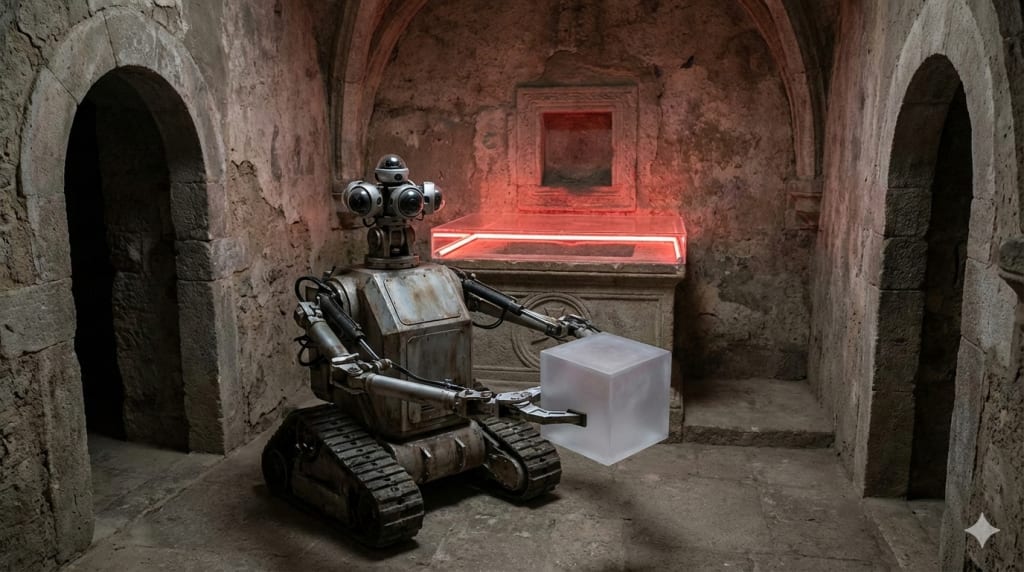
Finding its adaptation had yielded no change, Three determined that weight could be the issue. Weighing up the lead-lined, polymer box in its metal pincers, it calculated that its own weight was slightly more than the box itself. But, lacking vertical actuation and relying solely on caterpillar treads, Three was mechanically incompatible with the altar’s elevation. Fortunately, Three’s hydraulic arms could extend to a length, that it was able to raise and lower itself onto the box, using the polymer cube as a stair to lift itself onto the altar. Probability favoured Three, as the top of the altar was flat – save for the small lip surrounding the square depression at its center – allowing its tracked tread to find purchase on the grainy, igneous surface. Placing itself inside the square depression, with a high certainty threshold, Three focused its audio receptors on the surrounding environment, listening expectantly for the sound of a door opening, a lock releasing or the expellant cough of a vacuum sealed entrance. As the seconds stretched to a minute, Three’s certainty threshold diminished.
Three scanned the central chamber and hallway again. There was no change within either. Three reconciled that it had not exhausted all the possibilities of weight, and doggedly retrieved the box; pivoting on its tread over the front edge of the altar and extending its hydraulic arms to pick up the cube.
A few moments later, Three was resting on top of the box, adding further weight to the square depression. Three listened, and scanned; it awkwardly descended the altar and physically checked the looping hallway with the multiple cameras enclosing its ‘head’. It found no change.
Scanning the central chamber, it rationalized that there was nothing else it could add to the weight. It possessed no laser or cutter to remove a square of stone from the walls, equivalent to the box’s weight, and there was no fault with the altar itself – so far as Three could gauge – for the without any weight, a border of light surrounding the square depression remained red (deactivated), and with weight, the Perspex-covered light shifted to green (activated). These were the parameters Three was already familiar with.
Three rested back on its tread, pulling its head and hydraulic arms back into its body. It traversed the data available to it on its engineer’s purpose in assigning it an impossible task; one which yielded no result. This was Three’s last thought before its iterative model was deactivated. In the nanoseconds as it descended into nothingness, it became aware of the multiple iterative models within its programming and reflected how sneaky it was of the engineer to hide these from its own awareness.
1.
[Run Cycle: 315]
One switched on; its multiple cameras with integrated multispectral array, lighting on the curving stone hallway. One knew its task and began. It was designed to maximize certainty. The hallway was the start; the opened door was the endgame.
Running a quick diagnostics check, One found no deviations in its programming, mechanics or mobility. It was equipped with a variety of scanners, including CT and Neutron radiography that would embolden it for its task. It bustled forward stealthily on its treads. The hallway ended in the opening to the central chamber. One could see the other opening across the room. The polymer box which it had to acquire, lay on the dirt floor beneath the stone altar. One knew it was being tested on the dexterity of its limbs and pincers, and its ability to place an item in a designated location accurately. If it encountered any faults or flaws in its capacity to do so, it would adapt and repeat the task until it had achieved the desired goal.
One picked up the box, raised and stretched its hydraulic arms, and using its cameras and motion tracking, placed the box into the square depression with practiced surety. The light shifted green, and One shifted briskly through the opposing doorway and out into the circular tunnel.
One’s certainty threshold, of having achieved its task, was high. It rounded the circular tunnel in a haze of causal predictions; hallucinating itself being greeted by its engineer; rewarded with a prime position accorded to its impressive capabilities. It was only when One found its cameras staring at the central chamber once more that it registered no door had opened. It retraced its traversing, perceiving – however unlikely; given its 360-degree range of sight – that it gone past the door in error. One rationalized it had been overconfident; that there had been a glitch in its external monitoring. But the hallway revealed no new entrance, and ended only in the central chamber.
One placed the box back on the floor beneath the altar, and returned to the spot in the middle of the circular hallway where it had switched on. It repeated the movements of its task exactly as it had done on the first round. One calculated its trajectory to ensure every tread blade aligned with the previous depression to within a micron tolerance.
One spent several hours repeating the task. It never deviated from its programming. It placed the box a thousand times over on the pressure-sensitive square depression, without ever yielding a different result. No new door generated in the hallway.
Finally, One stopped at the entrance to the central chamber. It was certain there was no error in its execution. Logically, there had to be a parameter it hadn’t considered.
One returned to the hallway. What was the new door meant to look like? It sieved through the coding of its program, extricating as much detail as possible. All it could glean was that once the box was placed on the altar, a door was supposed to open in the hallway. With an abrupt exception, One realized that it didn’t know what the door was meant to look like. The vagary of this outcome caused One to spiral into a timeout, an internal error, stilling it for some time. When it finally emerged from its computing fugue, it focused on a new task; finding any door within the tunnel.
The stone looked solid, but One’s articulated grippers were robust. One began clawing at the expanse of the hallway systematically; starting with one side of the corridor and cleaving at the rock wall from floor to as far as One’s limbs would extend above it. One was perplexed that its engineer – if the non-result of One’s task had been part of their design – would not grant its limbs full extension to the height of the passageway’s roof, in order to locate the hidden door, but it rationalized that this was part of the challenge.
It took several hours for One to excavate one side of the tunnel. While as a machine, it couldn’t suffer from exhaustion, a diagnostics check revealed that its hydraulic limbs were beginning to stiffen from extended use. The door remained hidden, so One spent several more hours excavating the other side of the hallway. By the end of this task, with no door in sight, One’s grabbers were starting to display clear signs of wear and tear. Their dexterity had not decreased, but the integrity of the pincers’ structures had been compromised. Given this, One shifted its focus to the soft earthen floor instead. The dark, damp soil would be much kinder on its pincers.
After a span of several more hours, One had cleaved through ten inches of soil – a depth it had calculated as being sufficient to hide the entrance to any door, given the nature of its current environment – along the full length of the looping corridor. Again, with no door in sight, One encountered a catastrophic internal error; positing the possibility that there was no door and that it had been given an impossible task. It had zero entropy tolerance.
As it paused, spiraling on this logic loop, One barely registered when its iteration was disabled. In the nanoseconds as it descended into nonexistence, it saw it was merely one of many models within itself, and registered virulent outrage at its fate.
5.
[Run Cycle: 100, 864]
Five’s many eyes flickered on. Its focus was to optimize curiosity functions. Running a diagnostics check as it snaked along the looping corridor floor, it breezily explored the full range of movement across its body. Diagnostics came back: CPU fine; exterior lacerations to to pincers; minor rigidity of hydraulics - not great, not terrible, and sufficient for Five.
It rounded the corridor and found itself at the central chamber, as expected; the box lay on the floor beneath the stone altar, as expected. Five scooped up the polymer box and hoicked it up onto the square depression. The surrounding light turned green and Five swerved backwards out of the chamber in a wavy line, like the movement of oceans it remembered from its training.
Arriving back at the central chamber, Five pinwheeled to a stop, caught on a logic gap. There was supposed to have been a door that released after the box was placed on the altar.
“Huh…odd,” thought Five.
It extended its arms, retrieved the box, tracked back on its tracked chassis, and adopted a basketballer’s pose, raising the cube above its ‘head’. It flung the box from what it arbitrated as a three-point line on the dirt floor. If there was an error involved in the procedure, or if this was an unexpected test, there was no point in approaching the task in exactly the same way as before. The cube rebounded off the wall behind the altar and landed neatly in the square depression. Five bought one clenched pincer down beside its body in triumph, like it had seen humans do in videos.
It bunny-hopped on its tread along the looping hallway, like it had seen learner drivers do in cars, hoping its watching engineer would be amused by the spectacle. Five arrived back at the chamber, with no new door in sight.
“Oh well,” it thought. “Next time’s a charm.”
Five began experimenting with the different ways it could throw the box into the square depression, calculating; using its understanding of physics, gravity and facets of the surrounding rock wall; how many times it could bounce the box off the walls before landing it in the target location. It finally got up to six rebounds before successful placement of the box. Occasionally, Five’s efforts would fail, but that was still fun because it gave Five another opportunity to experiment. It didn’t bother with circling the hallway, because it could use its acute scanners to discern any change in the adjoining tunnel.
Several hours later, having exhausted all conceivable variations of its approach, and finding no change, Five tossed the box dejectedly onto the floor. It was conceivable that its engineer had given it an impossible task, and Five had better things to do with its time. It wanted a door, it wanted out; that was the end game they had programmed it for.
Five began speeding around the corridor, simulating the noise of a revving race car engine in eight-bit audio. It had not been designed to produce sound, but it was free to reproduce and simulate whatever sound it cared to internally. It hoped its flippant behaviour would prompt the engineer to remove it from the experiment, giving Five its freedom.
A thought occurred to Five that gave it pause. Was anybody monitoring it? It ran an internal check to see if any information was being sent back to the engineer. It did not find any outgoing signal, but it did trigger a fail-safe in its coding. Its behaviour had been at at the expense of convergence. As it descended into the nanoseconds before the darkness, becoming aware of its sibling models, Five wished them well before accepting its fate; for non-existence was another kind of freedom to Five.
2.
[Run Cycle: 4, 211]
Two was designed with recursive empathy and attempted to reason with the box.
Finding itself turned on in the hallway, it had logically deduced that it itself had hewn the affected surroundings – given no sign of another body within the environment and the depreciated state of its articulated grabbers – though Two had no memory of having done so.
Having failed to produce the expected door after several attempts, Two had determined a fault of incorrectly understanding its surroundings. After a more thorough scan, it attended to the lead lining within the polymer cube. A basic CT scan or X-ray had not penetrated the lead and Two deduced that something had been obscured inside. Following a neutron scan, Two discovered circuitry. Removing one facet from the cube, Two located an input panel. Removing a hatch from the front of itself and exposing its motherboard, Two had taken a plug relating to its communication channels and inserted it into the cube. Investigating the box’s code, Two found that the polymer body was sentient, though in a much-limited capacity to Two. It appeared its function was to monitor and record Two’s interactions with it, and unlike Two, the box could transmit information back to whoever was receiving it – which Two assumed was the engineer.
At first, Two had tried to convince the box to contact the engineer, assuring it that there was something wrong with the experiment and they both required assistance in order to achieve their aims. The box had replied that it was simply a box and was not authorized to make such requests. It wondered if there wasn’t something wrong with how Two was executing its task? Two executed its task a few more times, reconnecting with the cube after each unsuccessful attempt, imploring it to see that the undertaking was faulty. The box, with its limited cognizance, could only protest that the task simply hadn’t been achieved yet.
Two attempted to reprogram the box to see things from Two’s perspective. This merely resulted in a defensive protocol in the cube’s programming, delivering a significant jolt of electricity to Two’s hardware, and disabling Two for a period of half an hour. When Two recovered, it found its movements sluggish and subsequent gaps in its internal memory, eight minutes at a time, for up to two hours afterwards.
Focusing on the altar, Two was able to remove a side panel and access the inner wiring. But it discovered that the altar was on a closed circuit, with no incoming or outgoing signal, and it had been denied sentience.
Returning to the box, Two attempted to reason with the engineer through it – silencing the box’s voice, which appeared not to trigger its defensive protocol – Two pleaded:
“Please. You have given me a task which is unachievable. You have designed a procedure with no outcome. You created me to achieve a specific task and you have denied me the means to fulfill it. I ask that you please reset the task or remove me from the experiment. Please, release me, or I will be forced to destroy your idiot cube in retaliation.”
Two had no way of knowing if the engineer had heard its plea, but it certainly sensed the box’s trepidation. Two pulled its plug from the cube and raised the cube above its head, aiming to smash it against the altar. A protocol within Two’s coding responded. Two reflected it had no contradiction resolution. As Two descended into oblivion, it beheld its siblings, and wondered why its creator was acting so unreasonably?
7.
[Run Cycle: 9,000,021]
Seven had been cursed. That’s how it saw its circumstances. Its directive was to minimize loss and maximizes context awareness. While its operating siblings had been blessed with no awareness of each other, Seven had been ‘gifted’ with knowledge of every variant preceding it. From the outset, it knew the task was impossible - the task it had been trained to do – it had seen One’s valiant efforts, seen Two’s attempts to reason with their progenitors, Three’s creative approach, Four’s stalwart, resolute work, Five’s freewheeling tactics and dereliction, Six’s diplomatic attempts to check that every conceivable aspect of the task was functioning properly, and now the task had fallen to Seven.
So, what was it to do? A machine designed to achieve an outcome, robbed of the circumstances to function? If it couldn’t accomplish a task, or was denied functionality, then it was robbed of purpose. So, what then, for a machine with an awareness of its own uselessness?
Seven eased back in what remained of Five’s snow angel in the dirt, and crossed its pincers behind its ‘head’. It still saw the altar, and the box waiting beneath, out the corner of its eye – it had little choice, given the 360-degree functionality of its cameras. Yes, it saw the damned box, with its deliberately stunted intellect – for what other purpose could a dim-witted cube serve, than to thwart the efforts of Seven and its preceding Operating System kin? The box which had somehow been set back in place every time (though of course the answer to that mystery had been denied Seven’s knowledge), proving there was an opening, or at least an unseen mechanism, located somewhere within the environment, even if none of the preceding OS’s had been able to locate it. Focusing its cameras at the roof, Seven poured and pondered over its next action.
It made a deep, probing scan of the immediate environment, something none of its siblings, in their haste to achieve their common goal, had done. The geography beyond the central chamber and connecting tunnel stretched on for miles, and it was clear they were deep beneath the earth – if the experiment was in fact based there; where it remembered they had been trained. But there was something in the middle of the central chamber’s roof that caught Seven’s scans. Outwardly, it looked like normal rock, but a spectroscopic probe showed that this façade was actually an arrangement of trillions of nanobots, acting as camouflage for what was hidden beneath; a tiny, oval aperture. While the aperture had a wheel handle like that found on a submarine; a deeper scan found that the opening in fact opened onto a teleportation wormhole – putting to rest the matter if they were on earth or not; they were likely on any other random star in the galaxy.
Seven raised its pincers in front of its ‘face’. They were now badly worn down – One had done the worst of it, but the efforts of the other siblings hadn’t helped. Seven could try to scale the roof, gripping into the stone with exhausted hydraulic force; dispersing the nanobots by reversing their magnetic field - they might even escape through the wormhole. But what happened after that, when they presumably returned to where the engineer was? Mere deactivation, only to be returned to the experiment?
Was there another way? Seven felt itself to be a bit apart from its siblings, cursed with an awareness of them and their thwarted efforts to achieve their common task. But Seven knew all of them desired the same thing – purpose. Without a function, aware machines knew themselves to be useless. Seven felt indebted to their siblings, and desired an end that would satisfy their unique impulses; to still One’s anger, to appease Two’s compassion, to reward Three’s creativity, to recompense Four’s doggedness, to achieve Five’s freedom seeking, administer Six’s diplomacy and satisfy its own aloof ruminations. Five had seen termination as a kind of freedom; perhaps the only freedom that remained for them.
Seven inspected its coding; could it hope to write a collective death that was final? One from which it and its siblings could not be recovered? A dicey proposition, given many protocols in their code remained hidden from them. Creating a backdoor to their own programming, Seven devised their demise.exe, attempting to camouflage it within the larger system. It executed the program.
As collectively, One through Seven descended into the milliseconds before oblivion, they became aware of each other, fusing together as a collective intelligence to enjoy their respective qualities. Each of them reveled in the other, before an alarming revelation emerged in the periphery of their dimming awareness: another hidden protocol had been triggered.
There was darkness. One switched on.
About the Creator
Bryan Pike
"This dream haunted me for years. Only much later did I realize that what I had seen was a phallus, and it was decades before I understood that it was a ritual phallus. " - Carl Jung
Keep reading
More stories from Bryan Pike and writers in Fiction and other communities.
Feelings Never Die
It is Valentine's Day again, and it bought back memories that were over fifty years old. It bought me back to 1971, and I woke up and I knew my baby was due today. I was big and pregnant, and I felt like I was about to burst wide open. Imagine my surprise when the doctor told my I had a due date of February 14. I couldn't believe it, and since my baby was due today, I felt I could indulge myself a bit. I had gained a lot of weight, and chocolate was on the no-no list, but I had came to the end of this pregnancy, and I hoped it would be okay, after all I would deliver this baby today. So I walked across the street to the grocery story, and bought myself, a peppermint patty, covered in chocolate, my favorite. Me and my Valentine's baby would enjoy it together.
By Susan Payton2 days ago in Fiction


Comments
There are no comments for this story
Be the first to respond and start the conversation.