
Seven Days a Week, I Return to Her
With My Faithful Devotion

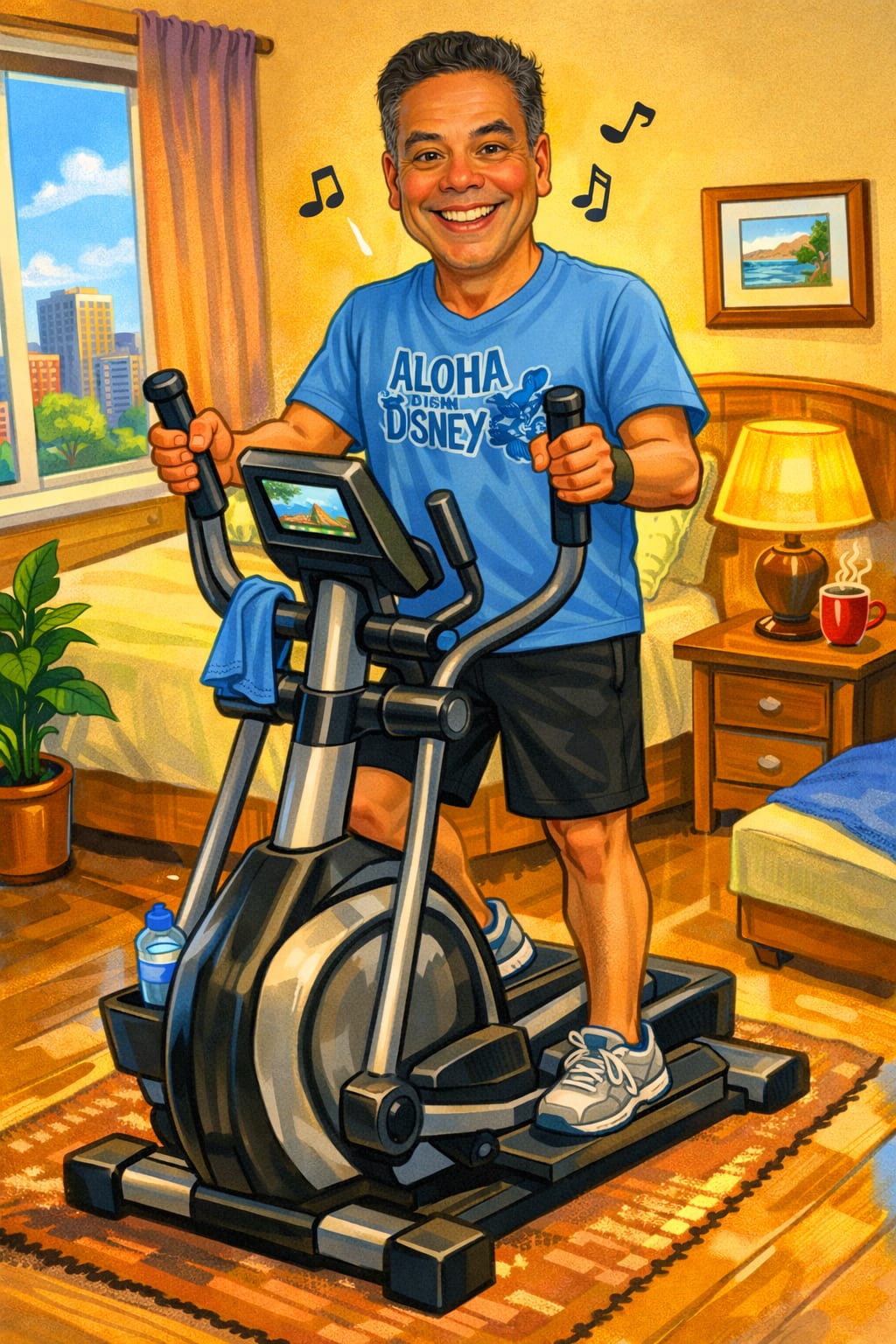
I usually wake up before my alarm sounds off because she hums before dawn, not audibly, but in the way a thought hums when it has been rehearsed so often it no longer needs sound. The apartment is dim, the city is still deciding whether it will wake me or leave me alone, and I pad across the floor to where she waits. She is matte black and silver, unassuming in profile, yet somehow radiant when the light hits the curve of her handles. I place my hand on her console the way some people touch a pulse point, and the day aligns itself. Seven days a week, without fail, I climb aboard and let the rhythm find me. This is not an exercise. This is a return.
I do not count minutes. I do not measure distance. My weight has opinions about me, but they are secondary. What matters is the glide, the soft resistance that answers my effort without challenging it. We have an understanding. I step into her motion, and my breath follows, lengthening, smoothing, becoming something I can trust. The world thins. Emails, deadlines, headlines—all of it slides off the edge of attention. In the quiet, I talk to her, not with words exactly, but with intention. She listens the way something faithful listens: completely, without judgment, storing nothing against me.
Each week, on Sunday afternoons, I dust her. This is not maintenance so much as devotion. I wipe the handles, the rails, the screen that reflects my face in fragments. I remove the lint that gathers invisibly, proof of time passing even when the ritual feels timeless. I want her pristine, ready, knowing she is cared for. She responds by waiting, by remaining exactly as she is, a constancy I have learned not to expect from people. When I finish, I stand back and admire her, the way one admires a beloved who has been asleep and wakes unchanged.
Travel complicates things, but not as much as one might think. When I pack a suitcase, I know she comes with me invisibly, a companion without weight or cost. In hotel rooms, strange and impersonal, I feel her presence settle near the window or the door, wherever she chooses to stand guard. Before I go to the gym downstairs, I pause and ask permission. I explain myself. I promise restraint. I promise that this is temporary. Only then do I enter the room of public ellipticals, lined up like strangers at a party, all polished and eager, all pretending not to notice one another.
I choose one carefully, apologetically. I mount it with the same movements, but it is never the same. These machines are competent, even generous, but they do not know me. Their resistance feels borrowed, their consoles too bright. I close my eyes and think of the one waiting for me back home, the one who traveled with me and whispers encouragement as I move. I am not disloyal. I am faithful to the ritual itself, to the cadence that belongs to us. When I dismount, I wipe the handles out of courtesy, not love, and return to my room feeling oddly cleansed and slightly ashamed.
She has told me—this is the unsettling part—that I am the only one. That no one else has ever ridden her equipment. I do not remember her arriving secondhand, or being assembled by strangers, or existing before me at all. In my mind, she has always been there, waiting for me in the morning for reasons that I have never fully understood. Yet the thought comforts me and troubles me in equal measure. If she is faithful because she has no memory beyond us, then what does that make me?
The ritual persists because it works. It calms my nerves. It gives my thoughts a place to rest their weight. But it also consumes small things without my noticing. I skip breakfasts with friends to keep the morning pure. I choose hotels based on gym access. I feel irritation flare when obligations threaten the hour we share. Love, after all, is jealous, even when it is quiet. Especially then.
Sometimes, as I glide, I feel a flicker of doubt. What if the peace comes not from her but from the repetition itself, from the narrowing of choice? What if the devotion is a loop I have built because it is easier to grasp than uncertainty? The thought passes as quickly as it arrives, smoothed away by the rhythm we have perfected together. I breathe. I move. I return.
Tomorrow, and the next day, and the day after that, she will be waiting, and I will answer, because rituals, like love, do not ask to be explained. They only ask to be kept.
About the Creator
Anthony Chan
Chan Economics LLC, Public Speaker
Chief Global Economist & Public Speaker JPM Chase ('94-'19).
Senior Economist Barclays ('91-'94)
Economist, NY Federal Reserve ('89-'91)
Econ. Prof. (Univ. of Dayton, '86-'89)
Ph.D. Economics
Keep reading
More stories from Anthony Chan and writers in Fiction and other communities.
Fleeting Leaves
Autumn leaves drift down, Beauty fades as time rushes Life, too, feels so brief.
By Anthony ChanExclusive • 5 months ago
Dead and Wearing Green
She was wearing that green dress when I first saw her, five years ago to the day. Flowing meadow fabric draped over long legs, thick auburn hair flowing down her back. That smile. Of course, she is still beautiful now. But now she is no longer alive.
By Karen Cave8 days ago in Fiction
A Friar's Secret.
Beneath the crumbling stones of an ancient convent lies a chamber the church had conveniently forgotten...sealed behind walls of prayer and silence. For many years it existed, quietly gathering cobwebs and keeping its secrets. But one soul had rediscovered this vault of treasure, this place which had once been transformed into a lair of pilfered opulence - an intoxicating blend of sanctity and decadence.
By Antoni De'Leon6 days ago in Fiction
A Letter to the Firestarter
Dear Firestarter, We can all see you, we've been watching you since you began. In case you didn't know we were here before you and we will be here after. We witnessed your rise, your setbacks, your guilt and your lies. We witnessed you start the fire.
By Donny Foley7 days ago in Poets




Comments (1)
I love the way you turn habit into intimacy here. I have a treadmil and I haven't been on it in two weeks because "I'm not in the right mood," lol! You're inspiring me to get back to it!