

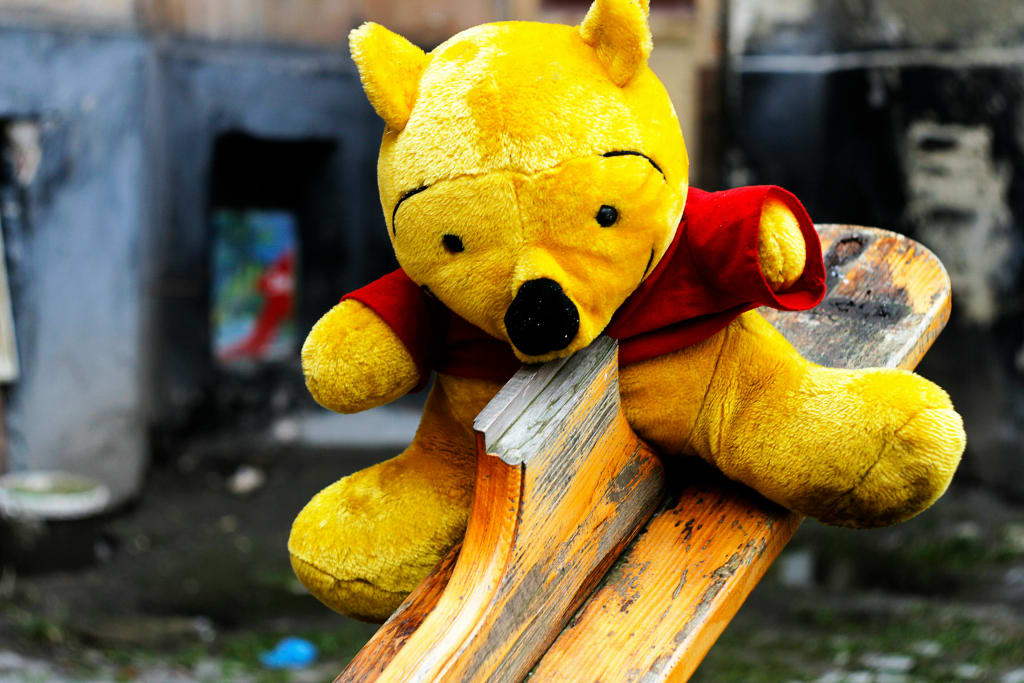
On they went in search of Roo's ball. They split up Pooh, Roo and Paddington went one way and Piglet, Eeyore and Kanga went the other. They scoured the area. "You know Pooh that ball could not have traveled too far, but maybe a little animal picked it up. I see a little squirrel over there for Kanga did say Roo went after one little squirrel. Maybe that was so that little squirrel could take the ball." Pooh thought and said, "Let's see." They sneaked up on this little squirrel and they saw that he did have a little ball.
About the Creator
Mark Graham
I am a person who really likes to read and write and to share what I learned with all my education. My page will mainly be book reviews and critiques of old and new books that I have read and will read. There will also be other bits, too.
Reader insights
Outstanding
Excellent work. Looking forward to reading more!
Top insights
Excellent storytelling
Original narrative & well developed characters
Heartfelt and relatable
The story invoked strong personal emotions
Keep reading
More stories from Mark Graham and writers in Fiction and other communities.
Pooh meets Paddington
As the small gang was walking through the Hundred Acre Wood Paddington was the first to spot two characters up ahead on the path. Paddington asked Pooh who these two were. Pooh looked up and seen that it was Kanga and Roo, and they both seemed to in a tizzy. Pooh asked Kanga what's the matter? Roo can't seem to find his ball. It rolled somewhere when Roo chased a squirrel. We will help you look for Roo's ball for it couldn't have rolled fall for this ground is slightly flat. Maybe it went this or that way. Let's go!
By Mark Graham6 months ago in Fiction
The Salt in her Voice
The myth says mermaids sing to lure sailors to their death. But why? The ocean is huge. Only 5 percent has been discovered by man. Why would a creature of the sea with that much space to roam ever care about the fate of men on ships? The answer, as it turns out, is not a simple one at all. The truth about the myth is older than the tides. Long ago before the first ship ever cut across the surface, the sea made a pact with the sky. The sky would take the souls of the drowned. Anyone who died in storms or any quiet accidents of the deep would have their soul lifted upward to the Heavens while the bodies would remain below, feeding the oceans endless hunger. The greedy sea however wanted more souls than the sky would claim. So it created mermaids. It gave them beautiful voices woven from currents and moonlight. It commanded them to sing. "Bring forth the ones who float where they should sink." it instructed them. So they did. They never killed out of malice but out of obligation. They sung to summon, not to seduce. A mermaid's voice could loosen the tether between the body and soul, making any man step willingly into the water. The sea would take the body and the sky would take the soul. Balance maintained.
By Sara Wilson6 days ago in Fiction
The Weight of Things I Never Said
I used to believe silence was strength. When I was younger, I thought strong people were the ones who endured everything without complaining. The ones who swallowed their words before they could cause trouble. The ones who nodded instead of arguing. Who smiled instead of breaking. So I learned to be quiet. In our house, quiet was normal. It sat at the dinner table with us. It followed us into separate rooms. It slept between the walls. We spoke about practical things—bills, school, groceries—but never about feelings. Feelings were like fragile glass; no one wanted to be responsible for dropping them. My father believed in discipline more than conversation. My mother believed in endurance more than expression. I believed in survival. The first time I remember holding my words back, I was nine. I had drawn something at school—a messy picture of our family standing under a bright blue sky. I was proud of it. I ran home with the paper folded carefully in my bag. That evening, my father came home tired. The air felt heavy. I stood in front of him with the drawing in my hand. “Not now,” he said. He didn’t look at it. It wasn’t anger. It wasn’t cruelty. It was dismissal. Casual and unintentional. But something inside me folded along with that paper. I told myself it didn’t matter. But that was the first thing I didn’t say: I just wanted you to see me. As I grew older, silence became easier. When friends argued, I listened. When teachers were unfair, I accepted it. When someone hurt me, I told myself it wasn’t worth the trouble of explaining why. Every unspoken sentence settled somewhere inside me. Not loud enough to explode. Not light enough to disappear. In high school, I fell in love with someone who liked my calmness. “You’re so easy,” they said once. “You never overreact.” They meant it as a compliment. I smiled. What I didn’t say was that I overreacted all the time—just internally. My chest tightened. My thoughts spiraled. My heart rehearsed conversations I would never actually have. When they forgot my birthday, I said, “It’s okay.” When they canceled plans repeatedly, I said, “I understand.” When they slowly drifted away, I said nothing at all. The truth was simple: It hurt. But pain, when buried long enough, starts to feel like personality. I became the understanding one. The mature one. The strong one. People confided in me. They trusted me. They told me their fears and heartbreaks. I held their words carefully, like fragile glass. No one asked what I was holding. It wasn’t that they didn’t care. It was that I had trained them not to worry. I had built a version of myself that required nothing. Silence can be addictive. It keeps things stable. It avoids conflict. It makes you appear composed. But it also builds walls. The first crack in mine came unexpectedly. I was twenty-three when my mother and I argued for the first time in years. It started over something small—missed calls, unanswered messages. Ordinary things. But the frustration in her voice surprised me. “You never tell me anything,” she said. “I don’t know what you feel.” I almost laughed at the irony. For years, I had wanted to say the same thing to her. Instead, I stood there, heart pounding, old habits tightening around my throat. I could end this easily, I thought. I could apologize. I could retreat. I could stay silent. That would be safer. But something inside me was tired—tired of carrying words that had grown too heavy. “I learned from you,” I said quietly. The room changed. She looked at me differently, as if noticing a stranger standing where her child used to be. “What do you mean?” she asked. My hands were shaking. I wasn’t used to speaking without rehearsal. “I mean… we don’t talk about things. We just endure them. And I got good at that.” The confession felt fragile. Dangerous. For a moment, I thought she might deny it. Or dismiss it. Instead, she sat down. “I didn’t know you felt that way,” she said. Of course she didn’t. I had never told her. That conversation didn’t fix everything. We didn’t suddenly become expressive or emotionally fluent. Years of silence don’t disappear in a single evening. But something shifted. I realized that the weight I carried wasn’t entirely caused by others. Part of it belonged to me—the choice to stay quiet, again and again, even when my voice deserved space. Silence had protected me as a child. It kept peace. It avoided disappointment. But as an adult, it was isolating me. There’s a difference between being calm and being unheard. Between being patient and being invisible. Between choosing silence and being trapped inside it. I still struggle. Even now, there are moments when words rise to my lips and hesitate. Old habits don’t vanish overnight. Sometimes it feels easier to let things slide, to avoid the risk of misunderstanding. But I’m learning something new. Strength is not the absence of emotion. It is the courage to express it. The weight of things I never said still exists. Some words will probably remain buried forever. Childhood versions of myself still holding drawings no one saw. Younger versions swallowing tears no one noticed. I can’t go back and speak for them. But I can speak for who I am now. And every time I choose honesty over silence—even in small ways—the weight shifts. It doesn’t disappear. But it becomes lighter. Manageable. Because some words stay buried. But the ones we finally dare to say? They teach us how to breathe again.
By Inayat khan3 days ago in Fiction



Comments (4)
That’s one cunning little squirrel. Maybe he got the ball from Roo by being cute. Nice work Mark ♥️🤗🙏🏽
Maybe the squirrel wants to play!
So lovely Mark well done✍️🏆✍️🦋🦋
finders, keepers? hmm; let's see what happens.