
MISS WINCHELSEA'S HEART
A Quiet Woman with Romantic Dreams Life Guided by Imagination The Charm of Foreign Adventures Expectations of Love and Destiny Misunderstandings of the Heart Reality Behind Romantic Illusions A Lesson in Self-Awareness The Difference Between Fantasy and Truth Acceptance and Inner Growth A Heart Wiser Than Before

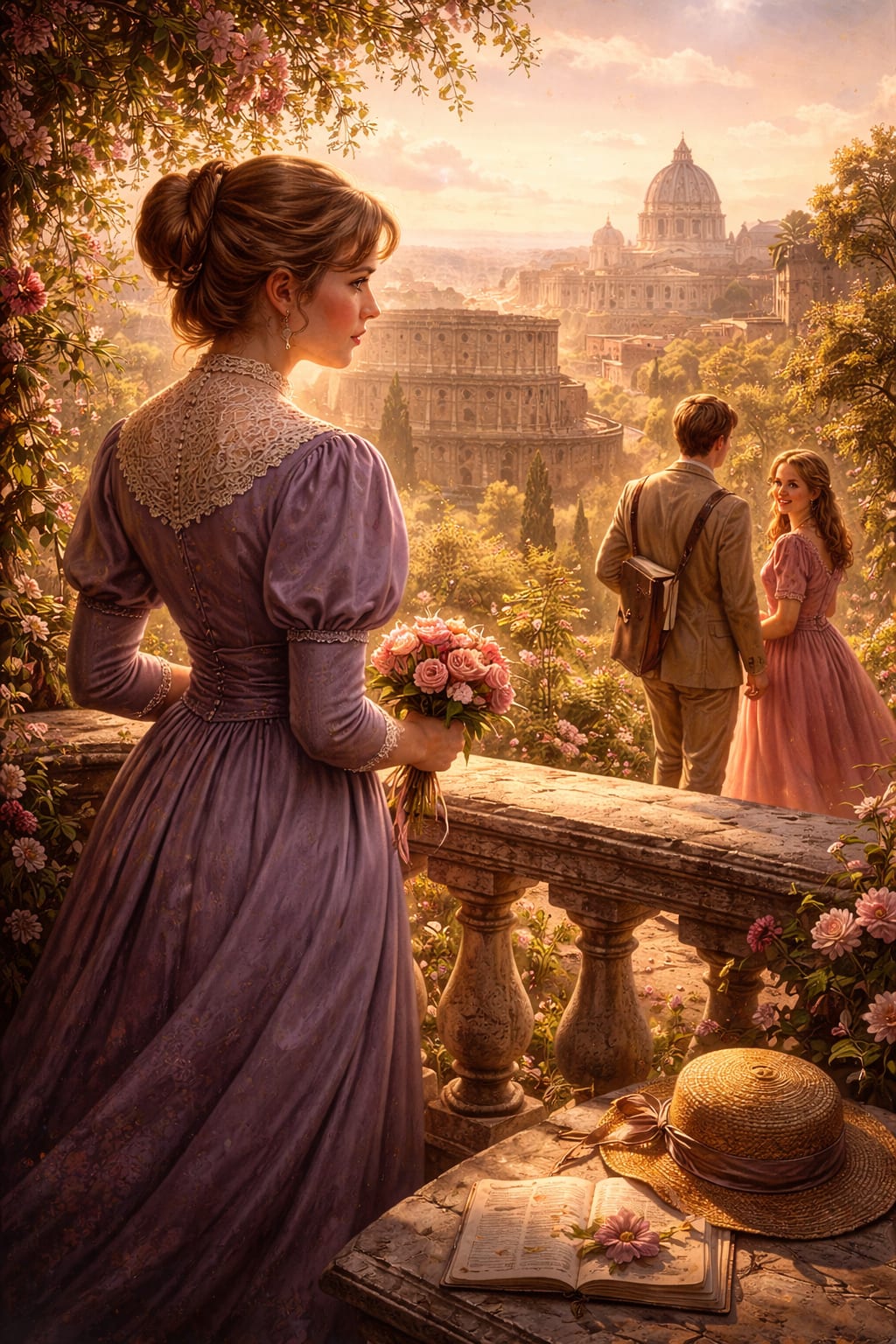
Miss Winchelsea had long dreamed of going to Rome. For more than a month before her departure, she spoke of little else. She discussed Roman history, art, poetry, and famous graves as though she had personal ties to them. Some people admired her enthusiasm, but others found it excessive. A few even suggested that she was rather proud of “her Rome.” Still, Miss Winchelsea believed her passion was refined and intellectual, not boastful. She carefully prepared for the journey, selecting clothes that were sensible yet not obviously tourist-like. Even her red guidebook was hidden in a gray cover to avoid looking common. When the great day came, she stood at Charing Cross Station feeling dignified and adventurous.
She was traveling with two old college friends, Fanny and Helen. They admired Miss Winchelsea’s knowledge and often looked to her for cultural guidance. Although they were cheerful and kind, they were less serious about history and literature. On the train, Miss Winchelsea quietly judged their slightly touristy accessories but decided not to comment. They soon found themselves sharing a compartment with various strangers, including a noisy family and a refined young man traveling alone. This young man carried a small volume of poetry instead of a guidebook, and Miss Winchelsea immediately felt he was different from the ordinary tourists. She noticed his quiet manners and thoughtful expression.
During the journey and Channel crossing, the young man proved helpful and considerate without being overly familiar. He assisted them politely with luggage and spoke French when necessary. Gradually, he began joining them in conversation. At dinner and later during their stops in Florence and Rome, he revealed that he was also a teacher, well-read in poetry and art. He quoted Horace and discussed paintings with confidence and sensitivity. Miss Winchelsea was delighted. She felt that at last she had met someone who truly shared her intellectual interests. Fanny admired everything enthusiastically, and Helen remained practical and somewhat reserved, but it was Miss Winchelsea who formed the deepest connection with the young man.
In Rome, the friendship grew stronger. They explored galleries, churches, and ruins together. They spoke of history as though the past were alive around them. Miss Winchelsea imagined a refined future—perhaps a quiet home filled with books and artistic prints, shared with this intelligent companion. One afternoon, while walking on the Pincian Hill, the young man began to speak seriously. He hinted that his feelings were deeper than friendship and suggested that their meeting had been almost providential. Miss Winchelsea felt her happiness nearing fulfillment.
Then everything changed. A friend approached the young man and called him by his surname: “Snooks.” The word struck Miss Winchelsea like a shock. Snooks! The name sounded ridiculous and vulgar to her refined ears. Instantly her romantic dream collapsed. She imagined herself as “Mrs. Snooks” and felt humiliated. No matter how cultured the man was, his surname seemed impossible to accept. She could not explain this feeling to anyone, but it overwhelmed her. From that moment, she began withdrawing emotionally.
Although the young man tried to understand her sudden coldness, she refused his proposal in a vague note, mentioning “obstacles” she could not reveal. She left Rome heartbroken yet determined. Fanny, however, continued corresponding with him. Soon letters arrived describing his visits to her school and his growing affection for her. Miss Winchelsea learned that his full surname was originally derived from “Sevenoaks,” and with Fanny’s suggestion, he even altered its spelling to make it more elegant—first “Senoks,” then eventually “Sevenoaks.” Fanny happily accepted his proposal. The news devastated Miss Winchelsea. She realized she had rejected him for a trivial reason.
Fanny married him and settled into domestic life. Miss Winchelsea continued teaching, outwardly composed but inwardly regretful. She sent wedding gifts and polite letters, hiding her disappointment. Years later, she visited the couple. By then, the young man had changed. He was less delicate in manner and more ordinary in conversation. He discussed practical matters and seemed fully absorbed in married life. The intellectual glow Miss Winchelsea had once admired had faded. She returned home saddened, realizing that her dream had been partly illusion.
In the end, Miss Winchelsea was left with her refinement and her solitude. She had lost a possible happiness because she valued appearance and social elegance over genuine affection. Her romantic vision had been stronger than reality itself.
About the Creator
Faisal Khan
Hi! I'm [Faisal Khan], a young writer obsessed with exploring the wild and often painful landscape of the human heart. I believe that even the smallest moments hold the greatest drama.
Keep reading
More stories from Faisal Khan and writers in Fiction and other communities.
China creates a 35.6 Tesla magnet that breaks records.
Using a magnet composed entirely of superconducting materials, China has created the greatest stable magnetic field ever recorded, 700,000 times stronger than Earth's. Extreme magnetism is transformed from a transient laboratory trick into a manageable force that scientists can rely on and plan for thanks to its persistent strength.
By Francis Dami6 days ago in Fiction
I wanted to title this something different, but worried that my chosen title might cause problems entering the United States in the future so this is the new title. It's the greatest title. No one has ever written a title better than this. (All titles unrelated to content).
Let me be honest. I am finding this difficult. Now, I like a challenge, a stretch, a bit of an obstacle course. “Write about the decline of the British Empire in the form of a narrative poem in which your protagonist is an artichoke” I read, and flex my fingers. “Write a haiku to evoke the sensation of sibilance using only the first half of the alphabet.” “Well”, I think to myself, “this should be fun.” But “write about a system that isn’t working”? A system that isn’t working? Now? In 2026? ONE system? My favourite system that isn’t working? The sexiest system that isn’t working? The one giving me the most angst day to day? The one giving me the most existential dread? I am, as I say, finding this difficult. I will own that I have contemplated writing a thousand words on why the steady “all on” setting on my fairy lights is the EIGHTH of seven options which must be sequentially activated to get there, because that is a system that some fool came up with and it definitely doesn’t work, and now who is paying the price, eh? But how can I write about my fairy lights when…. When…. When….
By Hannah Moore4 days ago in Humans




Comments
There are no comments for this story
Be the first to respond and start the conversation.