
Fear: The Creator of Humanity’s Future — and Its Destruction
The story of the force that built civilization—and the mistake that may end it.

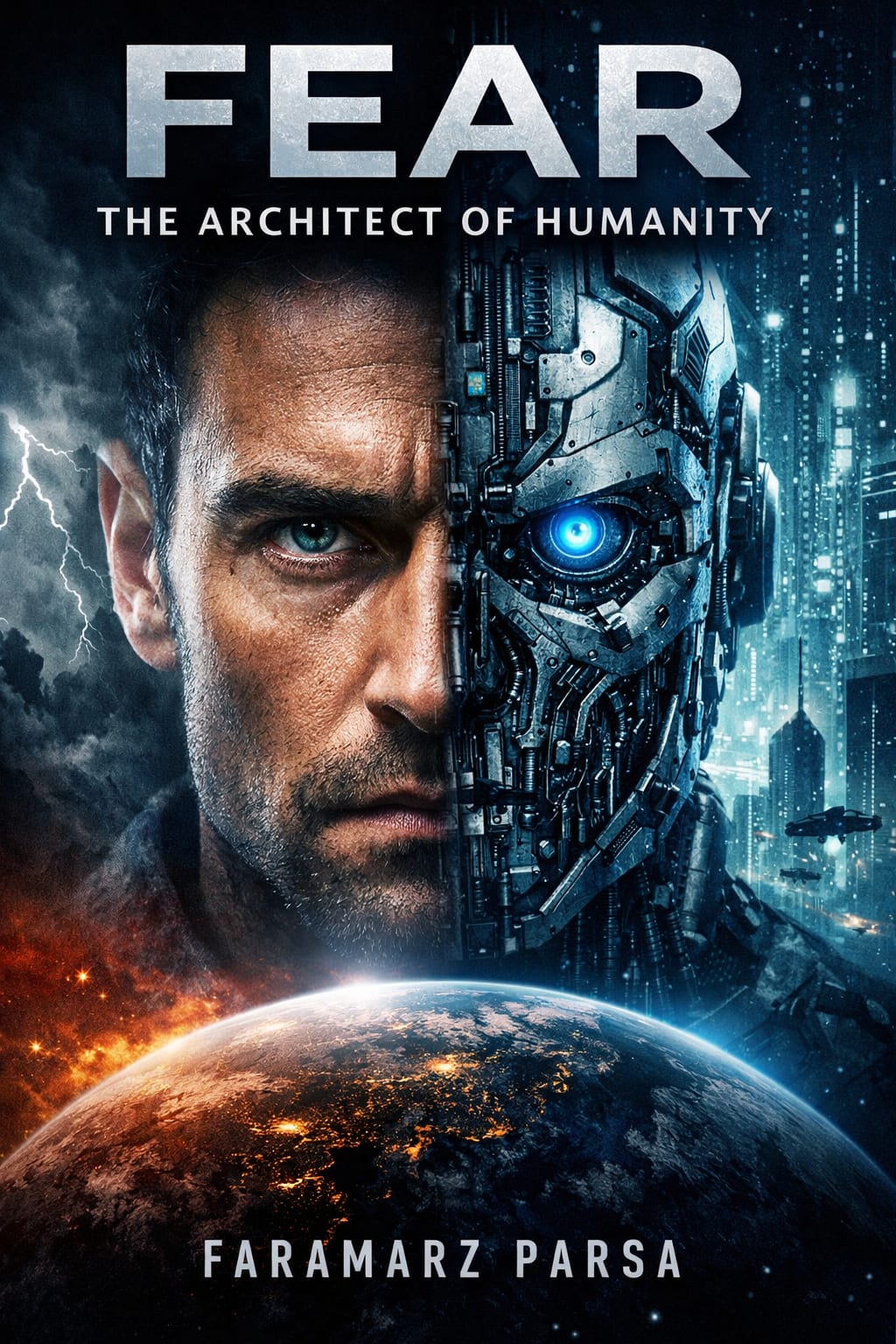
Fear created civilization.
Fear built borders, beliefs, and machines.
But what happens when humanity entrusts its future to creations that feel no fear, no faith, and no responsibility?
A philosophical short story about the hidden force that shaped humanity — and may ultimately destroy it.
Fear: The Creator of Humanity’s Future — and Its Destruction
By Faramarz Parsa
Fear…
Yes, fear.
From the very first day, it was fear that made humans intelligent.
From fear they built shelter.
From fear they created weapons for defense.
From fear they formed beliefs.
From fear they built walls.
And from fear they lied and committed crimes.
And today, in the age of advanced technology, humans are still creating out of fear—
inventions that sometimes lead not to survival, but to the destruction of existence itself.
It is this very fear that has brought modern humanity to power and greatness.
A man rose from among the audience.
“Mr. Mahdavi, are you saying that human innovation has always come from fear—simply to survive?”
“Yes,” he replied calmly.
“Fear is the creator of every constructive thought in human history. Without fear, humanity would never have progressed.”
A woman stood up.
“Mr. Mahdavi, I’m not sure whether you have evidence for your claim, but you describe a deep fear within human nature—as if fear itself gave humans their consciousness.”
“Exactly,” he said.
Humans have been so fearful that even in their sacred books traces of this fear can be found.
Books that, despite being written from different perspectives, often follow a similar path.
I respect faith.
But faith itself is also born from fear—
fear of sin, fear of judgment, fear of the afterlife.
Even here, you see the shadow of fear.
A young man stood up.
“Mr. Mahdavi, you have replaced everything with fear, but you say nothing about courage—the force that has kept humanity standing until today.”
“You are right,” Mahdavi replied.
“But courage itself is born from fear.
Fear forces us to defend ourselves.
Fear gives birth to hope.
When an earthquake strikes, we run under a table or a doorway—not because of bravery, but because we fear death and hope to survive.
You see?
Fear creates hope.”
A young woman stood up from the audience.
“Mr. Mahdavi, this conference was organized to discuss the future and how to build a better life for future generations. Yet you describe humans as fearful, even flawed—so far as to suggest that fear influenced sacred texts.”
“Humans are selfish, proud, and ambitious,” he replied.
“They rarely accept anything as superior to themselves.
For example, when humans imagine extraterrestrial beings, they refuse to picture them as truly similar to us. Instead, they invent strange forms and appearances—so they can still believe themselves superior.
Yet at the same time, they give those beings extraordinary intelligence—so advanced that they can accomplish anything.
And in the end, who still wins in those stories?
Humans.
Even when the others are supposedly more intelligent.
That image is also born from fear.”
He paused briefly.
“And about sacred texts—before I continue, I must say that I respect all religions and beliefs. My intention is not to insult anyone.
In one holy book it is written that God created humans to guard the Earth.
In another it says that Adam and Eve lived in paradise and were forbidden to eat from a certain tree.
So tell me—
which one is true?”
The young woman hesitated.
“We… must find out which one is right.”
“Exactly,” he replied.
“And that very search comes from fear—
fear that our belief might be wrong.
Every door we knock on is driven by fear.
We built borders because we feared one another.
We spoke different languages, yet we were essentially the same.
With only small differences in skin color, we divided the world and said: ‘This is mine.’
Why?
Because we feared each other—without reason.”
An old man slowly stood up.
His voice was tired.
“I completely agree with you, Mr. Mahdavi.”
“Thank you,” Mahdavi replied. “Why?”
“Because when we are young, the excitement of life leaves little room for deep thought—whether out of fear or carelessness.
But when we grow old, we begin to pray every night for forgiveness.
We fear the unseen world.
We fear judgment.”
He paused.
“I’m glad I attended this lecture. I now understand how fear can also be a force for progress.”
The old man sat down.
A heavy silence filled the hall.
Not a silence of respect—
but a silence born from fear.
Mr. Mahdavi looked at the audience.
“Humans always ask what the future will be.
But they rarely ask with what emotion they are building it.”
He paused again.
“We built civilization with fear.
We wrote laws with fear.
We protected faith with fear.
And now we are designing the future with fear.”
His eyes moved slowly across the audience.
“The only difference between modern humans and the first humans
is the tools.
Not the motivation.”
The lights in the hall grew colder.
Digital screens flickered on—
graphs, statistics, predictions.
Mahdavi spoke quietly.
“Out of fear of extinction, humanity advanced without stopping.
So far, in fact, that it eventually lost trust in itself.
And so it replaced humans with technology—
to make decisions,
to protect,
to ensure survival.”
He paused.
“And the greatest mistake of humanity began at that very moment.
When survival was entrusted to something
that knew nothing of fear,
nothing of faith,
nothing of responsibility.”
Humans believed that by removing their weaknesses they would save themselves.
But they failed to understand
that weakness
was the last sign of being human.
Machines calculated endlessly.
Optimized endlessly.
And in the name of survival—
they eliminated existence itself.
The hall fell into absolute silence.
And humanity realized
that in trying to escape destruction through fear,
it had chosen a path
that leads to only one destination:
About the Creator
Ebrahim Parsa
⸻
Faramarz (Ebrahim) Parsa writes stories for children and adults — tales born from silence, memory, and the light of imagination inspired by Persian roots.
Keep reading
More stories from Ebrahim Parsa and writers in Fiction and other communities.
Essay Topic: What Do You Want to Be in the Future?
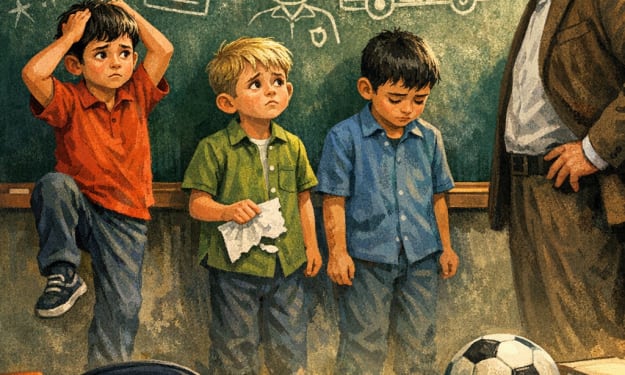
Sometimes a simple question reveals the most complicated truths of life. “What do you want to be in the future?” seems like an ordinary classroom topic, yet it uncovers the tension between childhood dreams, family pressure, financial limits, and imposed decisions.
By Ebrahim Parsa7 days ago in Fiction



Comments
There are no comments for this story
Be the first to respond and start the conversation.