
## Before the Smoke
### A night guard gets a message from a number that cannot exist—and it sends him running toward the one hallway that will catch fire first.

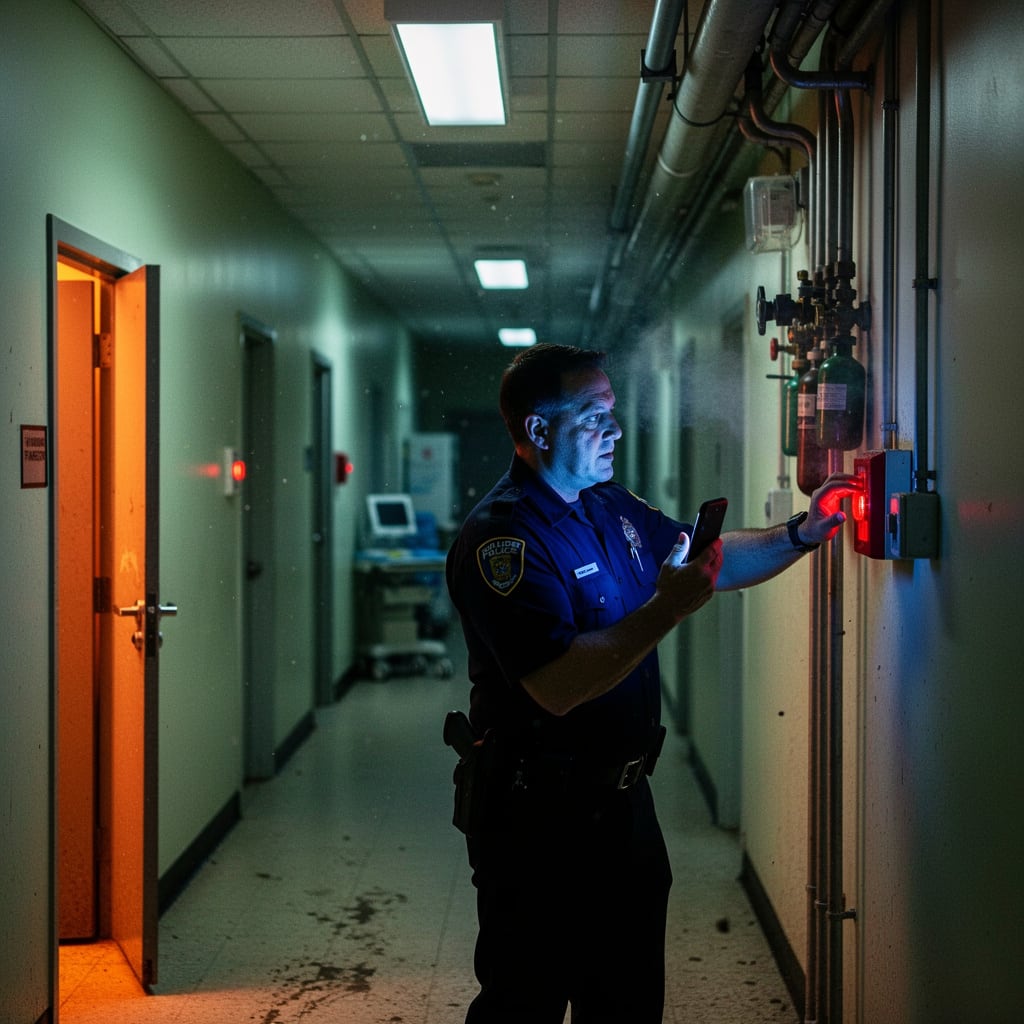
My phone buzzed at **3:07 a.m.**, and I almost ignored it.
Phones do not usually buzz during my rounds. Not like that. Not with that sharp little insistence that makes your stomach tighten before your brain knows why.
I was working security at St. Elara Children’s Hospital, walking the same quiet loop I had walked a thousand nights—checking doors, checking stairwells, listening to the building breathe through its vents.
The screen showed: **No Caller ID**.
One text.
Do not use the elevator.
Go to Stairwell B.
Third floor.
Door marked 3B.
Pull the red lever.
I stopped in the middle of the corridor and stared at it like it might change.
Who sends a message like that? And how did they know where I was in my rounds?
I typed back, “Who is this?”
No response.
A second buzz came almost immediately.
Four minutes.
That part got me moving.
Because pranks do not come with countdowns. And because hospitals do not forgive hesitation.
I walked fast without running, because running makes people ask questions, and questions waste time. My radio stayed quiet. The halls stayed quiet. The only sound was my own footsteps and the faint beeping of monitors behind closed doors.
Stairwell B was colder than the rest of the hospital, a concrete shaft that smelled like dust and old paint. The light above the door flickered once, then steadied, as if it had made up its mind.
I climbed.
Two flights up, my knee complained. I ignored it.
On the third floor, I found the door: **3B**.
It should have been locked.
It was not.
The moment I pushed it open, heat brushed my face—just a little, but wrong enough that my skin noticed before I did. The air smelled sharp, like plastic starting to melt.
I stepped into a narrow service corridor. No murals. No cartoon animals. Just utility doors, exposed piping, and that dry, electrical smell that never means anything good.
At the far end was a maintenance closet with a red lever mounted beside an oxygen junction panel.
The lever looked clean, almost new. Like someone expected it to be used.
My phone buzzed again.
Now.
I didn’t think. I reached and pulled.
A hiss answered immediately—pressure shifting through the lines as the system rerouted. The building didn’t scream, but it reacted, fast and decisive, like a body pulling back from pain.
Then the panel snapped.
A bright, ugly pop. A flash. And a thin tongue of flame licked up from the wiring.
I grabbed the extinguisher from the bracket and hit the base of the fire until the closet filled with white powder and my throat tasted like chalk. My eyes watered. My hands shook. I kept spraying until the flame died and stayed dead.
For a second, I just stood there, breathing hard, staring at the scorched edge of the panel.
**If I had been even one minute later, the fire would have found the oxygen line.**
And I didn’t let myself picture what that would have meant in a children’s hospital.
My radio crackled as I finally remembered to use it. “Security to Maintenance. Third floor, service corridor by Stairwell B. Electrical flare at oxygen junction panel. Fire is out. I need you here now.”
A nurse appeared at the corridor entrance, eyes wide. “What happened?”
“Small fire,” I said, voice rough from the extinguisher dust. “We stopped it.”
Her face tightened. “Any smoke in patient rooms?”
“Not that I can tell,” I said. “But we need vents checked.”
She nodded and disappeared, already moving. That is what nurses do: they do not freeze. They do not debate. They go.
The adrenaline wore off in an ugly wave, leaving me lightheaded. I leaned against the wall, wiped my palms on my uniform, and looked down at my phone.
No Caller ID. No name. No way to trace it.
I tried calling the number the text came from.
A recorded voice answered: “This number is no longer in service.”
I tried again, because denial is stubborn.
Same message.
My hands started shaking again, and this time it wasn’t from smoke.
I walked back toward the main corridor, passing the closed doors where kids slept under warmed blankets, their parents curled into chairs that never quite look comfortable. I have seen those chairs. I have sat in those chairs.
Years ago, my daughter, Amina, was a patient here.
She made it through. She grew up. She got older. I stayed on night shifts, telling myself I was doing what I had to do.
And somewhere along the way, “what I had to do” became the excuse I used for everything I missed.
We stopped talking after one last argument that didn’t feel dramatic at the time. Just tired. Sharp around the edges. She told me I always showed up for strangers and never showed up for her. I told her she didn’t understand how much pressure I was under.
It was the kind of fight that ends with silence instead of resolution.
My phone chimed again.
Voicemail.
No number. No ID.
I pressed play.
Static for a breath.
Then a voice, steady and familiar enough to steal the air from my lungs.
“Dad,” Amina said softly, “if you’re hearing this, it worked.”
My knees went weak. I sat down on the nearest bench like my body made the decision for me.
“This is going to sound impossible,” she continued. She sounded older than the last time I heard her—older, tired in a way that scared me. “But I remember the night the third-floor oxygen panel caught. I remember what happened after. And I remember you carrying it for the rest of your life.”
My eyes stung. I blinked hard, but it didn’t help.
“I’m not sending this to punish you,” she said. “I’m sending it because I know you. You wait. You tell yourself you’ll call when things calm down.”
A pause, and I heard her breathe.
“Things don’t calm down, Dad. Life just keeps taking turns.”
My throat tightened around her name.
“Tonight you ran,” she said. “You didn’t talk yourself out of it. You didn’t decide it was someone else’s problem.”
Another pause, gentler this time.
“Now do that for us,” she said. “Call me first. Not later. Not when you feel ready.”
The message ended.
I sat there in the too-bright hallway, listening to the hospital return to normal—carts rolling, distant footsteps, a muted announcement over the intercom.
I stared at my contact list until my vision cleared enough to read it.
Amina.
My thumb hovered, heavy with all the days I had convinced myself silence was safer than trying.
Then I pressed call.
It rang once.
Twice.
On the third ring, she answered, wary and awake.
“Hello?”
I swallowed hard. “Amina. It’s Dad.”
Silence, and then a small exhale like she’d been holding something in.
“Why are you calling?” she asked. Not angry. Just careful.
Because a building almost burned. Because a message saved lives. Because I heard your voice and realized how close you can get to losing someone without ever saying goodbye.
But what came out was simpler. Human. True.
“I should have called a long time ago,” I said. “I’m sorry.”
Another pause.
“I don’t know what to do with that,” she whispered.
“You don’t have to do anything right now,” I said. “Just let me be here. Let me start showing up.”
Her breath shook, and for a moment I thought she would hang up.
Then she said, quietly, “Okay.”
**And for the first time in years, I didn’t feel like I was too late.**
About the Creator
Our Song
Evening has given way to night. Gently, I settle next to you on the comfortable, old love seat and reach for your hand. You snatch it away, again. It cuts me to the quick, but I hide the pain, understanding that the reaction is but part of your demented state. Since the accident, your presence here in our cozy home has been clouded by a haze I can't see. Nevertheless, I feel the frigidity of your expressions and it serves as an excruciating reminder of the immeasurable distance between us.
By Dana Crandell4 days ago in Fiction
At 2:14, the Earth Listens
The first time Mara noticed the hour, she assumed it was coincidence. 2:14 a.m. The clock on her bedside table glowed that soft, watery green that feels almost alive in a dark room. She had rolled over half-asleep, arm searching for Elias out of habit, and instead of warm skin she found cold sheets and the faint dip of where his body had been moments before.
By Lawrence Lease4 days ago in Fiction
Lately, I'm empty
Lately, I feel an emptiness inside of me that doesn’t make any sense. I was fine a week ago and now I’m numb to the pain that I’ve been carrying around. Numb to the idea of me existing. I wish I could go to a place where I can hear happy positive thoughts and surround myself with joy. The medication I’m on doesn’t seem to work anymore. I still feel pain from existing, why am I here anyways? Merely to exist. I don’t feel like I’m making any differences being here.
By Cerina Galvan5 days ago in Confessions


Comments (1)
WOW