
It was in the barn, one of those days when it was hard to remember whether my father were still alive. Late autumn, with the sky slate-grey overhead.
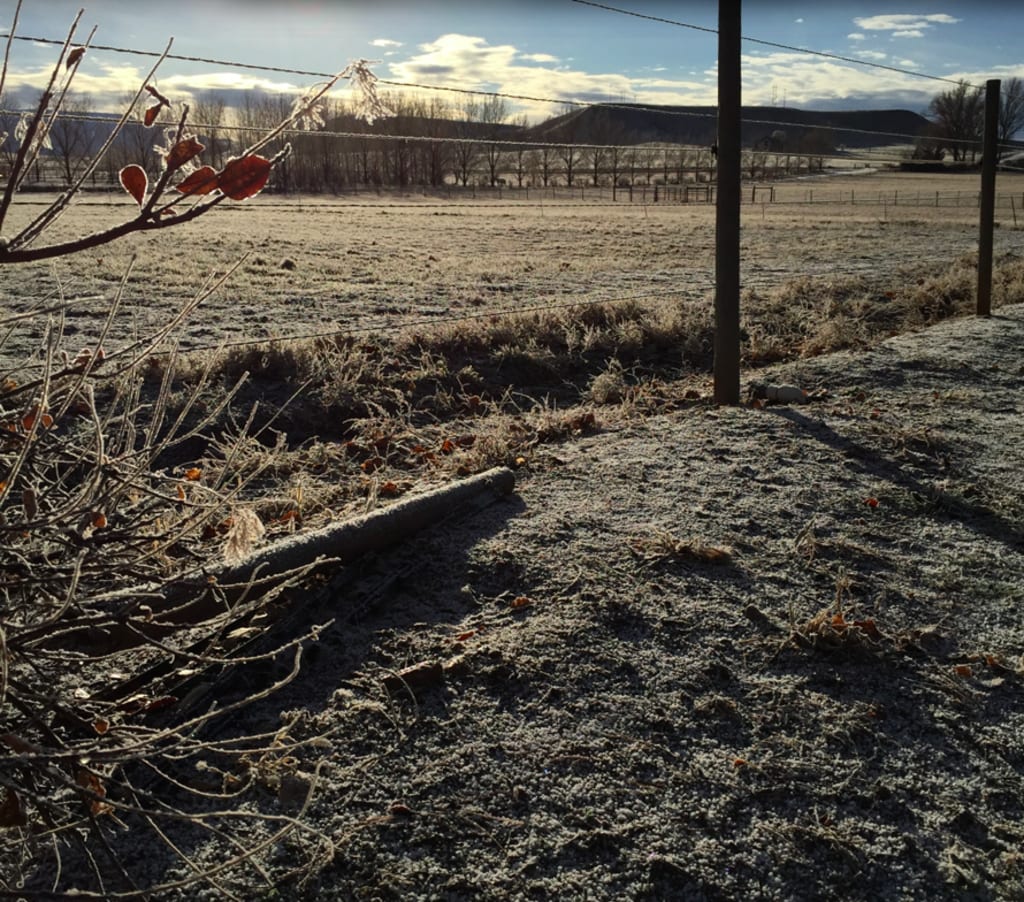
Only a few trees hung onto their leaves, withered crisp and rattling in a breeze colder than the air, sharp as a toothache. The skin of my knuckles had grown rough and brittle against the inside of my work gloves as I flexed my fingers against the creeping chill. Soon, like every year, crusts of ice would have to be broken off the watering troughs each morning and evening. Just like in those years when, with my hands around the handles of small shovels, I was always trying to match my father’s pace, always watching for the small nods of his approval. I flexed my fingers again, the memory of the resistance of ice kicking into my wrists.
The fields and orchards were brown, even the last apple picked or fallen, but still there was always more to do than a single day could hold. Fences, leaned-on throughout the spring and summer by the chests of mules, now canted over, their wires slackened. The posts would need to be righted one-by-one, with shovel and tamper, and the wires hauled taut, snipped and respliced before frost turned the ground hard. Locked in the corral until morning, the mules snorted and stamped their hooves, missing the grass of summertime pastures.
Dusk was drawing near, the shadows deepening inside the barn’s open double doors. I thought of the owl who we would sometimes see tucked into the eaves, watching us finish our chores in those last moments before the day faded. “Tyto alba,” my father had said, the second or third time we’d caught the owl’s eyes on us. “A barn owl,” he continued, seeing the question on my face. A smile crinkled the corners of his eyes as they met mine. “Pretty fitting home for him, isn’t it?”
“Yes,” I answered now, to nobody. The wind sent a twist of dust along the sandy floor.
I leaned my tools against the wall next to the corner where the siding was still splintered. Months before, my father had crashed his truck into the barn, passing out with the oxygen lines in his nostrils. When I had answered my phone, there was a pause, like someone gathering their breath before stepping into the snow. Then, my mother’s voice, flat and even as new-printed ink: “I think you need to come home now.” The sunlight through the windows had flared in my eyes, freezing each dust mote glinting in the suspended afternoon air.
The man came in behind me, footsteps silent on the sand, and was already halfway into shadow when I turned, expecting no one, and saw him there. He stopped, staring at me with the right side of his mouth drawn up into a grin, the whites of his eyes bright in the dimness. I stood up straighter. Neither of us spoke, but he kept grinning his half-sided grin, eyes now flickering around the inside of the barn, head bobbing on his shoulders like a listening bird, chest swelling toward me. Then he spun on his left foot and stepped deeper into the dusty shadows, his splayed-fingered hands waving out from his body palm-down. He swayed past my father’s tractor and its implements, always just managing not to stagger. I stood silent. The way his hands sliced the air and the brightness of his eyes felt like the butt of a palm against my chest.
In a clatter, he ran up the stairs into the loft, and I backed out the double doors.
When I got to the house, I could not find my parents, and remembered after a moment that there was only my mother to find. The backyard, too, was empty. Not a single one remained of the big, sharp-toothed dogs of which my father was always so proud, the last of them having gone just after he had gone. But the mules were gathered at the edge of the corral, ears turned toward the barn. Even from the living room windows, I could see the flare in their nostrils.
The man who used to work for my parents, who had lived in a rusting travel trailer behind the barn, had had to leave two months earlier. I could not stay the winter, and soon it would be only my mother and the mules. Who was this stranger who had walked straight into our barn, who now crashed about in the loft, making the wide-eyed mules’ nostrils flare? Would he have walked so readily past my father’s broad shoulders? So readily as he had past me, who had said nothing, who had only stood still with something spreading inside me like cracks in ice.
I could pick up the phone and call the sheriff. They would come, would take him away for trespassing, for leaping the barbed wire of rural law. But if he were ill? If he were harmless?
I had been places where people talked to themselves, people upon whom jail cell walls would only collapse. I did not wish to be so small and fearful as to throw someone into those teeth. But the glint in his eyes and the way he loomed toward me before dipping into the shadows—
My mother would soon be alone. I worried the knuckles of clenched fists against the seams of my jeans and waited, my eyes trained on the barn.
Dusk gathered quickly, a bluing in the grey of the sky, a color like the edges of an old bruise slipping along the western horizon. The sun had set without fire behind the pall of cloud.
Then the hay door of the loft rolled open.
The man stepped onto the 6x6 beam that jutted out into the air beneath the doorway. Fifteen feet above the hard-packed ground he perched, and then hopped forward, nearly to the beam’s end, before spinning around to hop in the other direction. His arms windmilled, his head bobbing on his neck and his body snapping back and forth like a flag in the wind. I had to call someone now, someone to save him. I tried to imagine my own feet on the uncertainty of that narrow beam, tried to imagine the feeling of plummeting headlong, but the only visions that came were the fall of my dog when he overshot the pickup’s bed, the shattered glass of car headlights, the hopping of a broken-footed rabbit in the dried grass of the farthest field.
The man leapt off the end of the beam, spreading dark wings and folding into the sky.
About the Creator
Keep reading
More stories from writers in Fiction and other communities.
The Lesions of Devotion
Every day I set myself down on the freshly cut lawn and strip myself bare. I take my guitar and finger the frets and pick at the strings, listening for dissonance. My life is dissonance. I twist the tuning pegs until each string sounds bright. Then I kneel, calves pointing behind me, kneecaps facing forward. All exposed to the breeze. I close my eyes and play the melody.
By Paul Stewart7 days ago in Fiction




Comments
There are no comments for this story
Be the first to respond and start the conversation.