
When They Stop Listening
How to Rebuild Connection When Your Kids Resist Your Voice.

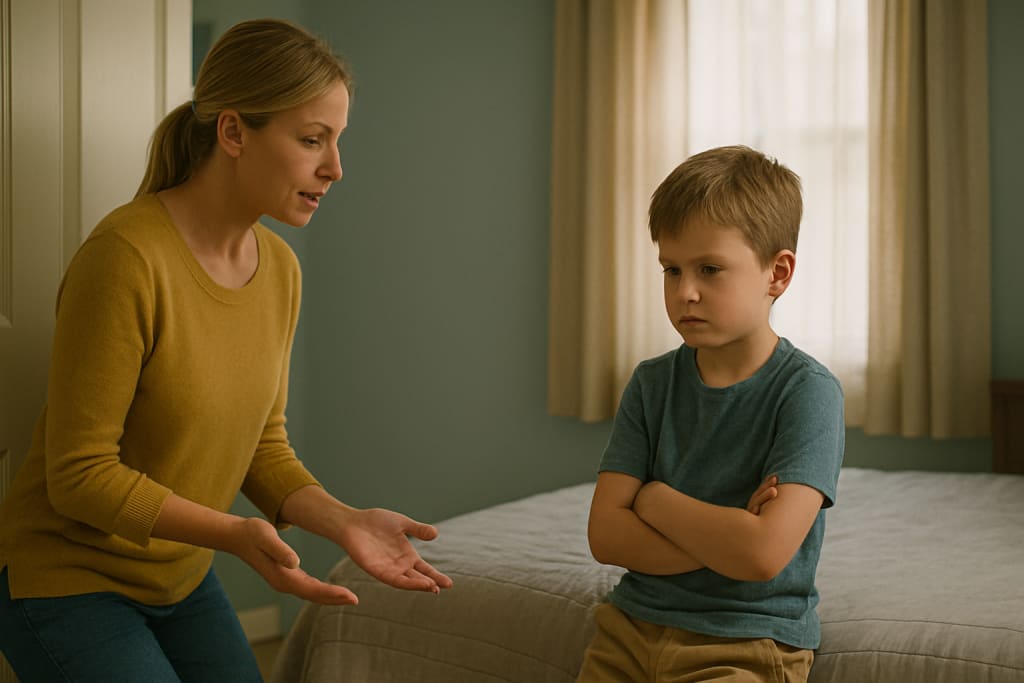
There comes a time in every parent’s life when their child—who once held their hand and soaked in their every word—suddenly stops listening.
The change is rarely dramatic. It’s subtle, almost imperceptible at first. A silent “no” when asked to clean up. A roll of the eyes during a conversation. A refusal to answer a call. Then it escalates: Defiance replaces compliance, distance replaces connection, and communication becomes a battlefield of misunderstandings.
It hurts. It frustrates. And it leaves many of us asking: What happened?
The Myth of Obedience
We’re conditioned to believe that obedient children are well-behaved children. That when our children listen, it reflects our skill and love as parents. So when they stop, it feels like a personal failure.
But here’s a truth that many people forget: Obedience is not the goal. Connection is.
Children are not meant to blindly obey — they are meant to grow into people who think critically, express needs, and understand boundaries. Sometimes, their “disobedience” is actually a signal of deeper emotional needs — a cry for freedom, attention, understanding, or control over their environment.
Behind the Resistance
When my daughter turned nine, she stopped listening. Not all at once — but in small, painful doses. My pleas for help were ignored. My reminders were met with a strong reaction. She started saying “no” — not unkindly, but coldly. We were drifting apart.
It wasn’t until I stopped reacting and began observing that I saw what was beneath her resistance. She was overwhelmed — school was difficult, friendships were complicated, and she was entering a phase of discovering her voice.
She wasn’t trying to hurt me. She was trying to listen.
The shift begins with us.
The hardest truth of parenting is this: The only behavior we can truly control is our own. If we want our children to start listening again, we must first listen to ourselves.
- Are we yelling more than we speak?
- Are we rushing more than we explain?
- Are we demanding more than we connect?
Children mirror what they see. If we model respect, presence, and patience - over time, they will reflect it.
5 Steps to Reconnection
Pause before you react: If your child ignores or teases you, pause. Take a breath. Respond, don't react. Modeling calmness shows strength, not weakness.
Be curious, not angry: Ask yourself: Why is this behavior happening now? Often, resistance is a symptom, not a cause.
Offer options: Giving kids control over small things helps them feel empowered. Instead of “Put your shoes on now,” try: “Do you want to wear blue shoes or red shoes today?”
Validate feelings, then guide behavior: Say, “I see you’re upset. You need to clean up. It’s okay to feel that way. Let’s do it together.” Validation builds trust.
Make amends when you mess up: Apologizing when you lose your temper doesn’t undermine your authority—it deepens respect. “I yelled at you earlier. I was frustrated, and I’m sorry. Let’s try again.”
Rebuilding takes time.
Reconnecting isn’t okay once. It’s a daily practice of showing empathy, boundaries, and open ears. It’s about moving from your child’s strength to your child’s power.
After weeks of changing my responses, my daughter changed. At first a little bit – a smile instead of silence, an “okay” instead of “no.” Then more. She started talking again. Until one afternoon she asked for help – not because she had to, but because she wanted to.
I realized she had never stopped listening. She had stopped hearing the love in my words.
The real question
When your child stops listening to you, don’t ask: How can I get them to listen?
Ask: How can I make them feel safe enough to trust me again?
Because in the end, parenting isn’t about raising obedient children.
It’s about raising people who feel heard, valued, and loved – even when they say no.
About the Creator
Echoes of Life
I’m a storyteller and lifelong learner who writes about history, human experiences, animals, and motivational lessons that spark change. Through true stories, thoughtful advice, and reflections on life.
Keep reading
More stories from Echoes of Life and writers in Families and other communities.
The Defiant Stage
We All Fear It - "The Stage." Broken Doors. Scornful Responses. Refusal to Hear the Simplest Requests. Suddenly, Your Once-Acceptable Child Becomes a Storm of "No!" and "You Can't Make Me!" Defiance Blooms Like an Unexpected Weed in Your Home Garden.
By Echoes of Life6 months ago in Families
After the Storm
After the storm of winter snow there sat a small bear by the name Ted, of course. He loves the snow and likes to roll around in it making all sorts of trails and whatever he has a mind to do. He wondered where all the people are, but in a way, he is hoping that they are all snug in the homes maybe drinking hot chocolate-one of his favorite drinks with mini-marshmallows and eating something homemade for he likes this winter wonderland all to himself to romp and play and maybe even catch some fish down by the river.
By Mark Graham7 days ago in Fiction




Comments
There are no comments for this story
Be the first to respond and start the conversation.