
My Mother Learned to Text at 63
A funny but emotional story about generational gaps — until one day her texts stop coming.

My mother got her first smartphone at sixty-three because the flip phone finally betrayed her.
“It swallowed my message,” she said, holding it up like evidence in a courtroom drama. “I wrote to your aunt Shazia that the biryani needed more salt and now it says ‘Message Failed.’ How can a message fail? It had all the ingredients.”
I bought her a smartphone the following weekend.
She held it the way one holds a fragile bird—firm enough so it won’t escape, gentle enough so it won’t die. I showed her how to swipe. She swiped too hard. I showed her how to tap. She pressed like she was trying to stamp a passport.
“It’s not a doorbell,” I said. “You don’t have to ring it with force.”
For the first week, she called it “the machine.”
“The machine is asking for an update.”
“The machine is angry.”
“The machine is listening.”
When I introduced her to texting, she looked personally offended.
“If I want to speak, I will call,” she said. “Why would I write when I can talk?”
“Because,” I said, “sometimes people are busy.”
She stared at me the way only mothers can. “Busy with what?”
Still, she tried.
Her first text to me arrived at 9:42 p.m.
HELLO
No punctuation. No emojis. Just HELLO in aggressive capital letters, as though she were announcing her arrival at the gates of modernity.
I replied: Hi, Mom 😊
Five minutes passed.
Then:
WHY IS YOUR FACE YELLOW
I laughed so hard I dropped my phone.
That was the beginning.
Soon she discovered emojis and used them with reckless abandon. If I said I was tired, she sent ten crying faces and a dancing lady. If I said I got a promotion, she sent a thumbs-up, three roses, a cake, a camel, and what I think was a satellite.
“I like the pictures,” she explained. “They make the words less lonely.”
Her spelling became its own dialect.
“Are you at the ofice?”
“Don’t forget to west your jacket.”
“I made your faborite dish.”
I never corrected her. It felt sacred somehow—these small mistakes traveling across invisible wires from her kitchen to my pocket.
Sometimes she texted as if she were still speaking out loud.
“Call me when you are free because I want to tell you something but not serious don’t worry nothing happened just call.”
Other times she sent voice notes by accident. Entire monologues meant for the neighbor somehow reached me.
“Tell Farah I saw her husband parking badly again—oh no, is this recording?”
I saved those.
The generational gap was most obvious in our arguments.
If I didn’t reply within ten minutes, she texted:
???
Then:
Are you alive
Then:
Answer me
I once told her I was in a meeting.
“Why can’t you text in the meeting?” she asked. “Is it a wedding?”
She didn’t understand “Do Not Disturb.” She thought it was an insult.
“Why would I not disturb you? I am your mother.”
Fair point.
Over time, her texts became a rhythm in my day.
8:03 a.m.
Good morning. Eat breakfast.
1:17 p.m.
Did you eat
6:40 p.m.
It looks like rain take umbrella
10:55 p.m.
Sleep now enough phone
I teased her once. “You have become very modern, Mom.”
She smiled, proud and slightly smug. “I am evolving.”
And she was.
She started sending me photos—blurry, usually of her forehead. Or half a tomato. Or the ceiling fan mid-spin. But occasionally, perfectly framed pictures of the sunset from our old balcony.
“Look,” she wrote once, “the sky is wearing pink today.”
She had always noticed small things like that. Texting simply gave her a new way to point at them.
Then one afternoon, in the middle of a long, dull workday, my phone buzzed.
I miss you.
That was it.
No emoji. No extra commentary. Just four words.
I stared at them for a long time.
I replied: I miss you too, Mom. I’ll visit this weekend.
She responded almost instantly.
Ok ❤️
The red heart. Her first time using it correctly.
The silence began on a Tuesday.
I sent her my usual morning text:
Morning, Mom.
No reply.
I assumed she was at the market or gossiping with the neighbors. By noon, I tried again.
Did you eat?
Still nothing.
A small, unreasonable irritation crept in. This was ironic—after years of her demanding instant responses, I now expected the same.
By evening, the irritation turned into something else.
I called.
No answer.
I called again.
On the third attempt, my father picked up.
His voice was steady in the way voices try to be when they have bad news.
“She felt dizzy this morning,” he said. “We’re at the hospital. It’s nothing dramatic. Just tests.”
Nothing dramatic.
Hospitals are full of “nothing dramatic.”
The waiting room had terrible Wi-Fi.
I kept checking my phone anyway.
It felt wrong—sitting there without her small digital interruptions. No reminder to drink water. No question about whether I had ironed my shirt. No random camel emoji.
I scrolled through our old messages instead.
HELLO
WHY IS YOUR FACE YELLOW
Are you alive
Sleep now enough phone
Hundreds of tiny threads stitching the ordinary days together.
I realized something quietly devastating: her texts had been proof of her presence. Not grand gestures, not long conversations—just constant, gentle taps on the glass of my life.
I am here.
I am thinking of you.
I am still your mother.
The doctor eventually said the word “stroke,” but followed it quickly with “mild” and “manageable.” They spoke about rest and monitoring and medication.
She was conscious when I saw her. Pale, tired, but unmistakably herself.
“Why are you crying?” she whispered, annoyed. “I only fainted.”
“You didn’t answer my texts,” I said, because somehow that felt like the real emergency.
She gave a weak smile. “The machine was charging.”
Even then.
She stayed in the hospital for a few days.
Each morning, I sent her a message from the chair beside her bed.
Good morning.
Her phone rested on the tray table, screen dark. The nurses said she should rest, no strain.
I waited for the buzz that didn’t come.
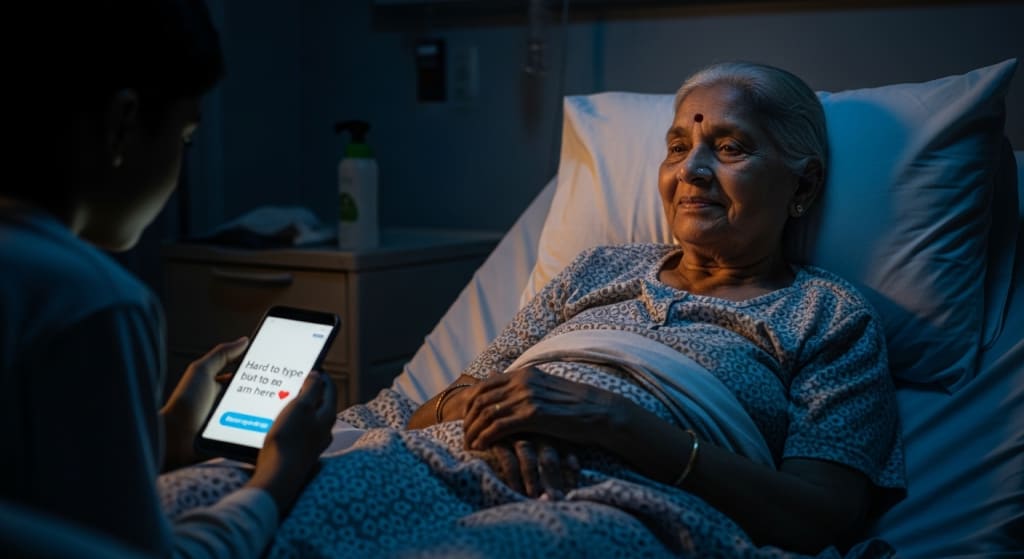
On the fourth day, as I was half-asleep in the plastic chair, my phone vibrated.
I jolted upright.
It was from her.
Hard to type
letters small
but I am here
And then, after a pause:
Eat breakfast
I laughed and cried at the same time.
Across the room, she looked at me, pretending innocence.
“They make the letters too small,” she complained softly.
I walked over and adjusted the font size, making the words big and bold.
“There,” I said. “Now the machine won’t swallow your messages.”
She squeezed my hand.
Her texts are slower now. Shorter. Sometimes just a heart. Sometimes just a thumbs-up.
But they come.
And every time my phone buzzes, I don’t see pixels or spelling mistakes or misplaced camels.
I see a sixty-three-year-old woman standing bravely at the edge of a new world, tapping at the glass until it answers back.
I see proof of life.
HELLO.
About the Creator
Fawad Ahmad
Storyteller from the United States sharing tales that inspire, entertain, and make you think. Follow for weekly stories and creative adventures!" ✍️🌟
Keep reading
More stories from Fawad Ahmad and writers in Families and other communities.
Senior Care Services That Support Better Sleep, Comfort and Daily Well-Being
The tranquility of the night usually stands out as the best indicator that the elderly are receiving proper care. Once an aged person wakes up fresh, moves freely and feels at ease emotionally, everyday life is significantly improved. Sleep is known to promote mobility, memory and mood and thus is a pillar of general well-being.
By Laura Parton4 days ago in Families
What Makes Senior Care Services Truly Comfortable and Caring?
It tends to complete in the same silent manner, where a senior eventually gets to sleep correctly, wake up without any form of disturbances and feel safe in their own environment. Such a feeling of coziness is never incidental. It is very well constructed, step by step, with careful thoughtful choices of care. To learn more about what actually constitutes senior care services being comfortable and caring, it is better to start at the end and go in reverse.
By Laura Parton4 days ago in Families




Comments
There are no comments for this story
Be the first to respond and start the conversation.