
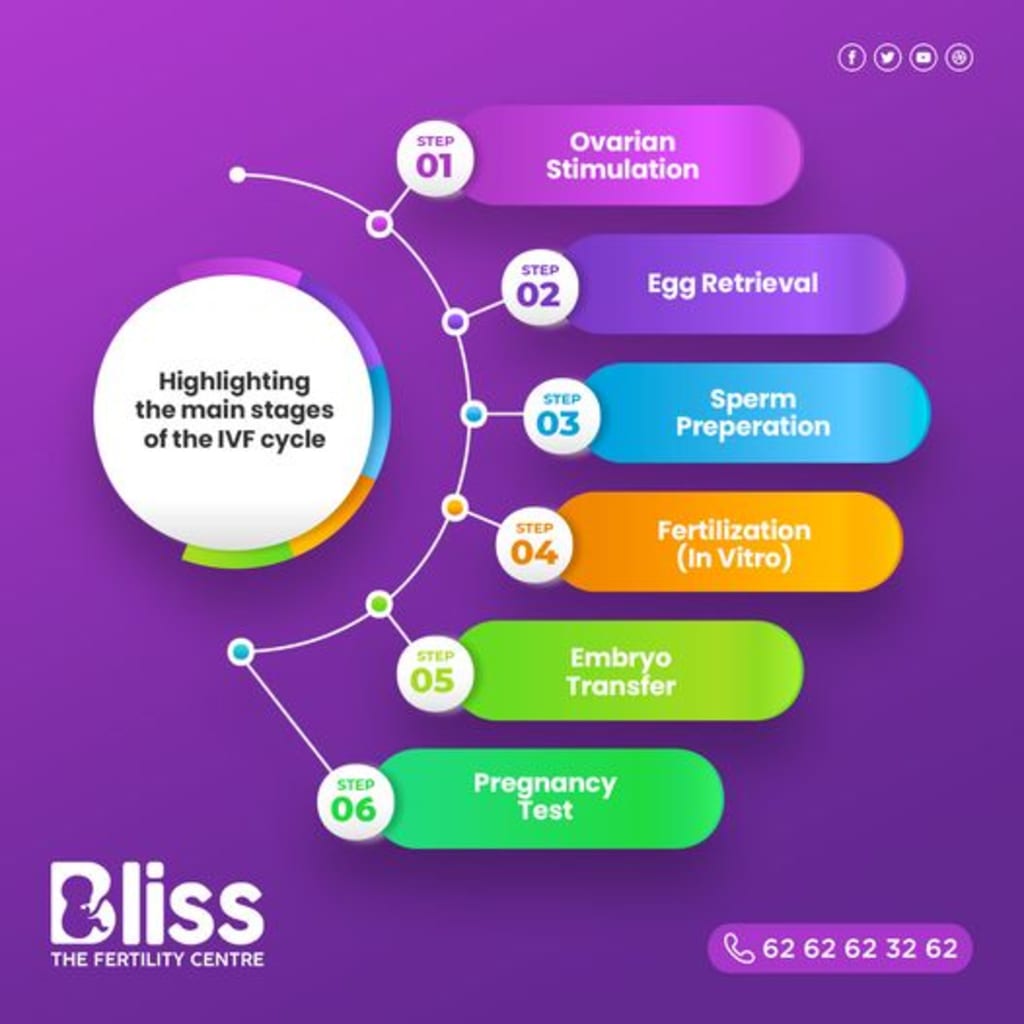
What are the 6 Stages of IVF?
The IVF process includes five key steps:
1- Ovarian stimulation
2- Egg retrieval
3- Sperm collection/retrieval
4- Fertilization & embryo development
5- Embryo transfer
6- Pregnancy Test
1-Ovarian stimulation
Whether you are using your eggs or an egg donor, your doctor will prescribe injectable hormones or other medications to stimulate the ovaries to produce several eggs instead of just one egg that normally develops each month. This helps increase the chances of having at least one viable embryo to use during the IVF procedure.
You will need several different fertility medications to stimulate ovarian follicles (cysts that contain microscopic eggs) ranging from a follicle-stimulating hormone (FSH), a medication to help eggs mature and prepare the lining of your uterus to hold the fertilized egg. Ovarian stimulation typically occurs over 10 days before your eggs are ready for collection. During this time, you can expect a vaginal ultrasound to monitor your ovarian follicles and blood tests to watch your estrogen levels. Once we determine your follicles are adequate size, measured by ultrasound, we can move on to the egg retrieval process.
2-Egg retrieval
Egg retrieval is typically performed as an office-based procedure in your doctor’s office about 36-hours after the final “trigger shot” to mature the eggs. The timing of the egg retrieval is critical because waiting much longer than 36 hours risks ovulation and the loss of some or all the eggs.
The procedure involves receiving intravenous sedation followed by a transvaginal ultrasound guided needle aspiration to carefully retrieve the eggs from each follicle. In about 20-minutes, multiple eggs are typically removed. The eggs are then placed in a culture medium and sperm are added later in the day for fertilization. Following the procedure, you will experience some cramping after the procedure for which you will be prescribed medication for relief.
3- Sperm retrieval
If you are using a partner’s sperm, you will be asked for a semen sample the morning of the procedure. Donor sperm can also be used. Or, in some cases, the sperm can be harvested in advance and frozen. There are several ways to harvest sperm from men depending on the primary fertility and health. In some instances, it may be necessary to harvest sperm surgically.
4- Fertilization
There are two primary methods of fertilization during IVF:
Conventional insemination mixes healthy sperm and eggs in a laboratory petri dish and leaves them to incubate overnight for natural fertilization ICSI, or intracytoplasmic sperm injection, involves the injection of a sperm into each egg to overcome male factor infertility or when testicular sperm are used.
Once the sperm and egg have been combined, your medical team waits up to 20-hours to determine if fertilization has taken place. The fertilized eggs then may be allowed to grow in the lab for up to six days before moving on to step five.
There are also other techniques that your doctor may recommend before step five, including:
Assisted “hatching” is used in certain circumstances to create a tiny incision into the shell of the embryo right before embryo transfer to increase implantation.
Preimplantation genetic testing (PGT) allows for genetic testing of the embryos prior to transfer to determine if the embryo is chromosomally normal and/or to screen for certain genetic diseases based on your genetic screening. Following PGT, which occurs on embryo development day five or six, the embryos are frozen to await the analysis results.
5- Embryo transfer
Two to five days after the eggs are retrieved, based on your individual situation, you will visit your doctor’s office again for the embryo transfer. You will remain on hormones prior to the visit, and throughout the first trimester, to support your uterine lining, called the endometrium.
The embryo transfer consists of the doctor inserting a soft, flexible tube (catheter) into your uterus through the cervix under ultrasound guidance. Then the embryos (or embryo) are carefully injected into your uterus. If there are any additional viable embryos, it may be possible to freeze them for later pregnancy attempts.
After the embryo transfer procedure, you can usually resume all normal activities, including exercise, but it’s a good idea to avoid intercourse until the pregnancy test. You may feel mildly bloated or have breast tenderness. Cramping or passing a little bloody fluid may represent embryo implantation.
Less than two weeks after the embryo transfer procedure, your doctor will run a blood test to determine whether you are pregnant and, if so, your test will be repeated in two days. As long as your blood hormone level (hCG) is rising appropriately, a vaginal ultrasound is scheduled approximately three weeks later to view the health of the pregnancy.
Keep in mind that you may become pregnant on the first try—but you may not. It’s good to think of your IVF journey as potentially multiple embryo transfers perone egg retrieval and less as an individual medical treatment.
If anyone want to more about IVF follow Bliss Fertility Centre Kottayam. There consistently delivers top IVF success rates and provides the best IVF treatment in Kerala .For more information freely contact 6262623262.
About the Creator
bliss fertility
Bliss Fertility Centre consistently delivers top IVF success rates in Kerala.Leading Fertility Centre in Kottayam Provides the best IVF treatment.Top Fertility Centre In Kottayam guarantee your pregnancy.
https://blissfertility.in/
Keep reading
More stories from writers in Families and other communities.
The Last Soldier Standing
The day I had my heart attack, the doctors told me I needed rest. Real rest. The kind where you let other people take care of you for once. I nodded, because that’s what polite patients do, but the truth was already forming in my mind like a command I couldn’t disobey.
By Lizz Chambers4 days ago in Families
He was 3,000 miles away these signs told me he wanted to marry me
He was 3,000 miles away these signs told me he wanted to marry me The video call froze on his face. Not on a grand declaration or a romantic moment just him, mid-sentence, talking about his lease renewal. "I told them I might need a two-bedroom," he said. "You know. For when you visit. Or if you ever..."
By Understandshe.com4 days ago in Families




Comments (1)
Thanks for sharing your experience, it's really appreciated. Thanks to such a phenomenon as donation, infertile women got a chance to have a child. Now everyone has the opportunity to create a family, I advise you to learn more about all the features here https://ovogenebank.com/blog/egg-donation-in-australia-all-you-need-to-know.html