
Why the Moon Appears Larger Near the Horizon
Have you ever watched a full Moon rise and felt amazed by how enormous it looked near the horizon — only to notice later that it seemed much smaller once it climbed higher into the sky? This striking visual effect, often called the “Moon illusion,” has fascinated humans for centuries. The Moon does not actually grow in size when it is near the horizon. Yet to our eyes and brain, it clearly appears larger. So what causes the Moon to appear bigger near the horizon? The answer lies not in astronomy alone, but in psychology, perception, and how our brains interpret visual information. In this detailed guide, we’ll explore the science behind the Moon illusion, why it happens, what role Earth’s atmosphere plays, and how you can test it yourself

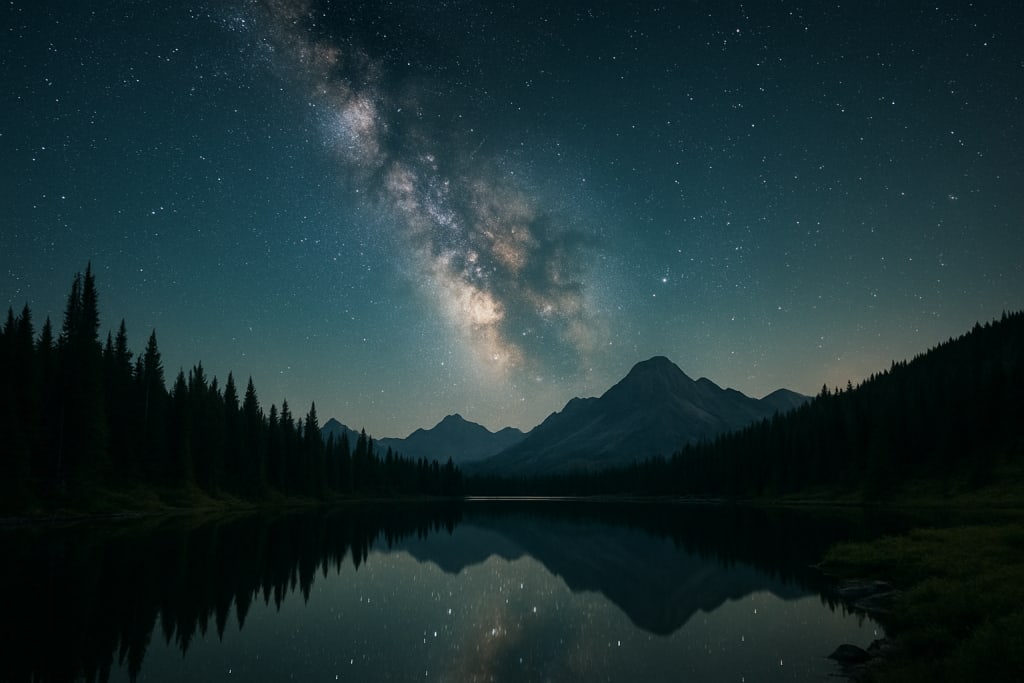
Is the Moon Really Bigger Near the Horizon?
The short answer is no.
The Moon’s physical size does not change during the night. In fact, when the Moon is near the horizon, it is actually slightly farther away from you than when it is overhead. That’s because when it’s overhead, you are about one Earth radius (roughly 6,371 kilometers) closer to it than when it’s on the horizon.
The difference is tiny — about 1–2% — and far too small to explain the dramatic size difference we perceive.
So if the Moon’s size doesn’t actually change, why does it look so much larger?
________________________________________
Understanding the Moon Illusion
The phenomenon is known as the Moon illusion. It is a perceptual effect, meaning it originates in the human brain rather than in the Moon itself.
When the Moon is near the horizon, your brain interprets it differently because of visual context cues — objects like trees, buildings, mountains, and the distant landscape.
When the Moon rises, it appears alongside familiar foreground objects. Your brain compares its size to those objects and subconsciously concludes that it must be very large.
When the Moon is high overhead, there are no reference points. The sky appears vast and empty, so the Moon seems smaller by comparison.
________________________________________
The Role of Depth Perception
One leading explanation for the Moon illusion involves depth perception.
Your brain interprets the sky as a flattened dome. The horizon appears farther away than the overhead sky. When the Moon sits near the horizon, your brain assumes it is farther away than when it is directly above you.
If two objects appear the same size but one seems farther away, your brain interprets the farther object as physically larger. This is called size-distance scaling.
In simple terms:
• The horizon Moon looks farther away.
• If it’s farther but appears the same size, your brain assumes it must be larger.
• Therefore, it looks bigger.
________________________________________
Atmospheric Magnification: A Common Myth
Many people believe Earth’s atmosphere magnifies the Moon near the horizon, like a lens. This is not true.
The atmosphere can slightly distort the Moon’s shape, sometimes making it appear squashed or reddish. However, it does not significantly magnify it.
In fact, atmospheric refraction actually makes the Moon appear slightly smaller vertically when it is low in the sky.
The perceived enlargement is almost entirely psychological.
________________________________________
Historical Curiosity About the Moon Illusion
The Moon illusion has puzzled thinkers for over 2,000 years.
Ancient Greek philosophers like Aristotle speculated about atmospheric effects causing the illusion. However, modern science has shown that perception plays the dominant role.
Even today, neuroscientists and psychologists study this phenomenon as a window into how the human brain constructs reality.
________________________________________
Why Photographs Show the Truth
If you take a photo of the Moon near the horizon and compare it with a photo taken later in the night using the same zoom level, you’ll notice something surprising:
The Moon is the same size in both images.
Cameras capture the Moon’s angular size accurately. Unlike the human brain, they don’t reinterpret distance based on visual cues.
This is why the illusion disappears in photographs.
________________________________________
Angular Size: The Real Measurement
The Moon’s apparent size in the sky is measured by its angular diameter, which averages about 0.5 degrees.
Whether the Moon is rising, setting, or directly overhead, its angular size remains nearly constant throughout the night.
The only time the Moon’s apparent size changes significantly is during its elliptical orbit around Earth.
________________________________________
Supermoons and Perigee
The Moon does not orbit Earth in a perfect circle. Its orbit is slightly elliptical. This means there are times when it is closer to Earth (perigee) and times when it is farther away (apogee).
When a full Moon occurs near perigee, it is called a supermoon. During these events, the Moon can appear about 14% larger and 30% brighter than when it is at its farthest point.
The Moon’s orbit around Earth creates this variation, but it is separate from the horizon illusion.
A supermoon near the horizon can look especially dramatic — combining real size increase with perceptual exaggeration.
________________________________________
Why the Horizon Enhances the Effect
The horizon is filled with visual information:
• Trees
• Buildings
• Mountains
• City skylines
These objects give your brain distance references.
When the Moon rises behind a skyline, your brain processes it as enormous because it appears beyond those objects.
When the Moon is overhead, the empty sky offers no scale comparison.
________________________________________
The Ponzo Illusion Connection
The Moon illusion is often compared to a psychological phenomenon called the Ponzo illusion.
In the Ponzo illusion, two identical objects appear different in size because of background perspective cues. Railroad tracks that converge in the distance can make a distant object appear larger.
Similarly, the horizon provides perspective cues that trick your brain into enlarging the Moon.
________________________________________
The Flattened Sky Theory
Another explanation suggests that humans perceive the sky as a flattened dome rather than a perfect hemisphere.
If your brain assumes the horizon is farther away than the zenith (point directly overhead), then an object near the horizon appears farther away.
Again, if something looks farther but maintains the same angular size, the brain concludes it must be physically larger.
________________________________________
Color and Atmospheric Effects
When the Moon is near the horizon, it often appears more orange or red. This happens because its light passes through more of Earth’s atmosphere.
Shorter blue wavelengths scatter more easily, leaving behind longer red wavelengths — similar to how sunsets appear red.
Although color change does not cause magnification, the warmer hue may enhance the dramatic appearance of the rising Moon.
________________________________________
Can You Break the Illusion?
Yes.
Here are simple ways to test it:
1. Use Your Finger
Hold your thumb at arm’s length and compare it to the Moon near the horizon. Do the same when the Moon is overhead. You’ll see it covers the same amount of space both times.
2. Bend Over
Look at the Moon upside down by bending forward and viewing it between your legs. This removes foreground context cues, and the Moon may suddenly appear smaller.
3. Take a Photo
Photograph the Moon at different positions using identical zoom settings.
These experiments demonstrate that the size difference exists only in perception.
________________________________________
Why the Illusion Feels So Convincing
The Moon illusion feels real because your brain constantly interprets visual information to create depth and scale.
Your brain evolved to judge distances and object sizes in complex landscapes — not empty skies.
When the Moon rises against a landscape, your brain applies familiar depth rules, even though the Moon is astronomically distant and unaffected by local scenery.
________________________________________
Cultural Impact of the Moon Illusion
Throughout history, the dramatic rising Moon has inspired myths, poetry, and art.
A giant orange Moon on the horizon feels more emotional and powerful than a smaller overhead Moon.
This emotional impact likely reinforced human fascination with lunar cycles, influencing calendars, agriculture, and storytelling across civilizations.
________________________________________
Scientific Importance
Studying the Moon illusion helps scientists understand how perception works.
It reveals that what we see is not always a direct representation of physical reality. Instead, our brains construct visual experiences using assumptions and context.
This research informs neuroscience, psychology, and even virtual reality development.
________________________________________
The Moon’s True Distance
On average, the Moon is about 384,400 kilometers away from Earth.
Whether it’s rising, overhead, or setting, that distance changes only slightly during the night due to Earth’s curvature — not enough to explain visual enlargement.
Its steady orbit around Earth ensures its apparent size remains remarkably consistent.
________________________________________
Final Thoughts
The reason the Moon appears larger near the horizon is not because it actually changes size, nor because the atmosphere magnifies it. The effect is a powerful psychological illusion rooted in how our brains interpret distance and scale.
When the Moon rises among trees and buildings, your brain perceives it as farther away. If it looks farther but maintains the same visual angle, your mind concludes it must be larger.
This fascinating interplay between astronomy and human perception reminds us of something profound: we do not simply see the universe — we interpret it.
The next time you witness a giant golden Moon climbing above the horizon, you’ll understand the science behind the spectacle.
And even knowing the truth, it will still take your breath away.
About the Creator
Keep reading
More stories from shahkar jalal and writers in Education and other communities.
Ultimate Ivy League Guide Reviews: What Families Are Really Asking
In the past several years, college admissions have become less straightforward for many families. Even students with strong grades, rigorous coursework, and meaningful extracurricular involvement sometimes find the process difficult to predict.
By Dr. Emily Harper2 days ago in Education
When Is Ramadan 2026, and How Is the Moon Sighted?
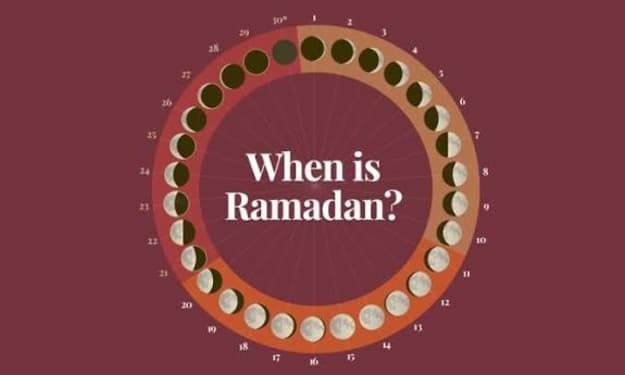
Ramadan, the holiest month in Islam, is observed by more than a billion Muslims worldwide through fasting, prayer, and reflection. Each year, its start date shifts because it follows the Islamic lunar calendar rather than the Gregorian calendar. This often leads to questions about when Ramadan will begin and how its arrival is determined. In 2026, Ramadan is expected to begin in the evening of Tuesday, February 17, and end at sunset on Wednesday, March 18, depending on the sighting of the moon. As with every Islamic month, the precise start date will be confirmed only after the new crescent moon is observed. Why Ramadan’s Date Changes Every Year The Islamic calendar is based on lunar cycles, with each month beginning when the new crescent moon (hilal) is sighted. A lunar year is about 354 days long — roughly 11 days shorter than the solar year used in the Gregorian calendar. As a result, Ramadan moves earlier each year, cycling through all seasons over a 33-year period. This shifting calendar means Muslims sometimes fast during long summer days and, in other years, during shorter winter days. The movement of Ramadan across the seasons is seen as a reminder of the spiritual nature of fasting rather than its physical difficulty. How the Moon Is Sighted Moon sighting is a deeply rooted religious and cultural practice. Traditionally, Muslim scholars and local committees attempt to observe the new crescent moon shortly after sunset on the 29th day of the preceding month, Sha’ban. If the moon is seen, Ramadan begins the following day. If it is not seen, Sha’ban completes 30 days and Ramadan starts one day later. In many countries, official moon sighting committees gather at specific observation points, often using telescopes and modern optical equipment alongside traditional naked-eye observation. Witnesses who claim to see the crescent must meet certain conditions, including reliability and clarity of vision, before their testimony is accepted. Weather plays a major role in moon sighting. Cloud cover, pollution, or haze can make it impossible to see the crescent even if it is astronomically present. This is why different countries sometimes begin Ramadan on different days. Astronomy vs. Physical Sighting There is an ongoing discussion in the Muslim world about whether Ramadan should be determined solely by astronomical calculations or by physical moon sighting. Some countries and Islamic organizations use scientific data to predict when the moon can be seen, while others insist on direct visual confirmation in accordance with traditional teachings. Supporters of astronomical calculation argue that modern science allows highly accurate predictions and promotes unity by avoiding confusion. Others believe that physically seeing the moon is a religious requirement and part of the spiritual significance of Ramadan’s arrival. As a result, Muslims in different regions — and sometimes even within the same country — may start fasting on different days depending on which method they follow. Global Differences in Moon Sighting Countries in the Middle East, South Asia, and Africa often rely on national moon sighting authorities. In contrast, Muslim communities in Europe and North America may follow local councils or the announcements of major Islamic institutions abroad. For example, some communities wait for sightings from Saudi Arabia or their country of origin, while others rely on local sightings or scientific visibility charts. This diversity reflects the global nature of Islam and the different legal and cultural traditions within it. Spiritual Meaning of Ramadan Beyond its calendar mechanics, Ramadan is a time of intense spiritual focus. Muslims fast from dawn until sunset, refraining from food, drink, and other physical needs. The fast is meant to promote self-discipline, empathy for the poor, and closeness to God. Daily prayers increase, charity is emphasized, and families gather for the evening meal known as iftar. The month also includes Laylat al-Qadr, the “Night of Power,” believed to be the night when the first verses of the Quran were revealed. Preparing for Ramadan 2026 As Ramadan 2026 approaches in February, Muslim families and communities will begin preparations well in advance. Mosques plan prayer schedules, charities organize food drives, and individuals adjust their routines for fasting and worship. Because the start date depends on moon sighting, official announcements are typically made the night before Ramadan begins. Until then, the expected date remains provisional. Conclusion Ramadan 2026 is expected to begin around February 17, but its true start will be confirmed by the sighting of the new moon. This centuries-old practice continues to unite faith, tradition, and astronomy in a unique way. Whether determined by telescopes or by the naked eye, the arrival of Ramadan marks a sacred time of reflection, discipline, and spiritual renewal for Muslims around the world.
By Fiaz Ahmed 6 days ago in Education
Where there's Art there's Heart
Here's a stupid thing: I adore art, but I start to panic whenever I step into a gallery. In the one place I should be at my contented best - surrounded by walls teeming with creative expression - I fall apart. What ought to be an enriching experience, tacitly designed to facilitate the exploration of human empathy and perspective, is for me an overwhelming purgatory of anxiety that compresses me to the point I cannot breathe. At the same time, I experience a sense of extraction, as though my head is being prized open to create a hole so big my sanity could evaporate. Somewhere between these two opposing forces of vice and vortex, I feel myself dissolving in a stream of panic that makes me want to cry; and I feel so daft feeling this way, that all I want to do is run for the hills.
By Caroline Jane5 days ago in Humans


Comments
There are no comments for this story
Be the first to respond and start the conversation.