
Why Data Matters More Than Funding in Nonprofit Technology Transparency
Why Outdated Data Systems — Not Lack of Funds — Are the Real Barrier to Nonprofit Transparency in the Digital Age


Transparency in non-profit sector is becoming increasingly important. Platforms, donors, and regulators want confirmation and tangible benefits before investing dollars or trust.
However, many charitable groups fail to report where donations are spent, who receives them, or if businesses are following the law.
Despite the common belief that a lack of finance is the primary impediment, the underlying constraint is a lack of modern, reliable, and interoperable data systems.
Fragmented and Outdated Data
Even financially stable organizations encounter challenges when trying to validate nonprofit status or demonstrate transparency.
Primary issues include
• Outdated tax-exempt records,
• Privileged access to systemized financial documentation,
• Provided data in non-editable formats such as PDFs.
Lack of transparency happens here because data is overly complex, not obscured, for automated systems to work with due to inadequate categorization.
Dispersed and Disconnected Sources
Nonprofit statistics in the United States comes from a variety of sources, including:
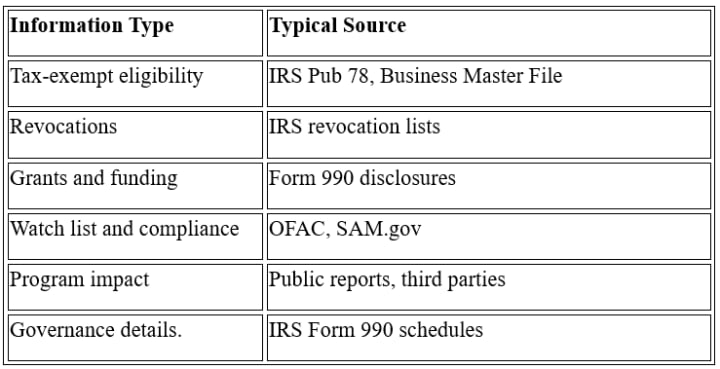
These sources are updated on different schedules, follow inconsistent formats, and often require custom processing to extract usable information.
Public but Not Practical
Making data publicly available is not enough. If it cannot be processed or interpreted by machines or analysts, its utility is limited.
Examples:
• Form 990s published as scanned PDFs are not machine-readable.
• Monthly updates to tax status may miss interim compliance changes.
• Watch lists in CSVs or static web formats require ongoing manual oversight.
Such formats reduce the effectiveness of automated systems and delay timely assessments.
Limited Progress Through Tools
Some tools exist that help query tax records or compliance lists more easily. However, their utility is constrained by the same problems—namely, outdated formats, inconsistent updates, and lack of system-wide coordination.
Packaging existing data more conveniently does not resolve the structural issues.
Need for Structural Improvements
A sustainable path forward requires data infrastructure improvements, such as:
• Standardized formats for identifiers, revocation history, and filings
• Use of machine-readable formats like JSON or XML
• Timestamped, version-controlled data
• System interoperability across public and private stakeholders
Platforms like LinkedIn’s Developer Portal offer insight into how structured data and APIs can be effectively documented, accessed, and maintained. See their developer resources for an example of clear and consistent data infrastructure.
These are essential for functional transparency.
Risks of Inaction
Without addressing data fragmentation, the sector may continue to experience:
• Gaps between donor expectations and available data
• Failure to detect fraud or sanctions
• Inadvertent noncompliance by digital platforms
• Trust loss due to rejected or old record
These issues can damage the credibility of the entire region.
Reframing Transparency as Infrastructure
Transparency should not rely on individual organizations stitching together disparate systems. Instead, it should be designed to understand how public data is structured and maintained.
This includes:
• Consistent governance of public data
• Broad-based access and accountability
• Technical standards to support clarity and automation
Conclusion
It is not a lack of funds or issues with a given platform that prevents transparency in the charity sector; it is the organization and retrieval of data. Because of outdated structures and inconsistent updating, stakeholders cannot access accurate and recent information. True transparency demands modern, cross-platform silos with machine-readable structures and standardized formats. Until that infrastructure is built, NGOs will struggle to keep pace with public, regulatory, and donor expectations. For example, Pactman's Nonprofit Check+ API. Nonprofit Check+ API documentation provides well-structured accessible data and stipulates tight frameworks for data transparency.
About the Creator
Muneeb ur Rehman
Muneeb ur Rehman is a software engineering student and API-focused tech writer. He explores software trends, nonprofit tech, and cloud tools, helping readers make smarter decisions with APIs. Connect with him on LinkedIn.
Reader insights
Good effort
You have potential. Keep practicing and don’t give up!
Top insights
Compelling and original writing
Creative use of language & vocab
Easy to read and follow
Well-structured & engaging content
Keep reading
More stories from Muneeb ur Rehman and writers in Education and other communities.
How Charity APIs Are Being Utilized by Developers to Promote Nonprofit Transparency
In today's digital age, more people want to know how non -profit manage and reports their funding. Whether they donate money, do their time volunteers, or simply care about the effect, they expect transparency. Developers are responding using a digital tool to make non -profit data more accessible and reliable.
By Muneeb ur Rehman7 months ago in Education
The Cave Part 6
If you have ever heard a tale about yourself that you cannot remember and doubtless think is made up, you will know how I felt when Tharkin related all that the eagle had seen of me before my memories were scattered. Of far distances and traveling companions that I did not recall, camping out under the stars and making our way to the mountains with deliberate purpose. The great bird had lost contact with my party once we entered the forests, and the seven other members were not seen again by him or his brethren since.
By Jamye Sharp4 days ago in Chapters




Comments
There are no comments for this story
Be the first to respond and start the conversation.