
THE POST- ONTOLOGICAL THOUGHT AND THE ABYSS OF NOTHINGNESS — ALEXIS KARPOUZOS
The meta-ontological thought of Alexis Karpouzos is constituted at a level where the traditional distinction between ontology and nihilism collapses.

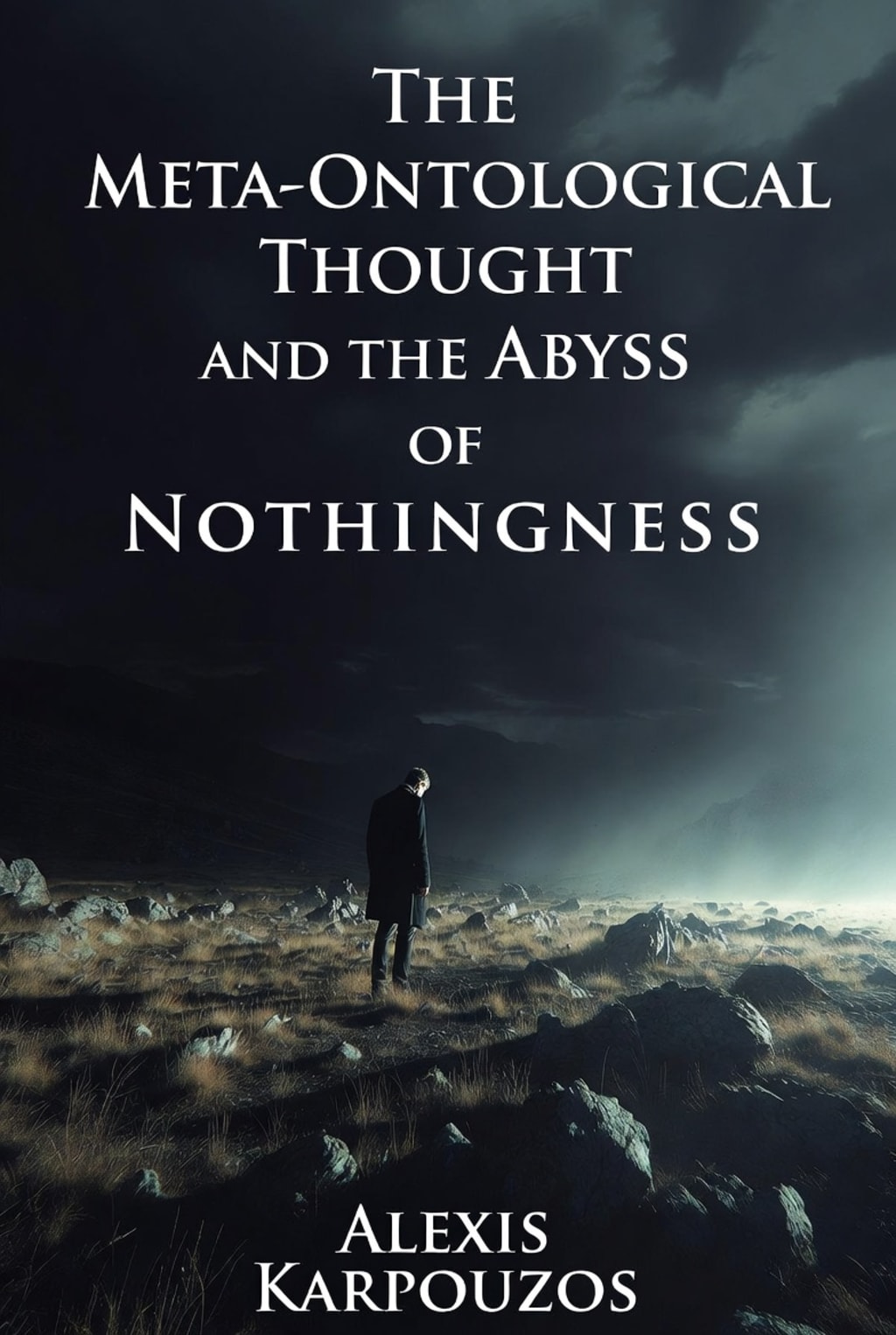
The meta-ontological thought of Alexis Karpouzos is constituted at a level where the traditional distinction between ontology and nihilism collapses. The nothing, as it appears in this context, is neither the opposite of Being nor its limit, but the groundless condition of its appearance. It is a nothing that is not conceived metaphysically as lack, negation, or absence, but corresponds to the mathematical zero: neither positive nor negative, non-polar, and at the same time capable of encompassing all possible values without identifying with any of them. This nothing does not negate the world; it makes possible its indeterminate genesis.
The abyss of nothingness, thus understood, is neither chaos nor void, but an open set of possibilities, a non-closed, non-exhausted, and non-completed set. It is not governed by necessity but by indeterminacy. This indeterminacy is not ignorance nor temporary ambiguity, but a structural condition: the real is not fully determinable because it has no foundation. The world is not constituted upon a stable substrate, but hovers above a field of possibilities that cannot be exhausted nor completed.
Consciousness, however, is unable to experience this openness directly. In order to constitute itself as an ego, it requires determinations, boundaries, and distinctions. Thus, the indeterminacy of nothingness is translated into oppositional categories: life and death, being and non-being, order and chaos. The first and deepest of these categories is the distinction between life and death, which functions as a primary mechanism of stabilization in the face of the abyssal openness of the real. Life is conceived as a positive value, death as negative, even though both are merely different manifestations of a unified transformative dynamic.
At the meta-ontological level, however, prior to the observation of consciousness, there are neither positive nor negative values. There are not even values. There is an invisible rhythm, which operates like the indeterminate variability of a mathematical field before any measurement. This rhythm does not choose, does not direct, and does not hierarchize. It coordinates without regulating, it transforms without deciding. It is the way in which the open set of possibilities is temporarily articulated into forms.
When consciousness intervenes, the rhythm does not cease to function. It simply ceases to be perceived as such. The oppositions that appear are not real fissures in the world, but polar complexes that arise from the process of observation. Just as in the mathematical field the zero permits both positive and negative values without identifying with any, so too the abyss of nothingness allows the emergence of opposites without grounding them as absolute. The opposites do not clash; they co-transform.
The notion of atemporal time becomes necessary here. Atemporal time is neither a transcendent duration nor an eternal presentness. It is the regime within which transformation occurs without being determined by succession. Just as in the field of indeterminacy there is no privileged value, so in atemporal time there is no privileged moment. Life and death do not come one after the other; they coexist as different forms of articulation of the same potential field.
The claim that the human being is simultaneously alive and dead thus acquires a strict, non-metaphorical meaning. Every moment of experience is already the result of a selection of form from an infinite set of possibilities and, at the same time, the exclusion of countless others. Life does not precede death; it is accomplished together with it as a process of selection and withdrawal of forms within the open field of nothingness.
From this perspective, domination, property, and conquest are revealed as attempts to impose closure upon an essentially open system. Property presupposes stable values and clear boundaries. Yet in a world governed by indeterminacy, where every form is a temporary choice from the abyss of possibilities, nothing can belong definitively. The negation of property is not a political slogan, but the logical consequence of a meta-ontology that recognizes nothingness as an open set and not as lack.
Knowledge, finally, is not the representation of a stable world, but participation in a process of determination that never completes itself. Karpouzos' meta-ontological endeavor does not seek to fill the abyss of nothingness with meaning, but to show that meaning emerges only because the abyss remains gaping and open.
Thus, nothingness is neither threat nor salvation. It is the condition of the freedom of the real. Not because it promises infinite possibilities, but because it imposes none. The invisible rhythm does not transcend nothingness; it operates within it, just as variability operates within indeterminacy. And within this ungrounded condition, the world is not explained — it simply transforms.
Excerpt from a lecture at the University of Berlin in the Autumn of 2025
About the Creator
alexis karpouzos
Alexis karpouzos (09/04/1967, born in Athens) is a philosopher, psychological theorist and author. His work focuses mainly on creating an "universal theory of consciousness.
Keep reading
More stories from alexis karpouzos and writers in Education and other communities.
THE PHIILOSOPHY OF MEDITATION - ALEXIS KARPOUZOS
The Paradox of Non-Striving in the Philosophy of Meditation: Agency, Awareness, and the Limits of Intentionality Meditation, a practice rooted in contemplative traditions, presents a paradoxical challenge for philosophical inquiry. In meditation, practitioners often aim for a state of effortless awareness—a state free from striving and intentional effort. Yet, meditation as a practice seems to require intentional effort to reach such a state. This paradox raises crucial philosophical questions about the nature of agency, intentionality, and selfhood. This paper explores the paradox of non-striving by examining the philosophical implications of meditation across different traditions, including Buddhist, Daoist, and phenomenological perspectives. The paper argues that the paradox invites a rethinking of agency as a dynamic, non-dualistic skill and suggests that non-striving is not the negation of effort but the cultivation of an effortless, fluid relationship to the present moment. The study of meditation, therefore, offers new insights into the nature of conscious experience, intentionality, and the self, challenging traditional distinctions between effort and non-effort. Meditation has become an object of both popular interest and philosophical inquiry, particularly in recent years. Beyond its applications in therapeutic and mindfulness practices, meditation has a long tradition as a path to self-awareness and liberation. A central theme across many contemplative traditions is the cultivation of effortless awareness, a state in which the practitioner is present in the moment without striving or attachment to goals. This ideal of non-striving is, however, paradoxical: in order to achieve such a state, one must often engage in deliberate effort. This tension forms the central paradox of meditation: how can one strive to reach a state of non-striving? This paradox is not just a theoretical curiosity; it points to fundamental questions about the nature of agency, intentionality, and the self. In particular, it challenges the dominant Western conception of agency as intentional, goal-directed, and willful. By examining the paradox from a variety of philosophical perspectives, this paper aims to illuminate the deeper philosophical issues at play and to reconsider how meditation might offer a new understanding of agency, intentionality, and the nature of consciousness itself.
By alexis karpouzos3 months ago in Education




Comments
There are no comments for this story
Be the first to respond and start the conversation.