
Responsible AI in Data Science: Ethics, Governance, and Compliance
AI in Data Science Ethics

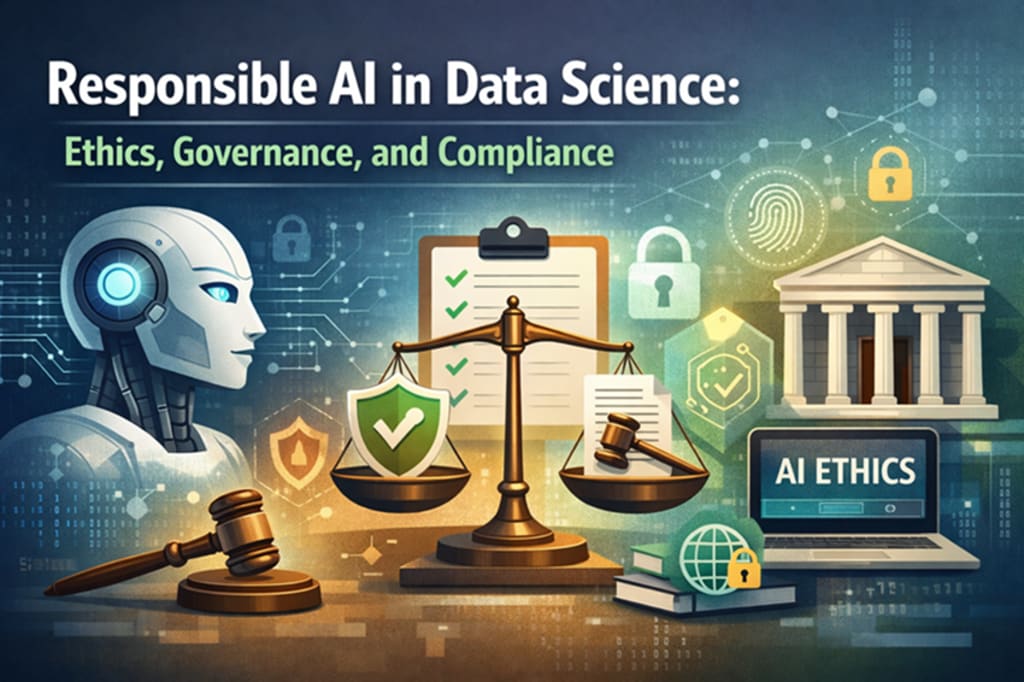
AI is no longer a background technology. It filters job applications, prescribes medical treatments, and determines the recipients of loans. Millions of decisions that formerly took the judgment of a human are now automated in milliseconds.
That speed and scale are exactly what make AI valuable. It's also exactly what makes it dangerous when things go wrong. According to McKinsey's report, 88% of organizations now use AI in at least one business function, up from 78% just a year prior. A pace of adoption that has far outrun the ethical and governance frameworks meant to keep it in check.
Let us discuss in detail about responsible AI in practice, the ethics, governance, and compliance principles with which a data scientist must be familiar nowadays.
What Is Responsible AI?
Responsible AI is the practice of creating, developing, and implementing AI systems in a manner that is equitable, transparent, responsible, and secure.
It's the difference between a model that works and a model that works for everyone.
In its bare essence, responsible AI answers a basic question, and that is, before any system is active, who might it harm, and how can we avoid it? That question does not sound complicated. Following through on it is where things get complicated.
Key Ethical Challenges in Data Science
Data science ethical risks are not in the abstract; at each point of the data lifecycle, they become risks. Between the data collection and deployment, minor missteps can have massive effects on society.
● Bias in Training Data: The historical data may respond to past discrimination in employment, lending, or policing. Models that are trained using this data recreate those patterns, which strengthen inequality with scale.
● Lack of Transparency: A large number of successful models are black boxes. In cases where systems are unable to justify their choices, fairness or mistake-finding auditing would prove very hard.
● Consent and Privacy: Little is known by users about the nature of gathering, handling, and utilization of their information in decision-making. Significant consent is not always evident, or it is even absent.
● Accountability Gaps: Diffusion of responsibility among teams is common when the AI systems have caused harm. In the absence of proper ownership, it would be difficult to rectify and eliminate future damage.
Principles and Frameworks for Ethical AI
Various frameworks have come up to assist organizations in navigating this space. The most frequently mentioned ones have similarities:
● Fairness: No group should face systematic disadvantages as a result of the models.
● Explainability: Decisions must be explainable by humans and not just machines.
● Privacy by design: Data protection must be integrated from the beginning and not later.
● Human supervision: A human in the loop for high-stakes decisions.
● Accountability: Open responsibility of AI must be conducted before and after implementation.
Tools and Techniques to Promote Responsible AI
Responsible AI involves real-world systems that can bring the ethical principles to specific, measurable safety. Fairness, transparency, and privacy can be integrated into development processes in modern data teams.
● Bias Detection Tools
Conducts audits on demographic groups to determine and avoid any discriminatory results during deployment.
● Explainability Methods
The methods of interpretation explain the way predictions are created, enhancing transparency and trust among stakeholders.
● Privacy-Preserving Approaches
Anonymization and different privacy techniques are some of the techniques that safeguard sensitive information.
● Documentation and Monitoring
Model documentation, audit trails, and continuous tracking strengthen long-term accountability and compliance.
Read More: What is the Data Ethics Toolkit for Data Scientists in 2026?
The Role of Education: Data Science Certification
In current data positions, technical skills are no longer enough. Professionals who are knowledgeable with respect to governance, fairness, and responsible deployment, coupled with modeling accuracy, gain importance to organizations.
1. Certified Senior Data Scientist (CSDS™) USDSI®
It is for professional data specialists moving into senior roles. It emphasizes advanced analytics, machine learning, alignment of business strategy, and responsible AI governance. The qualification shows leadership skills in complex data projects and the ability to create meaningful business change.
2. Machine Learning Foundations Certificate by eCornell
Integrates algorithmic fairness, model transparency, and accountability as central and significant elements of technical training needs instead of addressing them as peripheral topics.
3. Penn Wharton/SEAS, Data Science and Software Engineering Certificate
Instills responsible deployment principles in the entire applied coursework, the focus of which is on oversight, documentation, and ethical system design.
The Future of Responsible AI
The expectations of AI governance are increasing, and more attention is paid to control, documentation, and responsibility.
Ethical leadership instills ethical practices into the culture, design of the product, and decision-making. With greater focus on transparency and responsible practices, organizations will receive a better reputation, trust, and resilience in the long term.
Conclusion: Building a Trustworthy AI Future
The new stage of technological development will be responsible AI. Trust is going to be the real competitive advantage as the intelligent systems influence the key data-driven decision-making. Organizations that incorporate transparency, fairness, and accountability in all the models that they design are the ones that will have a competitive edge in the future.
FAQs
Why is responsible AI becoming a hiring priority in data roles?
Organizations want professionals who can manage risk, ensure fairness, and align models with compliance standards, not just improve accuracy.
How can companies measure whether their AI systems are truly responsible?
Through regular bias audits, model documentation, impact assessments, and continuous monitoring of real-world outcomes.
Does responsible AI slow down innovation?
When integrated early into workflows, it actually reduces long-term risk, prevents costly failures, and builds stronger stakeholder trust.
About the Creator
Pradip Mohapatra
Pradip Mohapatra is a professional writer, a blogger who writes for a variety of online publications. he is also an acclaimed blogger outreach expert and content marketer.
Keep reading
More stories from Pradip Mohapatra and writers in Education and other communities.
Best 3 Cybersecurity Certifications for Mid-Level Professionals in 2026
Skills, knowledge, experience, and a solid grasp of cybersecurity concepts are non-negotiable for those aspiring to accelerate their cybersecurity careers in 2026. But chasing all these together can be overwhelming. Watching YouTube videos, unstructured blog posts and forums, and numerous courses without any real value all lead to learning fatigue with no result. This is where cybersecurity certifications become the absolute weapon to master all.
By Pradip Mohapatra11 days ago in Education
Why Europe Cosmetics Is Redefining Beauty and Personal Care
Europe Cosmetics and the Evolution of Beauty Standards The beauty and personal care industry in Europe is undergoing significant transformation as consumers become more conscious of ingredients, sustainability, and brand values. Cosmetics are no longer viewed as simple aesthetic products; they are increasingly associated with self-expression, wellness, and lifestyle choices. Across the region, changing consumer preferences and technological advancements are reshaping how beauty products are developed, marketed, and consumed.
By deepanshu Thakur7 days ago in Education
Smart Investor’s Guide to Maximizing Rental Income from Property Purchases
Buying property for rental income can build steady wealth over time. But not every home or building will produce strong returns. Some properties look great on the surface but fail to attract good tenants or generate enough cash flow. That is why smart buyers take time to study numbers, location, and demand before making an offer. A careful review process protects your money and improves long-term results. The key is understanding how to measure rental property investment analysis before you commit.
By Ruvim Khemchanabout 18 hours ago in Education
What Happens To Your Brain When You Stop Multitasking
Digital technology is the culprit that is causing us to doom scroll when tired, disengaged and unmotivated with the content that motivated you to log onto your device to consume in the first place. That is only the beginning. In the modern workplace (and even when filing cabinets were around, I confirmed this with my adopted parents to get my facts right); reading files while you are supposed to be present to the caller on the other end of the phone line is another classic example of multitasking that causes your brain (although adaptable and intelligent) to lose focus and concentration.
By Justine Crowley4 days ago in Psyche


Comments
There are no comments for this story
Be the first to respond and start the conversation.