

“Grandpa! There is a solar eclipse today,” Yahya announced while reading the newspaper in the drawing room.
“What is that?” Grandpa asked calmly.
“When a planet comes in front of the sun and the sun disappears,” Yahya explained with confidence.
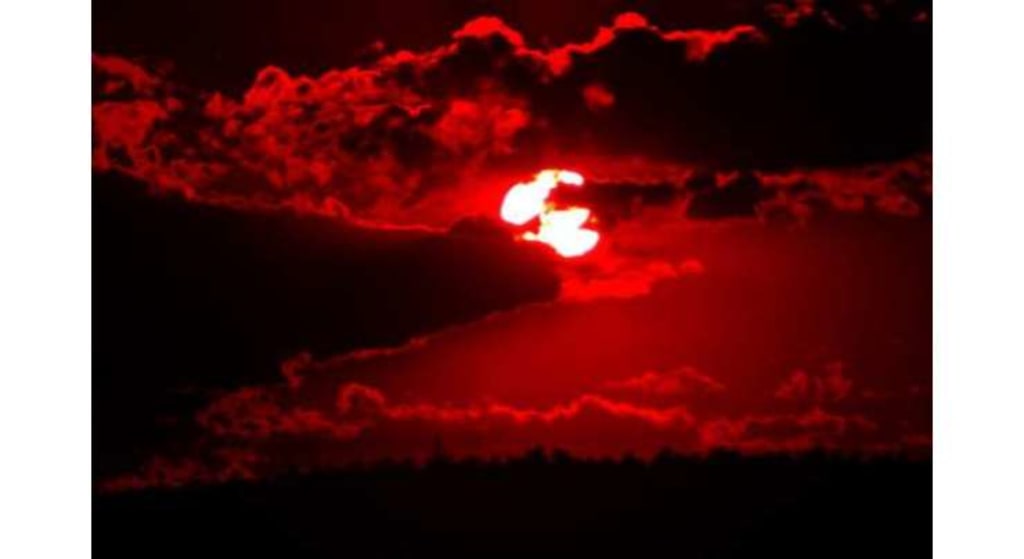
“Grandpa! It will get dark, just like night,” Warisha added quickly, “and the sky will turn red.”
Just then, Abdul Bari, Zahra, and Abdul Wasi entered the drawing room, fear clearly visible on their faces.
“Wasi is going outside. If he looks at the sun, his eyes will be damaged,” Zahra said wisely.
“Yes children, it is true that looking directly at the sun during a solar eclipse can harm the eyes,” Grandpa said as he put the newspaper aside. “But do you know why a solar eclipse happens?”
“Allah becomes angry, that’s why the sun hides,” Warisha replied immediately.
“Allah does not become angry like that,” Grandpa smiled gently. “However, it is true that eclipses are among the signs of Allah.”
“A solar eclipse is unlucky,” Zahra said softly.
“No, dear. These are old beliefs. Today, science has explained many things. Scientists travel long distances to observe solar eclipses and to discover the truth behind them,” Grandpa explained.
“Grandpa, tell us the truth as well,” Abdul Bari requested
“Yes, my child. We should always try to understand the truth. In some cultures and religions, solar eclipses are still considered bad luck, while others think they are signs of divine anger. But in Islam, we are told that the sun and the moon follow paths set by Allah and move according to His system.”
“Science also confirms this,” Grandpa continued. “The sun and the moon move in their own orbits. A solar eclipse occurs when the moon, during its rotation, comes directly between the earth and the sun. As a result, the sun becomes partially or completely hidden from the earth.
“The distance between the sun and the moon is about 400 times greater than the distance between the moon and the earth. That is why solar eclipses are not visible everywhere in the world, and not every eclipse looks the same,” he added.
“During a solar eclipse, our beloved Prophet Muhammad (peace be upon him) instructed Muslims to offer Salat-ul-Kusuf (the eclipse prayer). However, there is no specific prayer commanded for a lunar eclipse,” Grandpa explained further.
“There are different types of solar eclipses,” he continued. “Sometimes it is total, sometimes partial, sometimes hybrid, and sometimes annular.”
“What is a total solar eclipse?” Wasi asked after thinking deeply.
“A total solar eclipse happens when the moon is close enough to the earth to completely cover the sun,” Grandpa replied. “Because the orbits of the earth and moon are oval-shaped, the distance between them keeps changing. That is why a total eclipse does not occur every time.”
“During a total eclipse, daylight becomes dim, and stars can even be seen in the daytime. A total eclipse can last up to seven minutes and forty seconds at a single location, though it is often shorter. In the same region, such an eclipse may occur only once every 340 years.
“And when does an annular eclipse happen?” Zahra asked
“An annular eclipse occurs when the moon comes between the sun and the earth but is farther away. Because of this distance, it cannot fully cover the sun, leaving a bright ring visible around it,” Grandpa explained.
“As for a hybrid eclipse, in some regions it appears as a total eclipse, while in others it appears annular. The ring in such eclipses is very thin,” he added. “The longest solar eclipse recorded in history was seen in Europe in 1999.”
“Grandpa, you told us about solar eclipses. Does the moon also have an eclipse?” Warisha asked.
“Yes, dear. A lunar eclipse occurs when the earth comes between the sun and the moon, and the earth’s shadow falls on the moon, making it appear dark. Both the earth and the moon receive light from the sun. When the earth’s shadow falls on the moon, a lunar eclipse occurs, and when the moon’s shadow falls on the earth, we see a solar eclipse.”
Grandpa smiled and said, “Now come, everyone. Sit down and have breakfast.”
About the Creator
Sudais Zakwan
Sudais Zakwan – Storyteller of Emotions
Sudais Zakwan is a passionate story writer known for crafting emotionally rich and thought-provoking stories that resonate with readers of all ages. With a unique voice and creative flair.
Keep reading
More stories from Sudais Zakwan and writers in Education and other communities.
The Deer’s Carelessness
Once upon a time, our teacher was explaining an important lesson to us in class. He spoke in a calm but thoughtful tone and said, “Do not focus on who is speaking; instead, pay attention to what is being said.” The classroom became quiet, and everyone listened carefully. One student, curious and slightly confused, raised his hand and asked, “Sir, what does this mean?”
By Sudais Zakwanabout 10 hours ago in Education
The Fascinating Story of the 1955 Doubled Die Lincoln Cent and How to Authenticate It
Over eight years as a Senior Numismatic Analyst, I have handled thousands of error coins, but few generate the instant recognition and awe of the 1955 Doubled Die Lincoln Cent. It's not just a coin; it's a cultural icon, a symbol of minting fallibility that captivated a nation. While many dream of finding one in circulation, its story is one of limited creation, public discovery, and a legacy of counterfeits. This guide will take you through the remarkable history of this coin and arm you with the precise knowledge needed to separate a genuine piece of history from the endless stream of fakes.
By Laura Bennetta day ago in Education
Best Vibe Coding Platforms for Building AI-Native Products
Vibe coding platforms are transforming how teams develop AI-native products by enabling the conversion of ideas into functional software through natural language and AI collaboration. They help startups and enterprises move faster from concept to execution without losing alignment.
By Mobisoft Infotechabout 4 hours ago in Education




Comments
There are no comments for this story
Be the first to respond and start the conversation.