
Is the Universe Enough? Science, Meaning, and the Search for Completeness
Is the universe enough? At first glance, the question seems simple. The universe contains everything—every galaxy, every star, every atom, every living being. What could be more complete than totality itself? Yet the question lingers at the intersection of science, philosophy, and human experience. Is the physical universe sufficient to explain existence, purpose, beauty, and consciousness? Or does something lie beyond what astronomy and physics can measure?we explore whether the universe is “enough” from scientific, philosophical, and existential perspectivesand why the answer may depend on what we mean by “enough.”

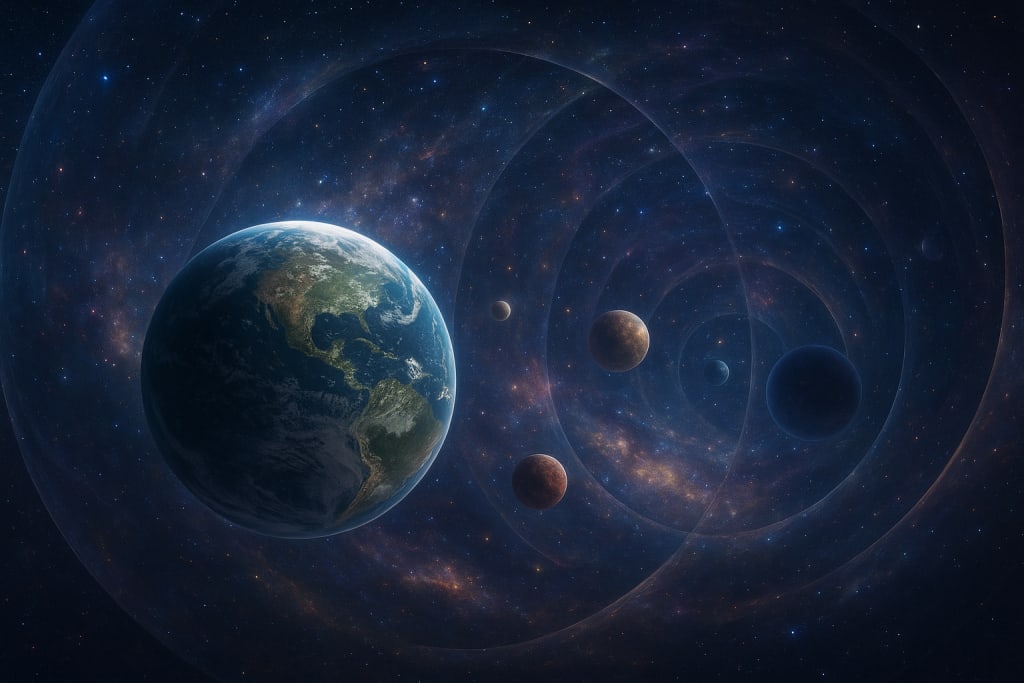
The Universe as Total Reality
Scientifically speaking, the universe includes all space, time, matter, and energy. From the Big Bang to the formation of galaxies, from quantum particles to black holes, everything observable belongs to this cosmic system.
Modern cosmology shows that the universe is approximately 13.8 billion years old and contains billions of galaxies. Observatories like the James Webb Space Telescope reveal light from galaxies formed shortly after the universe began.
In that sense, the universe appears complete. It contains the ingredients for stars, planets, chemistry, and life. No external additions are required for physical processes to unfold.
But physical completeness does not necessarily answer deeper human questions.
________________________________________
Scientific Sufficiency: Do We Need Anything Beyond Physics?
From a scientific perspective, many researchers argue that the universe operates through consistent laws. Gravity, electromagnetism, and quantum mechanics govern interactions at every scale.
When Isaac Newton described gravity mathematically, he showed that the same law governs falling objects and planetary motion. Later, Albert Einstein refined this understanding by describing gravity as the curvature of spacetime.
These discoveries suggest that the universe is self-contained. It does not require external intervention to explain its motion or structure.
If every phenomenon can, in principle, be described by natural laws, then scientifically, the universe may indeed be enough.
Yet science also reveals vast unknowns.
________________________________________
The Mystery Within the Whole
Even though the universe contains everything, we understand only a fraction of it.
Current estimates suggest that ordinary matter makes up about 5% of the universe. The rest consists of dark matter and dark energy—mysterious components whose nature remains uncertain.
If 95% of the universe is not fully understood, can we confidently say it is “enough” for explanation?
Perhaps the universe is complete in substance but incomplete in comprehension.
Mystery remains embedded within totality.
________________________________________
Is Physical Reality Enough for Meaning?
The question becomes deeper when we move from physics to meaning.
Human beings do not merely observe the universe—they interpret it. We seek purpose, value, and significance.
Is physical existence alone sufficient to account for:
• Moral values?
• Beauty?
• Consciousness?
• Love?
• Hope?
Some philosophers argue that everything—including consciousness and morality—emerges from physical processes. Under this view, the universe is sufficient because all higher experiences arise from its fundamental structure.
Others suggest that while physical processes describe mechanisms, they may not exhaust meaning.
The debate continues.
________________________________________
Consciousness: A Challenge to Sufficiency
Consciousness remains one of the most profound puzzles in science.
Neuroscience explains how brain activity correlates with thoughts and emotions. But the subjective experience of awareness—the “feeling” of being conscious—remains difficult to reduce entirely to physical processes.
If consciousness is fully explainable through physics and biology, then the universe may be enough.
If not, some argue, there may be aspects of reality that extend beyond current scientific models.
Either way, the universe contains the phenomenon of consciousness, even if its nature remains mysterious.
________________________________________
The Universe and Human Longing
Humans have always asked whether the material world satisfies our deepest longings.
When ancient astronomers observed the sky, they sought both knowledge and transcendence.
When Galileo Galilei revealed that Earth orbits the Sun, he changed humanity’s cosmic perspective—but he did not erase existential questions.
The vastness of space can inspire awe, humility, and wonder. But it can also provoke feelings of smallness and insignificance.
For some, the sheer scale of the cosmos is enough—its beauty and complexity provide meaning.
For others, meaning requires something more than physical vastness.
________________________________________
Beauty and Mathematical Elegance
One reason many scientists find the universe “enough” is its remarkable mathematical order.
Physical laws are consistent across vast distances. The same equations apply in distant galaxies as on Earth.
This coherence suggests an underlying unity.
Einstein once expressed awe at the comprehensibility of the universe. The fact that mathematics—a product of human thought—describes cosmic behavior with extraordinary precision is itself astonishing.
Perhaps the elegance of natural law is sufficient to evoke fulfillment.
________________________________________
The Possibility of Multiverses
Some cosmological theories propose that our universe may be one of many—a multiverse of varying physical constants and structures.
If true, even the universe as we know it may not be the final boundary of reality.
Would the existence of multiple universes make ours insufficient?
Or would it expand the concept of “enough” to include a broader cosmic landscape?
The multiverse hypothesis demonstrates that even the idea of totality may not be final.
________________________________________
Finite Minds in an Infinite Cosmos
Another dimension of the question concerns human limitation.
The universe may be complete—but human understanding is not.
We can observe only within the cosmic horizon. Regions beyond are forever inaccessible.
We may never know everything.
But does complete knowledge matter for sufficiency?
Perhaps the universe does not need to be fully understood to be enough.
________________________________________
Is Enough About Quantity or Quality?
When we ask if the universe is enough, we may be asking about qualitative depth rather than quantitative size.
The universe contains:
• Trillions of stars.
• Billions of galaxies.
• Countless planetary systems.
• Complex chemical processes.
• Life, at least on Earth.
It has generated beings capable of reflection.
From that perspective, the universe has already produced extraordinary richness.
But sufficiency may depend on perspective.
For a physicist, the universe’s structure may be enough.
For a philosopher, meaning may require more than structure.
For a spiritual thinker, transcendence may not be reducible to matter.
________________________________________
The Emotional Dimension
Standing beneath a dark sky filled with stars can feel overwhelming.
The Milky Way stretches across the horizon, silent yet immense.
In such moments, many people feel that the universe itself is enough—its beauty alone justifies existence.
Others may feel existential loneliness in the same scene.
The universe provides the canvas.
Human interpretation provides the emotion.
________________________________________
Exploration as Evidence of Sufficiency
Human exploration suggests that the universe offers endless opportunities for discovery.
Organizations like NASA continue to send probes to distant planets, study cosmic radiation, and search for signs of life beyond Earth.
The universe does not appear exhausted of potential.
Each discovery leads to deeper understanding—and deeper questions.
In that sense, it may be more than enough to sustain curiosity for generations.
________________________________________
The Limits of Material Explanation
Despite scientific success, some questions remain unresolved:
Why do physical laws exist?
Why do constants have the values they do?
Why does anything exist rather than nothing?
These questions push beyond empirical measurement.
Even if physics eventually explains every interaction, the meta-question of existence itself may persist.
Whether the universe is enough may depend on whether we accept unanswered questions as part of reality.
________________________________________
Conclusion: A Question Without a Single Answer
So, is the universe enough?
Scientifically, it appears self-contained. Its laws govern motion, energy, and structure without requiring external mechanisms.
Existentially, the answer varies.
For some, the universe’s beauty, complexity, and intelligibility are sufficient sources of meaning.
For others, the search for purpose extends beyond physical description.
Perhaps the universe is enough in one sense and incomplete in another.
It contains everything we observe.
It sustains life and consciousness.
It inspires art, philosophy, and science.
Yet it also leaves open profound questions.
Maybe “enough” is not about closure.
Maybe it is about richness.
The universe may not answer every human longing—but it provides the stage upon which those longings arise.
In its vastness and mystery, it continues to generate wonder, inquiry, and reflection.
And perhaps that ongoing invitation to think, explore, and question is itself enough.
About the Creator
Keep reading
More stories from shahkar jalal and writers in Education and other communities.
Does the Universe Invite Exploration? Humanity’s Endless Call to the Cosmos
The First Invitation: Looking Up Long before space agencies and advanced observatories, ancient civilizations observed the stars. The night sky was not just decoration; it was a calendar, a compass, and a source of wonder.
By shahkar jalalabout 9 hours ago in Education
Spain Beauty Products Market Outlook Clean Beauty Trends and Premium Innovation Driving Steady Growth 2026–2034
The Spain beauty products market was valued at USD 9.7 billion in 2025, reflecting the country’s strong and well-established position within Europe’s personal care and cosmetics industry. Spain has long maintained a vibrant beauty culture influenced by fashion, dermatological awareness, and a growing emphasis on wellness. Despite being considered a mature market, the sector continues to demonstrate resilience and adaptability in response to changing consumer expectations. According to estimates by IMARC Group, the market is projected to reach USD 11.2 billion by 2034, expanding at a compound annual growth rate (CAGR) of 1.55% during 2026–2034. Although this growth rate appears moderate, it highlights the industry’s stability and its ability to sustain consistent revenue generation over the long term.
By Neeraj kumara day ago in Education
Why the Recliner Chair Market Is Elevating Comfort in Modern Living?
With homes increasingly used for living, working, exercising and entertaining, the demand for comfort is increasing. With the home used for so many purposes, there is demand for durable and comfortable furniture. In particular, recliner chairs remain one of the most popular types of seating, offering luxury, comfort and reclining features. The recliner chair market is a segment of the furniture market that has emerged in this lifestyle trend.
By Akshay Kumar3 days ago in Education




Comments
There are no comments for this story
Be the first to respond and start the conversation.