
How Earth’s Rotation Affects Star Positions
If you’ve ever spent a few hours under a clear night sky, you may have noticed something remarkable: the stars appear to move. Constellations slowly drift westward. Some stars rise in the east and set in the west. Others circle endlessly around a fixed point. But are the stars actually moving that quickly? The answer is no. The apparent motion of stars across the sky is primarily caused by Earth’s rotation. Our planet spins on its axis once every 24 hours, and that rotation creates the illusion that the heavens are turning above us. We’ll explore how Earth’s rotation affects star positions, why different stars move in different ways depending on your location, and how this daily motion shapes everything from navigation to timekeeping.

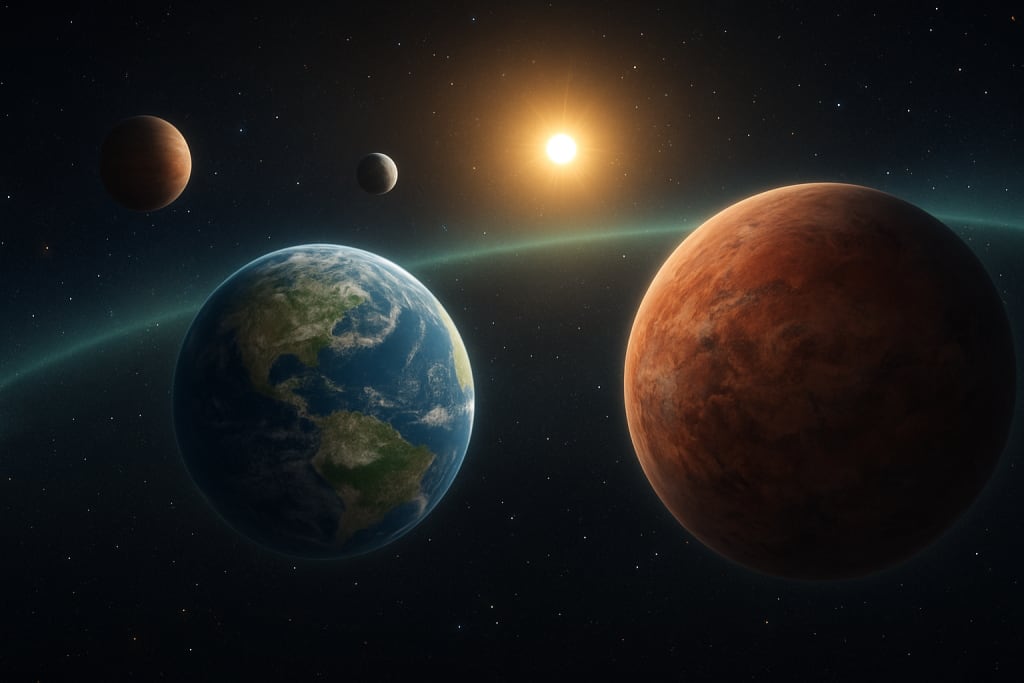
Earth’s Rotation: The Fundamental Cause
The key to understanding star motion lies in one simple fact:
Earth rotates from west to east.
Because of this rotation:
• The Sun appears to rise in the east and set in the west.
• The Moon appears to travel across the sky.
• The stars appear to drift westward during the night.
In reality, it is Earth turning beneath the sky.
Earth completes one full rotation approximately every 23 hours and 56 minutes relative to the stars. This period is called a sidereal day. The slightly longer 24-hour solar day accounts for Earth’s simultaneous orbit around the Sun.
________________________________________
Why Stars Appear to Move in Arcs
When you observe stars over several hours, you’ll notice they move in curved paths, not straight lines.
This circular motion happens because Earth rotates around its axis, which is tilted at about 23.5 degrees. As the planet spins, the sky appears to rotate in the opposite direction.
If you were to take a long-exposure photograph of the night sky, you would capture star trails — circular streaks centered around a fixed point.
In the Northern Hemisphere, these circles revolve around Polaris.
________________________________________
Polaris: The Anchor of the Northern Sky
Polaris appears almost motionless in the sky. That’s because it lies very close to the northern celestial pole — the point directly above Earth’s North Pole.
As Earth rotates:
• Most stars trace circular paths.
• Polaris remains nearly fixed.
This makes Polaris an invaluable navigation tool. For centuries, sailors used it to determine direction and latitude.
The constellations Ursa Major and Cassiopeia rotate around Polaris throughout the night.
________________________________________
Circumpolar Stars: Never Setting
Some stars never rise or set. Instead, they circle the celestial pole continuously. These are called circumpolar stars.
Whether a star is circumpolar depends on your latitude.
For example:
• In northern regions, much of Ursa Minor is circumpolar.
• Near the equator, no stars are permanently circumpolar.
• Near the poles, almost all visible stars are circumpolar.
This variation occurs because Earth’s rotation axis determines which part of the sky is always above your horizon.
________________________________________
Rising and Setting Stars
Most stars are not circumpolar. They rise in the east and set in the west due to Earth’s rotation.
Take Orion as an example.
In winter evenings:
• Orion rises in the east.
• Climbs high into the southern sky.
• Sets in the west by early morning.
This daily motion repeats predictably, governed entirely by Earth’s spin.
________________________________________
Latitude Changes Your View
Your position on Earth dramatically affects how star motion appears.
At the Equator:
• Stars rise straight up from the eastern horizon.
• They travel nearly vertically overhead.
• They set straight down in the west.
• No star remains permanently above the horizon.
At Mid-Latitudes:
• Stars rise and set at angles.
• Some stars circle the pole and never set.
• Others never rise at all.
At the North Pole:
• Stars move in horizontal circles.
• No stars rise or set.
• The celestial equator lies along the horizon.
All of these patterns are direct results of Earth’s rotation combined with your viewing position.
________________________________________
The Celestial Sphere Concept
To visualize how Earth’s rotation affects star positions, astronomers use the concept of the celestial sphere — an imaginary sphere surrounding Earth onto which stars are projected.
As Earth rotates:
• The celestial sphere appears to rotate westward.
• Stars maintain fixed positions relative to one another.
• The entire sky turns as a single unit.
This model helps explain why constellations keep their shapes while shifting position throughout the night.
________________________________________
Why Stars Rise Earlier Each Night
Although Earth’s rotation explains nightly star movement, another subtle shift occurs over longer periods.
Stars rise about four minutes earlier each night.
This happens because Earth is also orbiting the Sun. Each day, Earth must rotate slightly more than 360 degrees to bring the Sun back to the same position in the sky.
However, relative to distant stars, Earth completes its rotation slightly faster — about 23 hours and 56 minutes.
Over a month, this adds up to about two hours of difference. Over a year, it cycles completely.
________________________________________
Star Trails: Visual Proof of Rotation
Astrophotographers often capture stunning images of star trails. By leaving a camera shutter open for hours, they record the circular paths stars trace across the sky.
These trails clearly show:
• Circular arcs centered on Polaris in the north.
• Straight horizontal arcs near the celestial equator.
• Concentric circles at the poles.
Star trails are one of the most direct visual demonstrations of Earth’s rotation.
________________________________________
How Earth’s Rotation Influences Navigation
Before modern technology, understanding star motion was essential for navigation.
By observing the height of Polaris above the horizon, navigators could determine their latitude in the Northern Hemisphere.
The predictable nightly rotation also helped travelers maintain direction during long journeys.
Constellations like Crux (the Southern Cross) serve a similar role in the Southern Hemisphere.
________________________________________
Why Planets Move Differently
While stars maintain fixed patterns, planets shift position night after night.
Planets orbit the Sun at different speeds, so their positions relative to the stars gradually change.
However, their nightly rise and set times are still influenced by Earth’s rotation.
For example:
• Jupiter may rise in the east and set in the west like a star.
• But over weeks, it drifts against the background constellations.
The daily motion comes from Earth’s spin. The long-term drift comes from orbital motion.
________________________________________
Timekeeping and Earth’s Rotation
Earth’s rotation defines our concept of a day.
Ancient civilizations tracked star positions to measure time during the night. By noting which constellations were visible, they could estimate the hour.
For example:
• If Leo was rising, it indicated a specific time of year and night.
• If Orion was setting, dawn was approaching in winter months.
Star clocks were among humanity’s earliest timekeeping tools.
________________________________________
What Would Happen If Earth Stopped Rotating?
If Earth suddenly stopped rotating (ignoring catastrophic consequences), the apparent motion of stars would cease.
• One side of Earth would face constant daylight.
• The other would remain in perpetual darkness.
• Stars would no longer rise and set daily.
The dynamic sky we observe is entirely dependent on Earth’s rotation.
________________________________________
The Subtle Wobble: Axial Precession
Over thousands of years, Earth’s axis slowly wobbles in a motion called precession.
This changes which star appears as the pole star.
Currently, Polaris holds that position. But thousands of years ago, Thuban was the pole star.
Although precession affects long-term star positions, nightly movement remains driven by rotation.
________________________________________
Observing Rotation Yourself
You can witness Earth’s rotation with simple observation:
1. Choose a bright star near the eastern horizon.
2. Note its position relative to a landmark.
3. Return one hour later.
4. Observe how far it has moved westward.
This movement is not the star traveling rapidly through space. It is Earth spinning beneath you at about 1,670 kilometers per hour at the equator.
________________________________________
Final Thoughts
Earth’s rotation is the reason stars appear to move across the sky each night. As our planet spins from west to east, the heavens seem to drift in the opposite direction.
This rotation creates:
• Rising and setting stars
• Circumpolar constellations
• Star trails
• The daily rhythm of night and day
Though stars are moving through the galaxy, their nightly motion is almost entirely an illusion caused by Earth’s spin.
Every time you watch a constellation climb into view or fade below the horizon, you are witnessing the subtle yet powerful motion of your own planet.
The sky may look calm and eternal — but beneath it, Earth is turning, carrying you through space at incredible speed.
About the Creator
Keep reading
More stories from shahkar jalal and writers in Education and other communities.
When Is Ramadan 2026, and How Is the Moon Sighted?
Ramadan, the holiest month in Islam, is observed by more than a billion Muslims worldwide through fasting, prayer, and reflection. Each year, its start date shifts because it follows the Islamic lunar calendar rather than the Gregorian calendar. This often leads to questions about when Ramadan will begin and how its arrival is determined. In 2026, Ramadan is expected to begin in the evening of Tuesday, February 17, and end at sunset on Wednesday, March 18, depending on the sighting of the moon. As with every Islamic month, the precise start date will be confirmed only after the new crescent moon is observed. Why Ramadan’s Date Changes Every Year The Islamic calendar is based on lunar cycles, with each month beginning when the new crescent moon (hilal) is sighted. A lunar year is about 354 days long — roughly 11 days shorter than the solar year used in the Gregorian calendar. As a result, Ramadan moves earlier each year, cycling through all seasons over a 33-year period. This shifting calendar means Muslims sometimes fast during long summer days and, in other years, during shorter winter days. The movement of Ramadan across the seasons is seen as a reminder of the spiritual nature of fasting rather than its physical difficulty. How the Moon Is Sighted Moon sighting is a deeply rooted religious and cultural practice. Traditionally, Muslim scholars and local committees attempt to observe the new crescent moon shortly after sunset on the 29th day of the preceding month, Sha’ban. If the moon is seen, Ramadan begins the following day. If it is not seen, Sha’ban completes 30 days and Ramadan starts one day later. In many countries, official moon sighting committees gather at specific observation points, often using telescopes and modern optical equipment alongside traditional naked-eye observation. Witnesses who claim to see the crescent must meet certain conditions, including reliability and clarity of vision, before their testimony is accepted. Weather plays a major role in moon sighting. Cloud cover, pollution, or haze can make it impossible to see the crescent even if it is astronomically present. This is why different countries sometimes begin Ramadan on different days. Astronomy vs. Physical Sighting There is an ongoing discussion in the Muslim world about whether Ramadan should be determined solely by astronomical calculations or by physical moon sighting. Some countries and Islamic organizations use scientific data to predict when the moon can be seen, while others insist on direct visual confirmation in accordance with traditional teachings. Supporters of astronomical calculation argue that modern science allows highly accurate predictions and promotes unity by avoiding confusion. Others believe that physically seeing the moon is a religious requirement and part of the spiritual significance of Ramadan’s arrival. As a result, Muslims in different regions — and sometimes even within the same country — may start fasting on different days depending on which method they follow. Global Differences in Moon Sighting Countries in the Middle East, South Asia, and Africa often rely on national moon sighting authorities. In contrast, Muslim communities in Europe and North America may follow local councils or the announcements of major Islamic institutions abroad. For example, some communities wait for sightings from Saudi Arabia or their country of origin, while others rely on local sightings or scientific visibility charts. This diversity reflects the global nature of Islam and the different legal and cultural traditions within it. Spiritual Meaning of Ramadan Beyond its calendar mechanics, Ramadan is a time of intense spiritual focus. Muslims fast from dawn until sunset, refraining from food, drink, and other physical needs. The fast is meant to promote self-discipline, empathy for the poor, and closeness to God. Daily prayers increase, charity is emphasized, and families gather for the evening meal known as iftar. The month also includes Laylat al-Qadr, the “Night of Power,” believed to be the night when the first verses of the Quran were revealed. Preparing for Ramadan 2026 As Ramadan 2026 approaches in February, Muslim families and communities will begin preparations well in advance. Mosques plan prayer schedules, charities organize food drives, and individuals adjust their routines for fasting and worship. Because the start date depends on moon sighting, official announcements are typically made the night before Ramadan begins. Until then, the expected date remains provisional. Conclusion Ramadan 2026 is expected to begin around February 17, but its true start will be confirmed by the sighting of the new moon. This centuries-old practice continues to unite faith, tradition, and astronomy in a unique way. Whether determined by telescopes or by the naked eye, the arrival of Ramadan marks a sacred time of reflection, discipline, and spiritual renewal for Muslims around the world.
By Fiaz Ahmed 6 days ago in Education


Comments
There are no comments for this story
Be the first to respond and start the conversation.