
Why Africa is Splitting ?
Secrets of Africa – The Continent That’s Splitting Apart

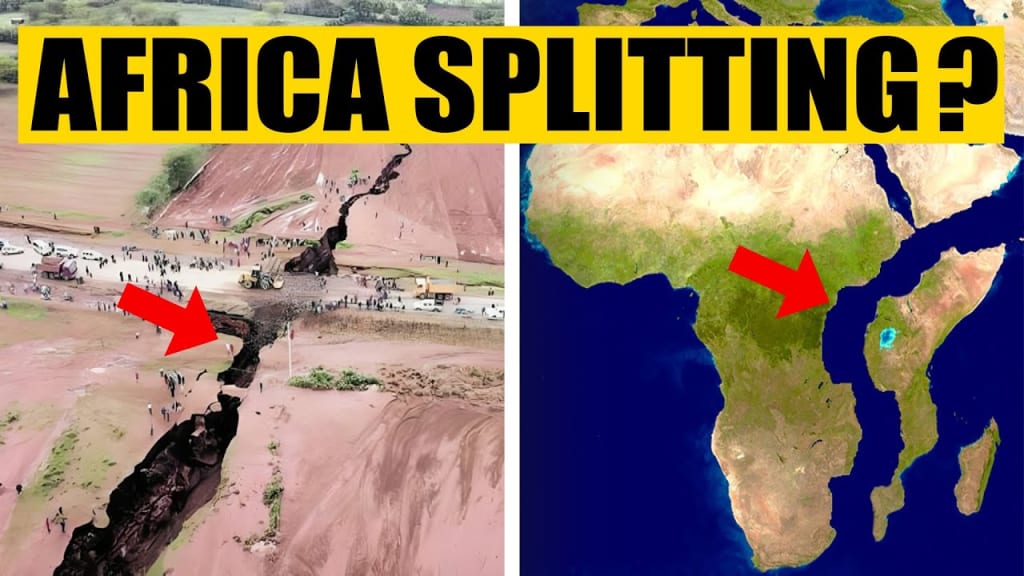
A massive crack has been spotted in Africa, stretching across Kenya, Ethiopia, and Tanzania. Drone shots and on-ground footage show an enormous rift dividing entire regions. This crack doesn’t care about roads, crops, homes, or cities—parts of it are up to 10 meters wide, while others are just 2 millimeters thin.
In some places, people tried filling the crack with soil, and in others, temporary bridges were built. Initially, people thought it was just loose soil settling. But scientists say otherwise—Africa is literally splitting in two.
The African Enigma
When we hear the word Africa, we might picture endless deserts and intense heat. And while it’s true that Africa is the hottest continent, it's also home to extreme cold—temperatures have dropped to -23°C in parts like Ifan.
Positioned right at Earth’s center, where the equator and prime meridian intersect, Africa is a land of extremes—from scorching deserts to lush jungles, from extreme poverty to unimaginable wealth.
A Land of Contrasts
- Africa hosts 10 of the world’s poorest countries, yet also holds the richest mineral reserves.
- In 2000, Libreville, Gabon, was declared the most expensive city on Earth—surpassing Paris, New York, and Singapore.
- Mogadishu, Somalia is ranked as the most dangerous city in the world.
- While 40% of Africa’s population is illiterate, the world’s oldest university is in Timbuktu, Mali, founded 800-900 years ago, once hosting 25,000 students when the entire city's population was just 100,000.
- Africa also has the highest twin birth rate in the world—50 out of every 1,000 births. But tragically, 1 in 14 newborns dies before reaching home.
Fast Feet, Fierce Fights, and Forgotten Facts
In 2010, Kenyan runners won 126 of 156 international marathons, many belonging to the Kalenjin tribe—still a mystery to sports scientists.
The world’s shortest war took place in Africa—just 38 minutes between Britain and Zanzibar in 1896.
Egypt is famous for pyramids, but Sudan actually has more—over 250 pyramids, though smaller and lesser-known.
The Truth About the Map
On world maps, Africa looks small, but this is an illusion. Africa is 30 million square kilometers—larger than the U.S., China, India, and most of Europe combined. The distortion comes from trying to flatten a spherical Earth onto a flat surface, like stretching tape off a tennis ball.
The Rift That Could Split a Continent
In 2018, a crack emerged that shocked scientists. For years, geologists knew the African tectonic plate was splitting, but no one expected visible signs so soon. Now, a huge part of East Africa is breaking off—from the Red Sea to Mozambique, moving away at about 6 millimeters per year.
What will happen? Scientists aren’t sure. A new ocean may form, or a separate island might emerge—or it might stop altogether. Either way, the process will take tens of millions of years.
Africa’s Hidden Power Beneath the Ground
Beneath Africa lies a third of the planet’s natural resources. For any rare mineral search, scientists look to Africa first. For example:
- Coltan, a vital metal used in electronics, is 80% sourced from Africa.
- Bauxite, used in aluminum production, is also mined here.
- The world's most valuable gemstone—diamond—is primarily mined in Africa.
The Sahara – More Than Just a Desert
The Sahara Desert holds enough secrets to rival the rest of Africa combined:
- The Eye of the Sahara is a massive, mysterious 40-km-wide structure visible from space.
- A unique gemstone found in King Tutankhamun’s necklace—found nowhere else on Earth—comes from the Sahara.
Incredibly, Sahara’s dust travels thousands of kilometers, fertilizing the Amazon Rainforest.
Was Africa Always Like This?
Geologists say every 500 million years, Earth's tectonic plates merge all continents into one supercontinent. The last one, Pangaea, began breaking apart 200 million years ago. Fossil records and geological evidence show that South America and Africa were once connected—like puzzle pieces.
So, could Africa split again? Is this the beginning of a new supercontinent breakup? Only time will tell.
Final Thoughts
What we’re witnessing is not just science—it’s history unfolding beneath our feet. Africa isn’t just the cradle of civilization—it's the stage of Earth's next big transformation.
About the Creator
Keep reading
More stories from Jehanzeb Khan and writers in Earth and other communities.
Impossible Rescue of Space Station After Power Failure | Salyut 7
During one of its orbits, a Soviet space station suffered an electrical failure, and all contact with the ground station was lost. Fortunately, at the time of this incident, no crew was onboard the space station known as Salyut 7. However, the power failure led to the station spinning out of control and drifting off its orbit.
By Jehanzeb Khan7 months ago in Futurism
Disappeared Bodies, Mass Burials and ‘30,000 Dead’
For years, reports emerging from Iran have painted a grim and often confusing picture of death tolls tied to political unrest, state violence, pandemics, and human rights abuses. Allegations of disappeared bodies, mass burials, and claims of “30,000 dead” have circulated widely among activists, exiled communities, and international media. Yet, inside Iran, official figures often tell a very different story.
By Aarif Lashari6 days ago in Earth
Tributes Pour In for Beloved Actress Catherine O’Hara
Tributes are pouring in from fans, fellow actors, and filmmakers celebrating the career and influence of Catherine O’Hara, one of the most beloved figures in film and television comedy. Known for her unforgettable roles, sharp wit, and emotional range, O’Hara has built a legacy that spans decades and generations of audiences.
By Aarif Lashari2 days ago in Earth


Comments (2)
This was absolutely fascinating. You wove together geology, history, and mystery so seamlessly. The idea that we’re watching a continent split in real time gave me chills—literally history beneath our feet.
Thanks for guide Talented peoples