
The Rise and Rise of the Inca Dove
Random notes from the conquest of a continent

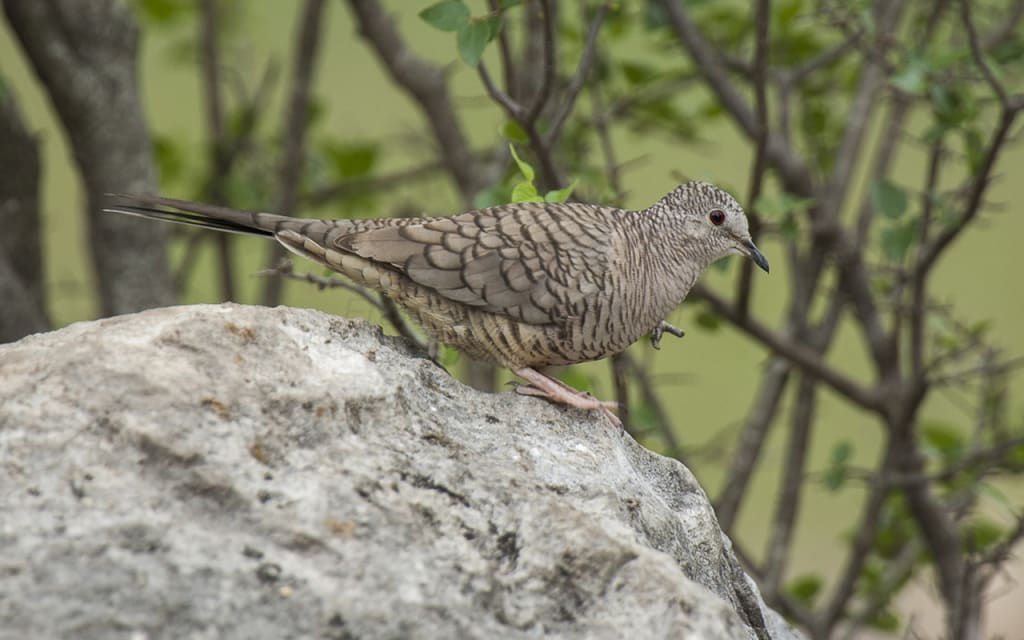
On December 4, 2003, I scribbled a note in my diary about the Eurasian Collared-Dove who got into a kerfuffle with a Common Grackle. Knocked off the feeder, the Collared-Dove flew to a nearby tree, where it landed next to a tiny Inca Dove — the first ever spotted in my yard.
It was years before I saw another Inca. My home in southeast Louisiana is too far northeast of its historical range.
And then, one fine day, I saw a flock of six sneaking around. And then they stopped bothering to sneak.
They knew I knew they were breeding in the power company’s easement behind my lot.
Now I see them several times an hour.
They like my feeder. They like my bird bath when the water’s low. They like my rock table where they pick happily in the sun among the specimens of petrified wood.
In my 1974 third edition of George Lowery’s Louisiana Birds, he lists all known records of the Inca Dove’s appearance in the state — seven of them starting with the first on December 28, 1935 and ending with an extended visit from October 1973-April 1974.
Seven records in 40 years!
But the world kept turning, and the Inca Doves kept coming.
On May 23, 2021, there were 10,431 Inca Dove records uploaded to bird reporting site Ebird from the state of Louisiana. (Ebird began accepting reports in 2002.)
And the Inca’s range is still expanding. East of us, on the same day, Mississippi had arrived at 742 Ebird reports. Alabama had 157. Florida 30.
The bird is marching north as well. Colorado (!) had 67 reports.
Canada had 16.
Random Moments from a Life
In cold weather, Inca Doves may flock together in a pyramid formation for warmth. I learned about this behavior during a cold snap this winter. I saw a number of my Inca Doves gathering on my fence and in a nearby tree, sort of lining up, and I snapped a quick phone photo of what they were doing:
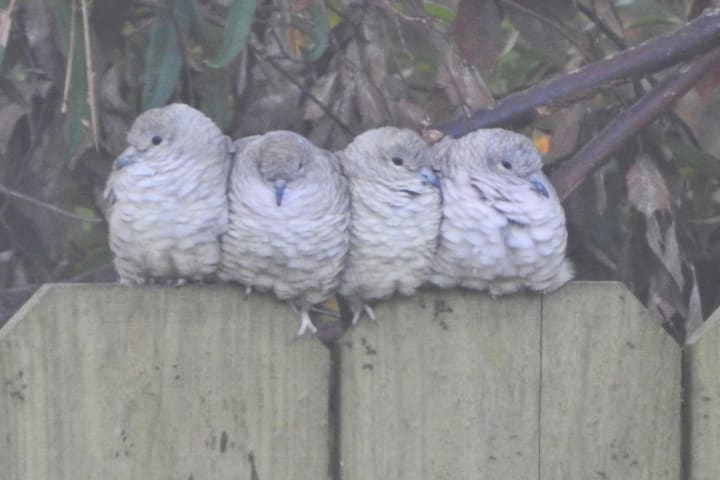
Someone told me what I was watching. It wasn’t cold enough, though. The birds in the upper tiers ultimately did not take their positions.
Don’t like the weather in Louisiana? Just wait a minute.
Inca Doves hang out in the sunny spots in my backyard. In any yard, like any dove, they like to bathe by dusting their feathers in the sand:
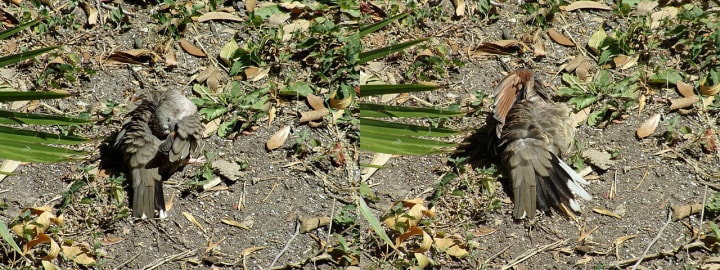
Ain’t no sand in this yard. It’s all mud, hon. When the water in my bird bath is low, they walk around and rinse their feet. But they bathe somewhere unknown.
Maybe a neighborhood kid’s sandbox.
What’ s In A Name?
There is controversy about the name Inca Dove. The traditional range of the bird is the US Southwest, Mexico, western Central America. The Incan Empire was located in western South America.
If the name has led you to believe you know something about the bird’s history or its relationship to human history, oops.
It’s a trick question.
Then, again, bird names are a minefield of trick questions. How else are we to know who’s in the club and who’s out?
There’s no such bird as the Seagull. Or the Canadian Goose. And most of my Red-Bellied Woodpeckers have a pink belly. If you can see any color on the belly at all.
A Challenger from the East
Of course, there are other tiny doves who might like to occupy our territories and sample of our tasty feeders. Consider the Common Ground-Dove.
On May 23, Canada had 22 Common Ground-Dove reports in Ebird. Colorado had 14.
But look what happens when you plug and play Florida. As of that day, there were an astounding 161,282 records.
Alabama had 4,511. Mississippi 526.
I’ve rightly been advised to watch out for Common Ground-Dove. On May 23, Louisiana had 601 records.
Twelve of these records were from St. Tammany Parish, the north shore of New Orleans.
One day, there will be two species of tiny doves in my backyard. The Incas marching from the West. The Common Ground-Doves marching from the East.
I’m going to need a bigger feeder.
Quick Guide to Telling Inca Dove From Common Ground-Dove
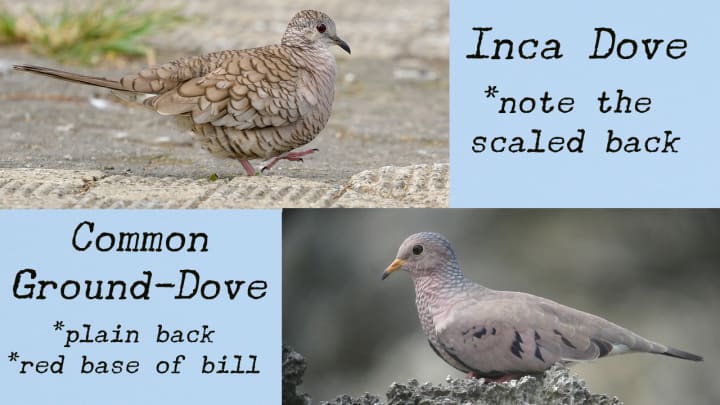
The images tell the tale-- which brings me to a final point. No bird guide, even a small one, is made without the input of multiple observers and photographers. So, without further ado, here are the photo credits.
Feature Image: “Inca Dove — Texas” by Francesco Veronesi is licensed under CC BY-SA 2.0
Central Images: Four Inca Doves Puffed Up by the Author. Two photos of “Inca dove grooming feathers” by Robert Kixmiller licensed under CC BY-SA 4.0 and placed in a composite by the Author
Bottom Comparison: “Inca Dove” by Becky Matsubara & “Common Ground-Dove” by Felix Uribe / Both dove photos licensed under CC BY-SA 2.0 / Collage & comparison by the Author (Birds not to scale)
If you found this article helpful, I'd be thrilled if you tapped the <3 button and/or left a small tip.
About the Creator
Amethyst Qu
Seeker, traveler, birder, crystal collector, photographer. I sometimes visit the mysterious side of life. Author of "The Moldavite Message" and "Crystal Magick, Meditation, and Manifestation."
https://linktr.ee/amethystqu
Keep reading
More stories from Amethyst Qu and writers in Earth and other communities.
Neighbors Are Quiet Drama
Spring 2021 A couple of Black-Bellied Whistling-Ducks have been visiting the dead tree a bit after sunrise each morning. It’s the tree the Red-Bellied Woodpeckers nested in earlier in the season, but now they’ve finished, and a pair of European Starlings has claimed one of the cavities. As I study it over the first cup of wake-up coffee, I observe a small drama that reminds me of the delicate dance we do when deciding how to handle difficult neighbors.
By Amethyst Qu5 years ago in Earth
Hunt for the Names of Mysterious Dwarf Planets
Far beyond the familiar planets of our solar system lies a cold, dark region filled with icy bodies, ancient debris, and mysterious worlds yet to be fully understood. Among these distant objects are dwarf planets, many of which orbit on the fringes of our solar system in regions like the Kuiper Belt and beyond. While some, such as Pluto, have captured public imagination for decades, many others remain unnamed, sparking a fascinating hunt among astronomers to discover, study, and ultimately name these elusive celestial bodies.
By Aarif Lashari5 days ago in Earth




Comments