

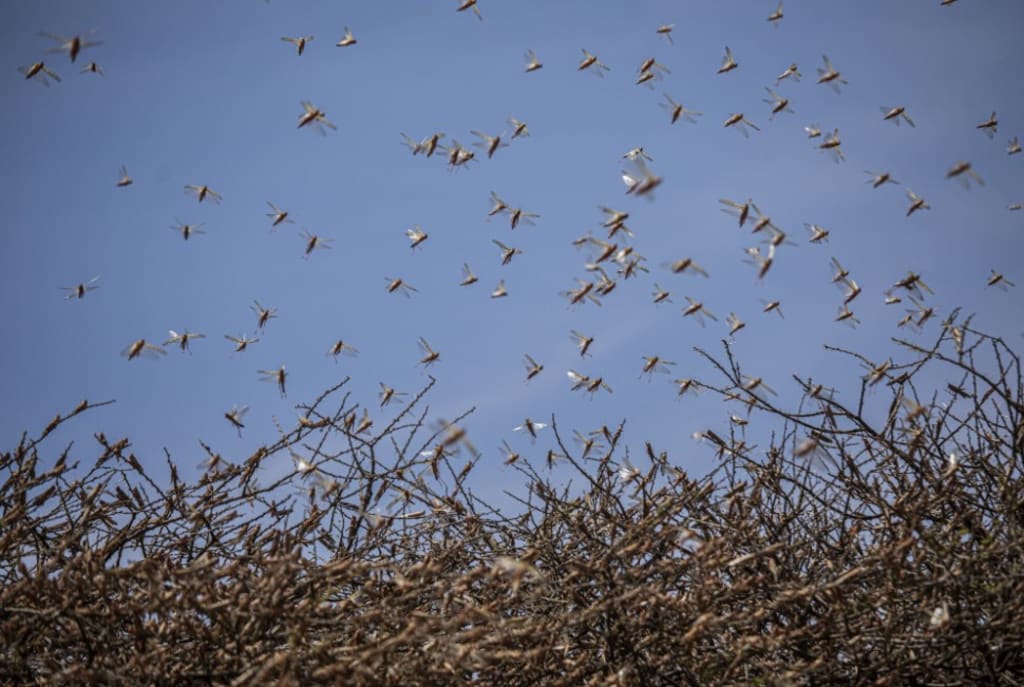
The Hebrew Bible outlines a plague of locusts encompassing the ground and eating everything in view and in the thousands of years because then they haven't truly let up locusts still routinely devastate crops in a lot parts of the world especially Africa and Asia in actuality they are thought to impact the food supply of one out of 10 individuals in the world but those Locust forms may be just as discontented about what they're doing as we are since according to some investigators a locust swarm is just a bunch of insects fleeing for their lives from one another locusts typically prefer to be on their own but sometimes they get jointly with other locusts kind of like college students on spring break and set about eliminating everything in sight and local storms are pretty complicated with swarming individuals undergoing shifts in behavior neurophysiology and also color there may be millions of locusts in one swarm and they can move thousands of kilometers stripping each leaf from every plant that gets in their way but they fail to just eat plants they will additionally eat each other which indicates that swarms aren't just terrifying for individuals they are also frightening for the locusts and even though Locust swarms have endured plaguing humans for thousands of years we still do not really know why they swarm what we do understand is as the population of locusts in a specific area increases they lose their choice for solitary living scientists do have some theories There are a number of reasons why insects may engage in cannibalism during swarms, but one of the most well-supported has to do with their propensity to eat one another. Insects are more prone to being eaten right after moulting, so if there are many molters in the group, that may encourage cannibalism. Additionally, when you're in a swarm, you have more chances to reproduce mating, which means you need lots of nutrients, which Swarming may genuinely be driven by behaviour, at least some of it. In 2012, researchers made the decision to build a computer simulation of swarming locusts. Computer-generated locusts were programmed to keep a minimal distance from other locusts, but they were also made to react to how quickly other locusts moved in their direction or away from them. As the simulation continued over several generations, behaviour might also change as certain locusts acquired behaviours that made them more probable to be eaten because they accrued rewards when they contacted other locusts and costs when they encountered by other locusts. When there were fewer of them, others were more inclined to conduct the eating, but computer-generated locusts would disperse and avoid one another. The avoidance behaviour at low concentrations and the swarming behaviour were induced by their propensities to chase and/or avoid one another, which prompted them to all go in the same direction. High-density behaviour could share the same overarching goal. If this is a good representation of reality, both behaviours assist in preventing individual locusts from being consumed. Locus Behavior it means that all the agricultural destruction that implies a locust swarm might not be so a great deal the purpose of the Swarm as a mere opposite effect so basically humans and locusts could be saved from a lot of issues if Locus could just embrace the strength of friendship research from 2023 though indicates it may not all be kill or be killed locusts may have a way to safeguard themselves from other locusts when they're swarming which may be why swarms don't just eat themselves into Oblivion prior to they can do any real damage in the Swarm phase and only in this form phase some locusts generate a pheromone called phenol acetonitrile or pan when scientists utilised genome editing to remove an enzyme responsible for making pan cannibalism in the Swarm headed up this means pan may be like a fail to eat me signal in other words locusts that produce the chemical are less likely to get eaten the study done so far doesn't totally clarify cannibalism and storming Behavior but it's a good begin and it does show that there might be a chemical way to end swarming by combating pan or inducing locusts to stop creating it for example at least the researchers say they'd like to appear into it they think that this may stop swarming behavior before it nonetheless starts by making the locusts simply eat each other rather of every plant in the vicinity not so excellent for the locusts but I think at least 10 percent of individuals out there would say it's a strategy worth going for.
About the Creator
Ian Sankan
Writer and storyteller passionate about health and wellness, personal development, and pop culture. Exploring topics that inspire and educate. Let’s connect and share ideas!
Keep reading
More stories from Ian Sankan and writers in Earth and other communities.
What About the Real Motive Behind Our Lack of Ocean Exploration?
Ever wonder why, despite our scientific and technological progress, there is so much of our world that we still know so little about? Over 80% of our seas are still unexplored. Why is this enormous body of water that covers most of our Planet also one of the most vulnerable and misunderstood areas in the universe? Pressure has a lot to do with it. Did you know that only about seven per cent of the world's oceans have a special tag called marine conservation areas or maps? We have this enormous aquatic playground in our backyard, but we've barely scratched the surface. Our deep ocean is a terrifying region with zero vision, subfreezing temperatures, and pressure so high that, in some places, you'd think you weighed fifty pounds. jumbo It makes sense that sending humans into space is easier than sending them to the ocean's bottom if you have jets on your body. the deeper you go into the waters the more stress piles up but let's not forget we have Tech on our side right researchers now use these cool satellite technologies that monitor the color of the ocean to examine how much phytoplankton is there for instance why is this important you might ask since these little plant-like Critters are genuinely pretty major players in our big blue oceans in the grand system of things in the Aquatic World phytoplankton is such as the Bedrock of the ocean food chain it provides Life to almost everything from the tiny zooplankton that are animal-like microorganisms to those colossal amazing whales when these Technologies first came within satellites could get clear images of the ocean faster compared to a ship could take the same number of measurements in 10 years but it's not all regarding looking at the ocean from space at times you gotta dive in there and see it for yourself gratefully we've come a long way in Ocean investigation Tech too we've got things like floats and Drifters that ride the ocean winds while collecting data and a whole Fleet of underwater Vehicles a few of which are manned some remote controlled and some even autonomous recall James Cameron the guy who made the movie Titanic he's super into examining the ocean and in 2012 he established a record by going down to the Mariana Trench in a vertical torpedo sub he believes there's nothing like being in the ocean and experiencing it firsthand Other companies use a variety of technologies for their ocean explorations, which has allowed them to find amazing things like the only deep sea coral reef in the Mediterranean Sea near Morocco. They have also discovered new species and documented ones thought to only exist in the Atlantic. These efforts have persuaded the local authorities to designate some locations as Marine Parks, but the road is challenging. We can't always rely on bathymetric information, which refers to the study of the ocean floor, because it's frequently unavailable, and that's the tricky part because it's not always available. We need to explore more to learn more, but raising money for these kinds of projects can be difficult when there are so many unknowable variables. The explorations of one particular company have so far assisted in protecting nearly 4 million square miles of ocean. The data they gather during their expeditions is invaluable; it is used to locate vulnerable habitats, identify new species, and even highlight areas where threatened species are being disregarded. Their work helps disprove justifications from local authorities who assert they lack the knowledge necessary to establish more marine protected areas. The same organisation supports the 30 by 30 initiative, which aims to safeguard 30% of our oceans by 2030. We must set aside areas for protection and research regardless of whether we don't have all the information just yet. On that note, some cool scientists have recently discovered a massive and Mysterious World beneath the Pacific Northwest Coast's ocean floor. The best part is that this massive realm of Life is essentially cut off from the rest of the Planet. Scientists call this type of Life chemosynthetic, which sounds complicated but simply means chemical reactions sustain Life. This type of Life has been found deep within the Earth and around seafloor hydrothermal vents. These tiny creatures aren't like you or me; they don't depend on sunlight or the organic products of aquatic and terrestrial ecosystems for sustenance instead. The team that discovered this finding included a geomicrobiologist from Denmark. The size at which these creatures are located beneath the oceanic crust is unparalleled; it may even be the most comprehensive ecosystem on Earth. He asserted that the oceanic crust, an average of four miles deep and makes up over 50% of our Planet's surface, is enormous; consider the magnitude of the chemosynthetic party taking place there. Since the 1990s, scientists have noticed strange, tiny holes in the basalt rocks that comprise a large portion of the Earth's outer crust. These holes appear to have been made by bacteria, but hey, there was supposed to be no life there; after all, imagine trying to survive in a place that's hot, dark, dense, and largely devoid of the organic compounds we require to sustain Life, yet here they are. Over the years, more puzzle pieces came together, and scientists made this discovery. Basalt After then, researchers wondered how long this Life would last. Drilling far below the ocean's surface, geologists obtained crust samples from a plate 120 miles off the coast of Washington. What they discovered down there was amazing. the Life down there runs on a distinctive fuel hydrogen yep in the lack of sunlight hydrogen offers the energy for all their biological processes these microbes use hydrogen to change carbon dioxide into organic have significance this matter and other byproducts like methane then fuel other organisms producing a network of light of obviously the Life down there isn't as complex as the one we understand up here scientists uncertainty there will be any multicellular life under the ocean since it's too hot and energy poor but hey who understands this universe under our oceans nevertheless has a lot to reveal this whole thing is important for many reasons first it indicates that Life can exist in places without oxygen which shifts our perspective on where we can find Life this makes us speculate if Life could exist under identical conditions on other planets where surface circumstances might be too harsh the implications on Earth are also significant if a large portion of Life exists in the oceanic crust then our comprehending of Life on our own Planet could be completely changed This fascinating Discovery pushes the boundaries of what we know about Life and encourages us to continue penetrating the enigmatic depths of our oceans. NASA is involved in the deep sea investigation project as well, so why shouldn't they be focused on space because they want to learn more about the possible characteristics of the oceans on other planets? NASA experts are highly optimistic that through uncovering undersea secrets, we will find answers to some of the key space-related mysteries, and they are also testing some cool technology for future trips across the solar system.
By Ian Sankan3 years ago in Earth
Under the Quiet Sky
Under the Quiet Sky The city wakes before the sun, breathing smoke, horns, and hurried footsteps. From the fourth floor of an aging apartment, Ayman watches the morning unfold like a restless tide. He is a delivery rider, a job built on speed, yet his own life moves slowly, measured by prayers whispered between traffic lights and thoughts carried across bridges. People notice his green jacket, not his eyes. They see the package, not the person holding it.
By Imran Hossaina day ago in Earth
The Devil's Triangle
The sails ruffled in the breeze as we cruised along. The Sea Breeze was a mid-size catamaran that sailed out of Royal Naval Dockyard in Bermuda. We had booked this trip weeks in advance and were now looking at our Captain, Spike and two boat hands. Paddy and Wilson seemed like nice guys, joking around with the passengers and telling us some stories about Bermuda that only locals would know. Their island accents sounded almost British but they were pleasant to listen to.
By Barbara Gode Wilesabout 11 hours ago in Fiction



Comments
There are no comments for this story
Be the first to respond and start the conversation.