
Scream 7 Review: A Proper Horror Movie
Scream 7 is not the best or the worst movie of the iconic saga

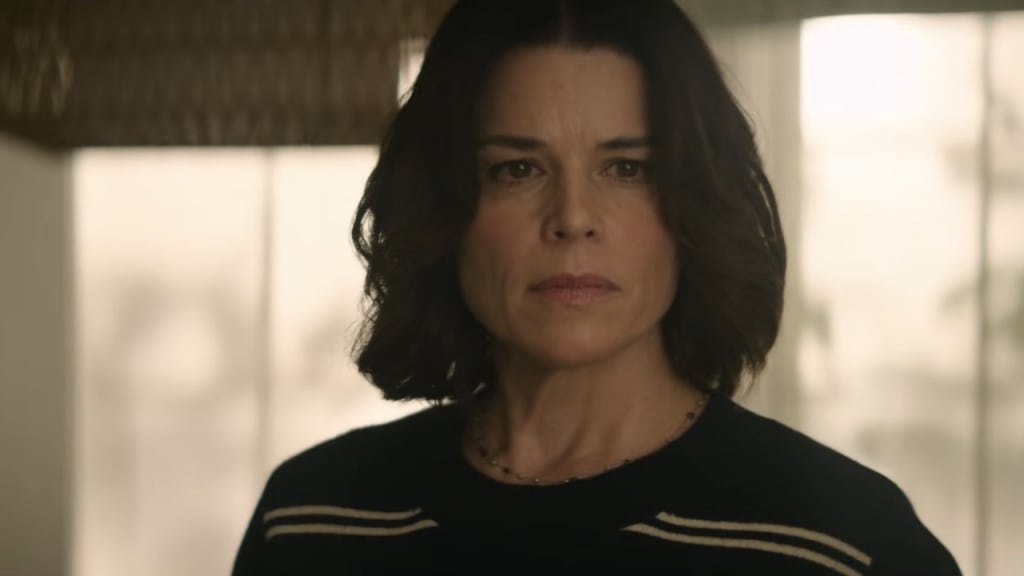
Scream 7 is the highly anticipated seventh film in the legendary Scream saga, directed and written by Kevin Williamson. The story stars Neve Campbell, Courtney Cox and Isabel May.
Scream 7 is coming to theaters with huge expectations. However, this movie is not the best of the saga, but not the worst either, as some are saying.
The movie starts with a typical parody scene before the credits, where a couple of horror movie fans hire a service to have a private experience at the Macher House, which now functions as a museum of everything related to Stab, the horror movie within the Scream saga.
The true story begins in Pine Grove, a small and quiet town where Sidney Prescott lives with her husband, policeman Mark Evans, and her teenage daughter Tatum, whom her mother, who has been through many traumas, protects excessively.
Tatum lives his first romantic experiences and prepares for a play. Ghostface appears to provoke a feast of blood and viscera, with stabbings, severed heads and dismembered bodies. And, to get the audience bursting into applause, Gale Weathers will join in to report on events affecting the community.
Ghostface selects Tatum as his new target, forcing Sidney to face her deepest fears with the help of her family.
At certain moments, the movie seems to pay homage to the original film. At other times, it tries to touch on topics such as the risks of artificial intelligence or the psychological trauma that is transmitted between mother and daughter. However, none of these plots develop with the depth that is required.
The script underwent numerous changes. The story feels like a series of good ideas that don't quite come to fruition.
The result is a narrative that lacks clear direction. The characters live a story that does not allow them to grow significantly. There are no memorable changes or hard-hitting learnings, which diminishes the emotional impact of the ending.
Virtues that endure
The beginning of Scream 7 argues that the saga still controls its own narrative: precise management of perspective, use of the off-field and an edition that distributes information and moments of violence effectively. The beginning not only acts as a strong first impact, but also as an aesthetic continuation within the saga. In formal terms, the artistic direction maintains a clear coherence: contrasting images, normal spaces transformed into danger areas and death scenes designed with a particular identity, both in their choreography and in their visual resolution, showing originality and control.
Throughout the development, a solid atmosphere is created and a tension is maintained throughout much of the film, reaching the end without the strength of other installments. The accumulation of doubts stops intensifying and stabilizes, causing a slight decrease compared to the power of the onset and the outcome.
The story really finds its originality by focusing attention on Sydney and her daughter. The conflict between generations introduces an aspect that goes beyond the simple question of who is the murderer?, focusing on the meaning of the legacy. The surname Prescott acts as a symbol: violence is no longer just an external danger, but an inheritance that influences identities and relationships. In this detour, the film deliberately reduces the importance of the villain in order to give priority to the family drama.
The choice of not connecting the assassins directly with the previous story of the saga avoids repeating the formula and increases the surprise at the end. However, that same decision affects the construction of the antagonists: they are less iconic and have less depth than in other films. They act more as narrative elements than as characters destined to overcome the revelation.
Conclusion
Scream 7 does not make the most of its potential, although it manages to keep viewers entertained throughout the narrative. The themes of generational trauma, post-traumatic stress and motherhood in a violent environment had a great capacity for generating drama, but they are only lightly touched on in the story.
The reasons behind so much evil feel unsound and not very credible, almost reaching the ridiculous. This is a finding that could change the way audiences view this film.
Despite its failures, the movie stands firm and is positioned at the same level as the best installments of the saga. Not so much because of the strength of his antagonists, but because of its ability to redirect the slasher towards a reflection about heredity, trauma and continuity. The mask continues to be the most visible symbol, but the real drama lies in those who constantly survive it.
About the Creator
Ninfa Galeano
Journalist. Content Creator. LGBT+ perspective 🏳️🌈
Keep reading
More stories from Ninfa Galeano and writers in Critique and other communities.
The sign of the cross; Part 2 A
The ancient tav was usually an X, not a +! When scholars talk about the ancient Hebrew letter tav, they mean the letter as it appeared in the Paleo‑Hebrew and Proto‑Canaanite alphabets. In those scripts, the tav was most commonly drawn as: an X shape or; a slightly tilted cross‑like shape, but not the Christian cross.
By CA'DE LUCE5 days ago in Critique


Comments
There are no comments for this story
Be the first to respond and start the conversation.