
Beyond Bars: Rethinking Prisons, Punishment, and What Justice Is Really For.
Exploring Justice, Reform, and the Human Cost of Confinement

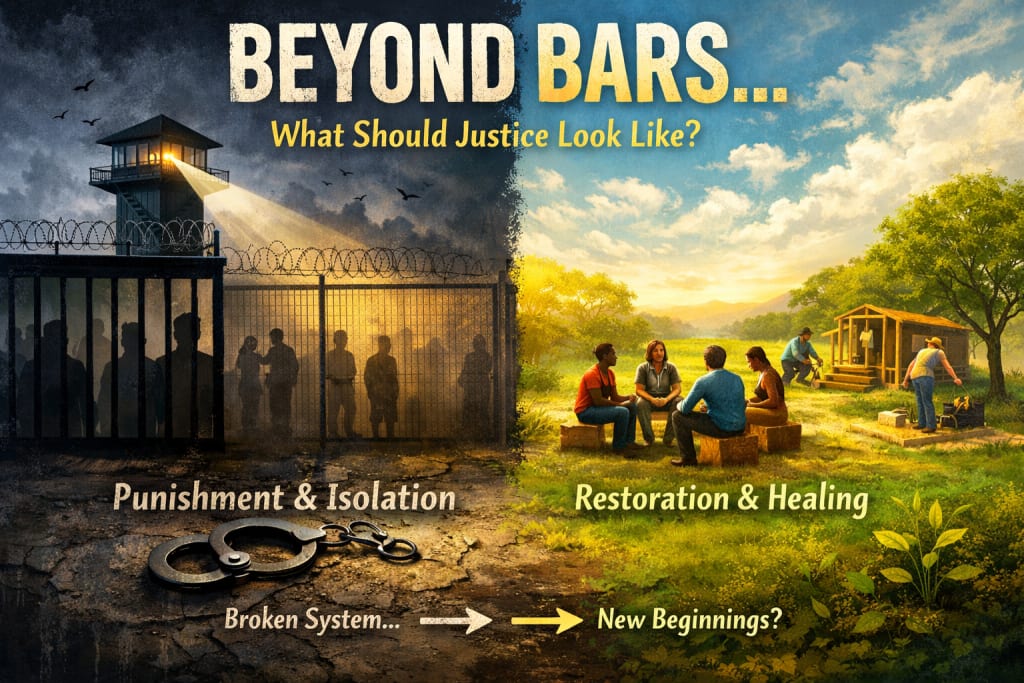
Do we need prisons? It is a deceptively simple question—one that exposes deep assumptions about justice, responsibility, fear, and hope. My answer is yes, but only provisionally. Prisons should exist, but only as a last resort, tightly limited in scope, radically reformed, and oriented toward a clear moral purpose: restoration and public protection, not suffering for its own sake.
What Is the Proper Purpose of Punishment?
Punishment is often defended as deserved suffering—you did wrong, therefore you must suffer. But this retributive instinct, while emotionally powerful, is morally incomplete. A more defensible purpose of punishment is forward-looking: to reduce future harm by promoting accountability, rehabilitation, and, where possible, restoration.
In other words, punishment should aim to:
protect society from serious harm. 🛡️
acknowledge wrongdoing and its impact.
reduce the likelihood of reoffending.
repair damage done to victims and communities.
Punishment that does not advance these aims is morally suspect, no matter how emotionally satisfying it may feel.
How (and Whether) Prisons Advance These Aims.
Prisons can advance some legitimate goals—especially incapacitation. For individuals who pose a serious and ongoing threat, confinement may be necessary to protect others. In this limited sense, prisons can be justified.
But here is the problem: most modern prisons are poorly designed to achieve rehabilitation or restoration. Instead, they often:
normalize violence and coercion.
sever social and economic ties.
stigmatize people permanently.
increase, rather than decrease, recidivism
If punishment is supposed to reduce future harm, a system that reliably produces repeat offenders is self-defeating.
Consider a familiar example. Two people commit similar nonviolent offenses. One is sent to prison, loses employment, housing, and family support, and leaves with fewer skills and more resentment. The other enters a community-based restorative program, meets the victim, makes restitution, receives treatment and training, and remains socially embedded. If our goal is public safety, the second response is clearly superior.
Necessary Reforms to Prison.
If prisons are to exist, they must be transformed. Necessary reforms include:
Dramatically limiting prison use to serious violent offenses.
Shorter sentences with regular review.
Humane conditions that respect basic dignity.
Education, therapy, and vocational training as core functions.
Strong reintegration support upon release.
In short, prisons must stop being warehouses of human failure and become temporary, rights-respecting institutions aimed at reintegration.
Alternatives to Prison.
For most crimes, the best alternatives are:
restorative justice programs.🤝
community supervision.
treatment-based responses (mental health, addiction).
reparative sanctions like restitution and service.
These alternatives align far better with the proper purpose of punishment and consistently outperform prisons on outcomes.
A Serious Objection—and a Reply.
Objection: Abolishing or minimizing prisons risks public safety. Some people are dangerous, unrepentant, and resistant to rehabilitation.
Reply: This concern is real—and it is precisely why a limited prison system may still be justified. However, acknowledging hard cases does not justify a system that overuses incarceration for millions who pose little threat. Designing justice around the worst cases guarantees injustice for the many.
Conclusion
The real question is not “Should we have prisons?” but “What kind of society do we want punishment to serve?” If the answer is safety, dignity, and reduced harm, then prisons must be rare, restrained, and radically reimagined. Justice should not be about cages—it should be about repair, responsibility, and the possibility of return. 🌱
About the Creator
Rachid Zidine
High School Teacher
Keep reading
More stories from writers in Critique and other communities.
Standing While Falling
Quotation from Friedrich Nietzsche "He who wrestles long with monsters should beware lest he himself become a monster. And if you gaze long into an abyss, the abyss also gazes into you. Man is not destroyed by suffering, but by the meaning he makes of it."
By LUCCIAN LAYTH26 days ago in Critique
Marty Supreme: Movie Review
Marty Supreme presents itself as a sports film, but it isn’t really about victory, legacy, or even competition. It’s a hyper focused character study of an athlete whose entire sense of self is tied to proving his superiority even when the proof is unnecessary, humiliating, or already lost.
By Louise Noel 6 days ago in Critique


Comments
There are no comments for this story
Be the first to respond and start the conversation.