
The Boy in the Box
A Child Found in the Woods, and a Name the World Lost for Decades

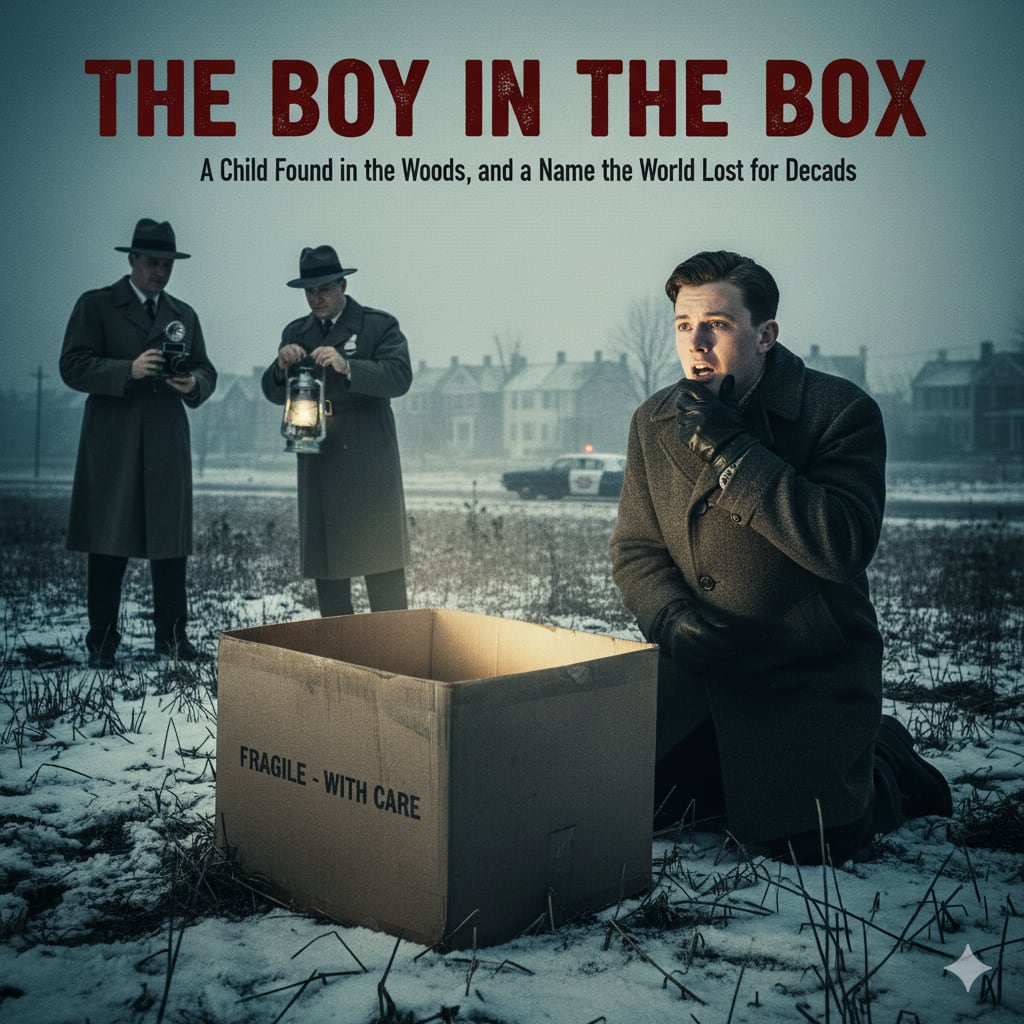
In February 1957, winter still held Philadelphia in its grip. Snow clung to the edges of roads. The city moved slowly, wrapped in coats and routine. In a patch of scrubland known as Fox Chase, a college student searching for a lost trap stumbled onto something that would haunt the city for generations.
A cardboard box.
It was the kind used for bassinets, discarded like trash among weeds and melting snow. Inside was the body of a small boy.
He was naked. Cleaned. Carefully placed. And brutally beaten.
The discovery triggered an immediate investigation. Police arrived quickly. Photographs were taken. The area was combed for clues. Yet from the very beginning, one fact overshadowed all others:
No one knew who the child was.
He appeared to be between four and six years old. He had recently had his hair cut. His fingernails were clean. There were no signs of prolonged neglect. Whoever he was, someone had cared for him—at least enough to wash his body before abandoning it.
That contradiction disturbed investigators more than the violence itself.
Philadelphia police launched one of the largest manhunts in the city’s history. The boy’s face was plastered on flyers and newspapers. Thousands of posters were distributed nationwide. His fingerprints were taken. Dental records were checked against every missing child report available.
Nothing matched.
No missing child fit him.
It was as if he had existed entirely outside the system.
Autopsy results revealed grim details. The boy had suffered repeated abuse. Bruises at various stages of healing suggested his death was not a single act of rage, but the end of a longer pattern. The official cause of death was blunt force trauma to the head, likely following prolonged mistreatment.
Yet despite the brutality, the case resisted clarity.
There was no murder weapon. No blood-stained clothing found nearby. No witnesses. The box itself offered little—no usable fingerprints, no shipping records that led anywhere useful.
Investigators canvassed the surrounding neighborhoods. They questioned families, checked orphanages, hospitals, and foster care systems. A reward was offered. Tips poured in.
Most went nowhere.
One lead stood out—a woman known in reports only as “M.” Years later, she claimed that her abusive mother had purchased the boy, raised him in secret, and eventually killed him. Her story was disturbing, detailed, and emotionally raw.
But it came too late.
Key evidence had been lost. Witnesses had died. Records were incomplete. Police could not corroborate her account. The lead remained unresolved, suspended between confession and imagination.
As years passed, the boy became a symbol rather than a person.
He was called “The Boy in the Box.”
“America’s Unknown Child.”
His case inspired books, documentaries, and endless speculation. Amateur sleuths studied photos, reanalyzed evidence, mapped theories. Some believed he had been trafficked. Others suspected a failed adoption gone wrong. Still others argued he had been born into isolation and never officially registered.
Each theory tried to answer the same unbearable question:
How could a child vanish so completely that no one came looking?
The most painful part of the mystery was not how he died—but how he lived. Somewhere, at some point, he laughed. He learned words. He trusted someone. And yet no record remained of those moments.
For decades, the case stayed open but stagnant. Evidence degraded. Hope dimmed.
Then, in the twenty-first century, technology reopened old doors.
Advances in forensic genealogy allowed investigators to extract DNA from preserved evidence. In 2022, after more than sixty-five years, the impossible happened.
The boy was identified.
His name was Joseph Augustus Zarelli.
He had been born in 1953, not far from where his body was found. He had parents. A family. A paper trail—hidden not by impossibility, but by circumstance, silence, and failure.
Authorities have not publicly named a suspect. The investigation continues quietly, constrained by time and loss. But something fundamental changed with the naming.
Joseph was no longer a symbol.
He was a child who belonged to history.
A name cannot undo violence. It cannot bring justice where evidence has vanished. But it restores humanity. It corrects a wrong that lingered for decades.
Today, Joseph Augustus Zarelli rests beneath a headstone bearing his name. Visitors leave toys, flowers, and notes apologizing for how long it took to remember him.
The Boy in the Box was never truly unknown.
He was simply unheard.
And his story remains a reminder that some mysteries are not puzzles to solve—but debts we owe to the forgotten.
About the Creator
Amanullah
✨ “I share mysteries 🔍, stories 📖, and the wonders of the modern world 🌍 — all in a way that keeps you hooked!”
The Amityville Legacy: The Silent Massacre at 112 Ocean Avenue
Introduction: The Illusion of Suburban Peace In the picturesque South Shore of Long Island, New York, the village of Amityville stood as a symbol of the post-war American dream. Its streets were lined with majestic trees and large, stately homes. None was more iconic than the Dutch Colonial at 112 Ocean Avenue, a house featuring distinctive quarter-moon windows that looked like watchful eyes. But on a frigid night in November 1974, that dream dissolved into a waking nightmare. The DeFeo family, pillars of this quiet community, were systematically erased in a crime so baffling and brutal that it remains the focal point of American true crime and paranormal folklore.
By Mayar Younes4 days ago in Criminal




Comments
There are no comments for this story
Be the first to respond and start the conversation.