
The Neptune Incident
A Terrifying Phenomenon Beyond Comprehension

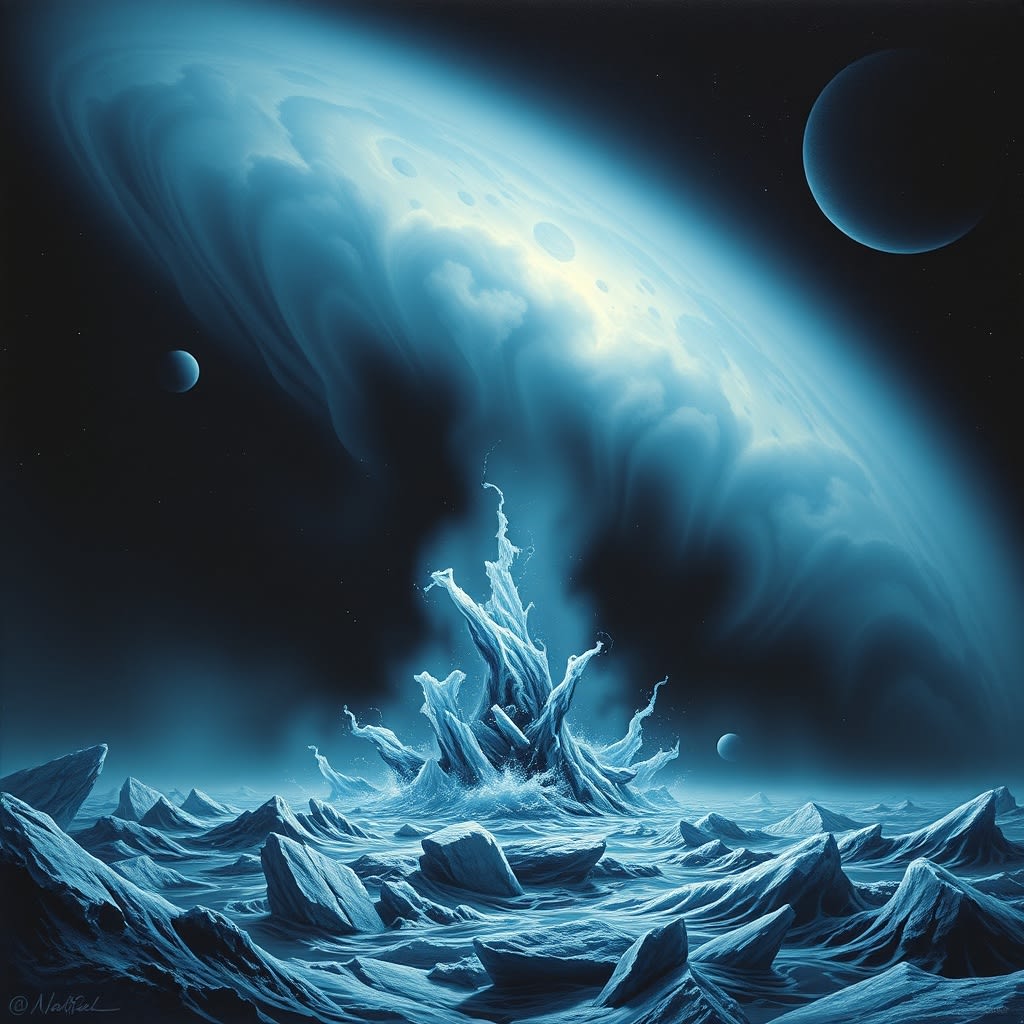
On June 7, 2041, a mysterious and terrifying event occurred on Neptune, one that defied scientific explanation and left the world in a state of shock and fear. What began as a routine observation of the distant ice giant turned into a cosmic nightmare, as Neptune became the epicenter of an inexplicable phenomenon that threatened to rewrite the laws of astrophysics.
Part 1: The Initial Observation
The event began innocuously enough, when astronomers at the Hale Space Observatory in Hawaii noticed a strange anomaly in the outer atmosphere of Neptune. The planet’s characteristic blue hue, caused by methane in its atmosphere, had begun to darken. What initially appeared as a shadow quickly spread, casting an eerie black tint over the entire planet.
At first, scientists assumed the event was atmospheric in nature—perhaps a massive storm or a solar anomaly affecting Neptune’s methane clouds. But the darkness continued to intensify, transforming the planet into what could only be described as a void. It was as if Neptune itself was disappearing into a black hole, swallowed by an all-consuming darkness.
Dr. Elizabeth Morrow, a planetary scientist leading the research team, described the event:
“We’ve seen storms on Neptune before, and we’ve recorded solar impacts. But this was different—this wasn’t natural weather. This was something new, and it was terrifying.”
Part 2: The Black Swell
As the darkness spread across Neptune, astronomers noticed a chilling development: the planet’s Great Dark Spot, a massive storm system larger than Earth, began to expand unnaturally. Dubbed “The Black Swell,” this phenomenon quickly dwarfed any weather pattern ever recorded in the solar system.
The Black Swell spread across the planet, moving with a speed that defied Neptune’s rotation and winds. More disturbingly, its growth seemed to disrupt the fabric of space around the planet. Light itself bent unnaturally, as if Neptune was warping space-time. The planet no longer reflected sunlight properly, and telescopic images became distorted, making Neptune appear as a swirling mass of darkness. It was as if Neptune had become a black mirror, reflecting nothing but emptiness back at the universe.
For days, the Black Swell expanded, until Neptune had effectively vanished from sight. Its once-beautiful azure appearance was replaced by a chilling void. Attempts to capture clear images of the event failed; radio waves and other observational tools were blocked or returned incomplete data.
Dr. Morrow remarked:
“It was as if Neptune was… erasing itself. We couldn’t see it anymore. It became something else—something beyond our understanding.”
Part 3: The Gravitational Disturbances
As the darkness on Neptune intensified, more disturbing events began to unfold. Instruments aboard spacecraft orbiting the outer planets detected unusual gravitational anomalies near Neptune. These distortions were inexplicable, as if the planet’s gravity was fluctuating wildly. Several spacecraft, including NASA’s Neptune Orbiter, were thrown off course, while others detected intense bursts of radiation emanating from Neptune’s southern hemisphere.
Back on Earth, teams of astrophysicists scrambled to understand the source of these anomalies. Some feared that Neptune was undergoing a transformation into a black hole or a similar catastrophic event. If this were the case, the consequences for the outer solar system could be devastating—planets and moons could be thrown from their orbits, and debris fields could form.
At the European Space Agency (ESA), Dr. Simon Drake, a leading astrophysicist, led a team analyzing the data:
“The gravitational anomalies were the most alarming part. Neptune’s mass was behaving erratically—one moment, it was as if it had doubled, and the next, it was vanishing. This kind of behavior shouldn’t be possible for any planetary body.”
Part 4: The Wave of Fear
As news of the Neptune phenomenon spread, the world entered a state of growing panic. Scientists struggled to explain what was happening, but no answers came. Across the globe, the media broadcast images of Neptune’s transformation, sparking conspiracy theories and doomsday prophecies. Was this a natural event? A catastrophic planetary collapse? Or worse—was it a signal of something far more terrifying coming from the depths of space?
Religious and apocalyptic groups seized on the event as a sign of an impending cosmic reckoning. The eerie disappearance of a planet that had been stable for millennia, and the visible distortion of its very existence, fueled fears of a domino effect that could ultimately reach Earth.
The psychological toll was heavy. Neptune was a distant planet, more than four billion kilometers from Earth, yet its transformation carried a profound sense of existential dread. If such an event could happen to a planet so far away, what forces in the universe might be capable of affecting Earth itself?
Part 5: The Theories and Uncertainty
In the days following the event, a number of theories emerged within the scientific community. Some believed that Neptune was undergoing a massive shift in its magnetic field, potentially caused by interactions with dark matter or other exotic cosmic forces. Others speculated that the planet had encountered a hidden black hole or that it was being consumed by an unknown form of cosmic energy.
A more unsettling theory was proposed by Dr. Morrow’s team, suggesting that Neptune had encountered a “cosmic rift”—a tear in space-time itself. This rift, they hypothesized, could be an intersection between dimensions, and Neptune had somehow been drawn into it.
Dr. Morrow explained:
“If this is a rift in space-time, it means we’re dealing with forces that go beyond our current understanding of physics. Neptune may have crossed into another plane of existence, or worse, it could have been absorbed by an entity or force that we can’t perceive.”
Another chilling possibility was the idea that Neptune had been “consumed” by a sentient, predatory cosmic force. This theory, while highly speculative, drew on the patterns of the Black Swell’s movement and the gravitational anomalies, which seemed almost deliberate, as if guided by some unseen hand.
Part 6: The Disappearance
Then, on June 15, 2041, the unthinkable happened. Neptune, the eighth planet from the sun, disappeared entirely.
In one final, inexplicable event, the planet was wiped from existence. Telescopes showed nothing but a blank patch of space where Neptune had once orbited. The Black Swell, the gravitational anomalies, the distortion—all gone. Neptune had ceased to exist, leaving no trace behind. It was as if the planet had been erased from the solar system.
Dr. Drake’s final assessment was one of awe and fear:
“We’re not just dealing with a planetary phenomenon. We’re dealing with something that changes our understanding of reality itself. What happened to Neptune may not be a one-time event. It could happen to any planet, even Earth.”
Part 7: The Aftermath
In the wake of the Neptune incident, the scientific community was left with more questions than answers. Theories abounded, but none could definitively explain what had happened to the planet. Neptune’s disappearance marked a turning point in humanity’s understanding of the universe. The event was terrifying not only because of what happened, but because of what it implied—that the universe harbored forces far beyond human comprehension.
In the years that followed, monitoring systems were put in place to detect any similar phenomena across the solar system. Yet, for all the precautions taken, the question remains: will this happen again? And if so, where?
The disappearance of Neptune is now regarded as one of the greatest cosmic mysteries in human history—a phenomenon so terrifying and enigmatic that it serves as a humbling reminder of our smallness in the vast and unpredictable universe.
About the Creator
Cosmic Dread
A cosmic horror writer. I blend real science with chilling possibilities, exploring the terrifying forces of the universe—black holes, rogue planets, and cosmic horrors lurking in the cold void of space.
Keep reading
More stories from Cosmic Dread and writers in Chapters and other communities.
The Cosmic Pulse
In the cold and infinite expanse of space, the universe often unveils mysteries that defy explanation, bringing awe and fear in equal measure. Among these, there is one event—a cosmic anomaly—that stands out in history as both terrifying and inexplicable. Known as “The Cosmic Pulse,” it appeared suddenly and with devastating consequences, baffling scientists and stirring fear across the globe.
By Cosmic Dreadabout a year ago in BookClub
The Devil's Triangle
The sails ruffled in the breeze as we cruised along. The Sea Breeze was a mid-size catamaran that sailed out of Royal Naval Dockyard in Bermuda. We had booked this trip weeks in advance and were now looking at our Captain, Spike and two boat hands. Paddy and Wilson seemed like nice guys, joking around with the passengers and telling us some stories about Bermuda that only locals would know. Their island accents sounded almost British but they were pleasant to listen to.
By Barbara Gode Wiles5 days ago in Fiction




Comments
There are no comments for this story
Be the first to respond and start the conversation.