
The Chapter That Never Ends: Living with the Story That Has No Resolution
Some Chapters Don't Close—They Become the Background Music of Everything That Follows
We speak of chapters as though they always end. We imagine our lives as books with clear divisions—childhood, adolescence, young adulthood, middle age—each section neatly concluded before the next begins. We take comfort in this structure. It suggests that pain is temporary, that difficult passages will eventually give way to something new, that resolution is the natural order of things. The chapter ends. We turn the page. The story moves on.
But some chapters do not end. Some experiences become not passages but permanences, not phases but foundations. They do not conclude and recede into memory. They become the background music of everything that follows, playing constantly, shaping every note, coloring every silence. The loss of a child. The betrayal that rewires the heart. The trauma that lives in the body forever. The love that ends but does not leave. These are not chapters we can close. They are chapters that become the book itself.
We are not prepared for this. Our stories teach us that suffering is temporary, that heroes overcome, that time heals all wounds. We carry this expectation into our own lives and then wonder what is wrong with us when the wound does not heal, when the grief does not fade, when the chapter refuses to end. We judge ourselves for not moving on, for still feeling, for still being shaped by something that happened years or decades ago. We think we have failed at living when we have only failed at forgetting.
But forgetting is not the goal. Healing is not erasure. The healthiest people are not those who have left their hardest chapters behind but those who have learned to carry them differently. The grief does not disappear; it becomes integrated. The trauma does not vanish; it becomes something we have learned to hold. The love that ended does not stop mattering; it becomes part of the architecture of who we are. The chapter that never ends is not a failure of healing. It is a recognition that some things are too significant to be contained in a single section of the story.
I think about a woman I knew whose son died when he was seventeen. She lived another forty years after his death, and in all that time, there was not a single day when she did not think of him. Not a single day when his absence was not present. Not a single day when she was not, in some way, still living in that chapter. People who did not know her history would sometimes say, "You must be over it by now," and she would smile the smile of someone who knows something they do not. She was not over it. She would never be over it. She had simply learned to live with the not-over.
What she taught me was that the chapter that never ends does not have to be the only chapter. It becomes a kind of ground note, a constant presence, but other notes can sound above it. She found joy again—not the same joy, not the uncomplicated joy of before, but real joy nonetheless. She loved her surviving children fiercely. She delighted in her grandchildren. She traveled, read, gardened, laughed. The grief was always there, underneath everything, but it did not prevent the rest of life from happening. It just made everything happen in its presence.
This is the art of living with the unclosed chapter: learning that something can be both permanent and not paralyzing. That pain can coexist with joy. That loss can be carried while also carrying on. That the chapter that never ends does not have to be the only chapter. It becomes the soil in which everything else grows—dark, rich, difficult, but fertile too. The flowers that bloom in that soil are different from flowers that bloom elsewhere. They are hardier. They know something. They have learned to live with shadow.
The chapter that never ends takes many forms. For some, it is grief. For others, it is a chronic illness that becomes a permanent companion. For others, it is the memory of abuse, the residue of betrayal, the long aftermath of war. For others, it is a love that could not be, a person who remains in the heart despite every effort to move on. For others, it is simply the knowledge of mortality, the awareness that we are finite, that haunts every moment of joy with its opposite. These chapters do not close. They become part of the texture of existence.
The culture does not know what to do with these permanent chapters. It wants resolution, closure, tidy endings. It offers platitudes about time healing and moving on. It pathologizes persistent grief, calls it complicated, treats it as something to be fixed. But some things are not fixable. Some losses are not reparable. Some chapters do not end because they are not supposed to end. They are not interruptions to the story; they are the story, or at least a permanent part of it. The task is not to close them but to learn to live in their presence.
This learning takes time. It takes trial and error. It takes allowing ourselves to feel what we feel without judgment, without the added burden of thinking we should feel differently. It takes accepting that the chapter is still open, that it may always be open, and that this is not a personal failing but a human reality. It takes finding ways to honor what was lost while also engaging with what remains. It takes building a life that includes the permanent chapter rather than one that tries to exclude it.
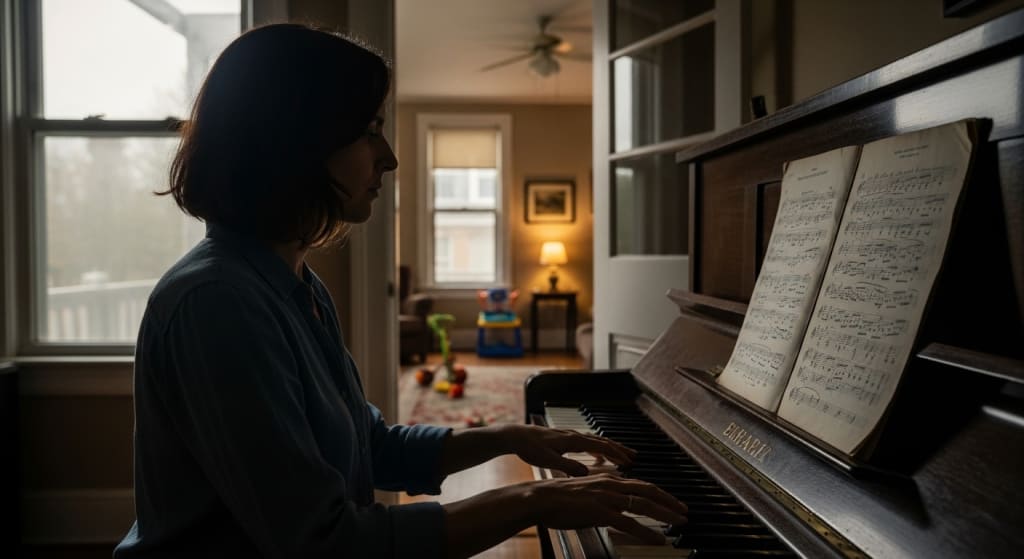
The woman at the piano, hands resting on the keys, the faded music before her—she is living with a chapter that never ends. The music on the stand was written by someone she loved, someone who is gone. She cannot play it without feeling that absence. She cannot look at it without remembering. But she also cannot stop coming to this room, cannot stop letting her hands rest on the keys, cannot stop being in relationship with what remains. The chapter is not closed. It is not going to close. But she is still here, still at the piano, still in the room with the light and the silence and the memory. That is something. That is everything.
The chapter that never ends is not a curse, though it often feels like one. It is a testament to the depth of our capacity to love, to be affected, to carry what matters. The things that become permanent are the things that mattered most. The grief that will not fade is the grief for what was precious. The trauma that lingers is the trauma that changed us. The love that remains after loss is the love that was real. These permanent chapters are not signs of failure. They are signs of having lived deeply, having loved fully, having been touched by something that will not let go.
And so we learn to live with them. We learn to build lives around them, lives that include them without being consumed by them. We learn to let other chapters exist alongside the permanent one, to let joy and grief coexist, to let the present and the past share the same space. We learn that healing is not the absence of pain but the presence of something else alongside it. We learn that the chapter that never ends can become, over time, a kind of companion—difficult, yes, but also wise, also grounding, also a reminder of what we have loved and what has loved us.
The book of a life is not always tidy. Some chapters do not end. Some stories do not resolve. Some experiences become permanent residents rather than passing visitors. This is not a problem to be solved. It is a reality to be lived. And the measure of a life is not how many chapters it contains or how neatly they conclude. The measure is how fully we live in whatever chapters we have, including the ones that never end. The measure is whether we can keep coming to the piano, keep resting our hands on the keys, keep being present to the music that was and the silence that remains. The measure is whether we can stay in the room, with all of it, and still find something worth playing.
About the Creator
HAADI
Dark Side Of Our Society
The Cave Part 6
If you have ever heard a tale about yourself that you cannot remember and doubtless think is made up, you will know how I felt when Tharkin related all that the eagle had seen of me before my memories were scattered. Of far distances and traveling companions that I did not recall, camping out under the stars and making our way to the mountains with deliberate purpose. The great bird had lost contact with my party once we entered the forests, and the seven other members were not seen again by him or his brethren since.
By Jamye Sharp8 days ago in Chapters


Comments
There are no comments for this story
Be the first to respond and start the conversation.