
Pxless Design: Engineering Digital Interfaces for an Unpredictable Future
Engineering Digital Interfaces for an Unpredictable Future
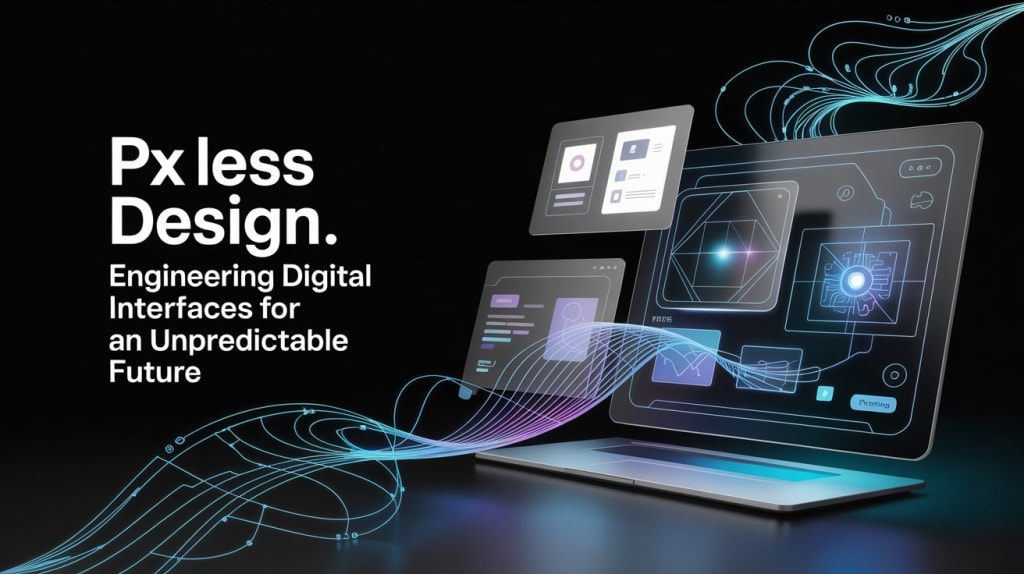
Digital interfaces no longer live in stable environments. They exist in ecosystems defined by variability, personalization, and continuous technological evolution. A product launched today might appear tomorrow on a foldable device, next year inside augmented reality glasses, and eventually on display surfaces that do not yet exist.
Traditional pixel-dependent design methods were built for predictable screens. Pxless design represents a fundamental architectural evolution—one that prepares digital systems not just for current devices, but for unknown contexts.
This is not a styling preference. It is a structural transformation in how interfaces are conceived, engineered, and maintained.
Rethinking Precision in a Variable World
For years, precision meant defining exact pixel values. Designers measured spacing down to single units. Layouts were treated as fixed compositions. This approach made sense when screens were uniform and user control was limited.
However, precision today must mean something different.
True precision in modern interface design means:
Preserving hierarchy under scaling
Maintaining clarity under zoom
Ensuring interaction comfort across densities
Remaining readable under accessibility adjustments
Supporting unknown future display environments
Pxless design redefines precision as behavioral consistency, not dimensional control.
Why Fixed Measurements Create Long-Term Fragility
Pixel-based systems appear stable at first glance. Yet their fragility becomes visible over time.
Device Diversity Exposes Rigidity
Modern products operate across:
Small and large smartphones
Ultra-wide desktop monitors
High-density retina displays
Split-screen tablet environments
Foldable screens with changing aspect ratios
Embedded vehicle dashboards
Wearable devices
A layout that depends on strict pixel rules must constantly be revised to accommodate these environments.
User Autonomy Breaks Static Layouts
Users increasingly adjust:
Default font sizes
Browser zoom levels
Accessibility scaling preferences
Interface density
Reduced motion settings
Rigid systems often collapse when these preferences are changed. Pxless systems anticipate user control rather than resisting it.
Dynamic Content Disrupts Fixed Containers
Content rarely remains consistent:
Localization expands text length
Data-driven interfaces display unpredictable values
Personalized experiences vary from user to user
Pixel-constrained containers cannot gracefully absorb this variability.
Understanding Pxless as Adaptive Interface Engineering
Pxless design is better described as adaptive interface engineering rather than simply a visual approach.
Instead of defining how large something must be, Pxless defines:
How elements respond to expansion
How components reorganize under compression
How spacing scales proportionally
How hierarchy remains stable regardless of size
It replaces static layout diagrams with behavior-driven systems.
The Behavioral Model of Layout
In Pxless systems, layout is not a frozen arrangement—it is a living structure governed by logic.
When space increases:
Elements expand proportionally
Margins scale smoothly
Line lengths remain readable
When space decreases:
Components stack intelligently
Non-essential elements reprioritize
Navigation simplifies
This eliminates the abrupt transitions often caused by breakpoint-based systems.
Typography as a Living System
Typography is one of the most critical elements in digital design.
In pixel-driven systems, font sizes are fixed for specific devices. In Pxless systems, typography is governed by scale relationships.
This ensures:
Visual hierarchy remains intact at all zoom levels
Line length remains comfortable
Reading flow remains uninterrupted
Accessibility adjustments do not damage layout
The system focuses on maintaining typographic ratios rather than enforcing rigid sizes.
Component Intelligence and Environmental Awareness
Pxless components are defined by behavior rules instead of fixed dimensions.
For example:
A navigation bar might collapse into an overlay when space becomes constrained.
A content grid may shift from multi-column to single-column fluidly.
A sidebar may transform into a contextual drawer.
Each component is aware of its spatial and contextual environment.
This is particularly important in modern multi-window environments where a user may resize the interface continuously.
From Breakpoints to Continuous Fluidity
Traditional responsive design relies heavily on breakpoints. Layouts jump from one version to another when a screen width crosses a defined threshold.
Pxless minimizes these abrupt changes by embracing fluid scaling.
Instead of:
“Desktop layout” → “Tablet layout” → “Mobile layout”
There is one adaptable structure that transforms progressively as conditions change.
This creates smoother transitions and greater visual continuity.
Accessibility as Structural Design, Not Compliance
Accessibility is often treated as an additional requirement implemented late in development.
Pxless makes accessibility foundational.
Because the system is inherently scalable:
Zoom functions seamlessly
Screen readers encounter logical structure
Large text modes do not disrupt design
Touch targets remain appropriately sized
Inclusive design becomes embedded into architecture rather than layered on top.
Performance and Engineering Benefits
Beyond aesthetics, Pxless improves technical robustness.
Reduced Hard-Coded Values
Fewer rigid measurements mean fewer layout conflicts.
Cleaner Styling Architecture
Relative measurement systems reduce redundancy and increase clarity in codebases.
Long-Term Stability
When new devices enter the market, adaptive systems require minimal adjustment.
Stronger Design-System Alignment
Pxless integrates naturally with scalable component libraries and token-based design systems.
Applying Pxless in Large-Scale Digital Products
Complex digital ecosystems benefit the most from adaptive design foundations.
Consider large platforms such as:
Enterprise SaaS dashboards
Financial management tools
Healthcare portals
E-commerce systems with thousands of products
Data-heavy analytics interfaces
These systems must operate consistently across multiple device categories.
Pxless ensures structural coherence without duplicating layout logic for every screen size.
Psychological Impact on Users
Users rarely articulate why an interface feels intuitive—but they notice when it fails.
Pxless contributes to:
Lower frustration rates
Greater reading comfort
Higher engagement retention
Increased trust in the product
Reduced cognitive load
When an interface adapts gracefully, users perceive it as reliable.
Implementation Strategy for Teams
Adopting Pxless requires cultural change within design and engineering teams.
Shift from Pixel-Perfect Mockups to Behavior Documentation
Designers should describe how components react under different conditions rather than focusing solely on static compositions.
Define Scalable Systems Early
Establish proportional spacing rules, scalable typography hierarchies, and component behavior guidelines.
Test Beyond Standard Viewports
Instead of testing only common screen sizes, test:
Extreme zoom levels
Split-screen resizing
High-density environments
Long localized text expansions
Encourage Cross-Disciplinary Collaboration
Adaptive systems thrive when designers and developers collaborate at the architectural level.
Common Misconceptions About Pxless Design
One misconception is that Pxless eliminates precision. It does not. It simply changes the definition of precision.
Another misconception is that Pxless removes visual control. In reality, it strengthens control by enforcing systemic relationships instead of isolated values.
A third misconception is that Pxless is only useful for web interfaces. Its principles apply equally to native applications, embedded systems, and emerging immersive environments.
Preparing for Emerging Interface Paradigms
The future of digital interaction includes:
Foldable and rollable displays
Spatial computing environments
AI-driven adaptive layouts
Mixed reality workspaces
Context-aware ambient displays
Rigid measurement systems will struggle in these unpredictable contexts.
Pxless prepares products for continuous transformation without requiring structural redesign.
Challenges and Organizational Adjustment
Transitioning to Pxless may involve:
Letting go of pixel-perfect habits
Redesigning legacy systems
Training teams in system-level thinking
Investing more time in initial architecture
However, these costs are front-loaded. Over time, maintenance decreases, stability improves, and adaptability becomes a competitive advantage.
The Strategic Value of Pxless Design
Pxless is not merely a technical adjustment—it is a strategic investment.
It reduces redesign cycles.
It enhances accessibility.
It improves scalability.
It increases resilience against technological change.
It strengthens user trust through consistent adaptability.
In a digital world defined by uncertainty, rigidity becomes a liability. Adaptability becomes an asset.
Final Perspective
Pxless design represents a mature evolution in interface engineering.
It replaces rigid measurement systems with intelligent behavior.
It prioritizes context over control.
It transforms layouts into adaptive structures.
It prepares products for environments that have not yet been invented.
Rather than designing for specific screens, Pxless designs for change itself.
That is what makes it not just modern—but future-ready.
About the Creator
Backlinks Cart
Mohsin (CEO BacklinksCart Agency).
Check Our Agency Backlinks Platfrom " Backlinkscart.com"
For any edits or link insertions. Whatsapp" +92 309-1821105"
Gmail: [email protected]
Keep reading
More stories from Backlinks Cart and writers in Chapters and other communities.
Blooket: A Deep Analytical Study of Gamified Learning and Its Role in Modern Education
Introduction: The Shift Toward Interactive Digital Learning Education has experienced a profound transformation in recent decades. The integration of technology into classrooms has redefined how knowledge is delivered, assessed, and reinforced. Traditional methods—lectures, worksheets, and paper-based tests—are increasingly being supplemented by digital tools designed to enhance engagement and participation.
By Backlinks Cartabout 14 hours ago in Education
Valentine's Dates Over the Years
Colin grinned as Brooklyn slipped into the living room. “Is it all set?” he asked. The twenty-one year old grinned. She was in her last year of college and Colin knew that Lincoln was proud of her. Although she had been away at college, she’d eagerly helped Colin plan his surprise for Lincoln. “I’m so glad you’re finally doing this,” she said.
By Reb Kreyling5 days ago in Chapters
Hunny
Chapter 7: Three Days, No Air, and a Toddler Full of Screams Lisbeth was one and a half, and her lungs were as strong as her mother’s pride—capable of rattling windows, nerves, and the occasional stranger’s sympathy. The Navy had released E.C., honorable and quiet as ever, his duffel bag packed with folded memories and letters from home. He stepped off that bus from the base for the last time, with the same soft-eyed steadiness he’d had since boyhood, the kind that made people trust him without knowing why.
By Lizz Chambers5 days ago in Chapters




Comments
There are no comments for this story
Be the first to respond and start the conversation.