
Merchants of the Dead: How American Companies Profit from Selling Human Bodies
Inside the controversial world of the U.S. body trade — where donated remains become commodities for research, training, and profit.

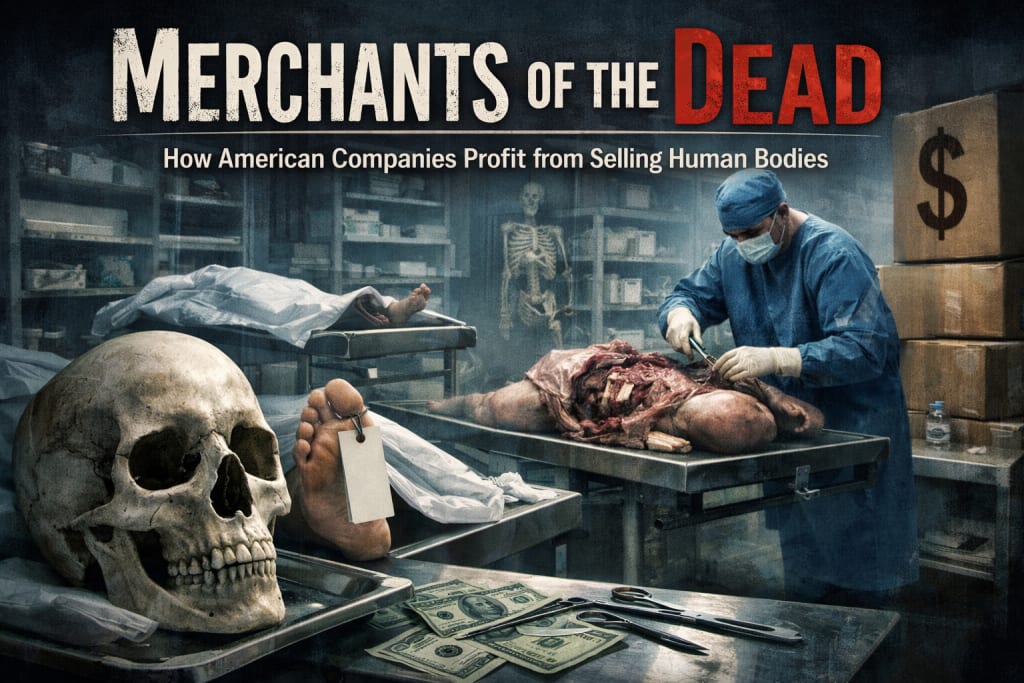
In the United States, the idea of donating one’s body to science is often associated with noble intentions — advancing medical research, training surgeons, and contributing to life-saving discoveries. Families frequently believe their loved ones’ remains will help cure diseases or educate future doctors. However, behind this altruistic image lies a little-known and controversial industry: the commercial trade in human bodies.
Often described by critics as “merchants of the dead,” certain American companies legally acquire donated human remains and sell them — sometimes in parts — for profit.
### The Legal Framework
Unlike organ donation for transplant, which is strictly regulated under the **National Organ Transplant Act (1984)**, the trade in whole bodies and body parts for research and education occupies a regulatory gray area. The law prohibits the sale of human organs for transplantation, but it does not clearly forbid the sale of bodies or body parts intended for research, testing, or training purposes.
This loophole has allowed a network of private “body broker” companies to operate across the country. These businesses collect donated bodies, dismember them, and sell various parts — heads, torsos, limbs — to medical schools, research institutions, military contractors, and private corporations.
While many companies follow ethical standards, investigations have revealed cases of abuse, deception, and poor oversight.
### How the Industry Works
The process often begins with donation. Families are approached during emotionally vulnerable moments — sometimes immediately after a loved one’s death. Body broker companies may offer to cover cremation costs in exchange for the remains. This arrangement can appeal to families struggling with funeral expenses.
Once acquired, the body is transported to a facility where it is prepared for distribution. It may be dissected into parts depending on demand. A head could be sold for neurosurgical training. Limbs might be used for orthopedic testing. Torsos may be employed in trauma simulations.
Each part carries a price tag. Reports suggest that a single body can generate thousands of dollars in revenue when divided and sold separately.
Unlike accredited medical schools that run regulated donation programs, many body brokers operate with minimal federal oversight. Regulations vary from state to state, and in some areas, licensing requirements are limited or nonexistent.
### Who Buys Human Remains?
The demand for cadavers and body parts is driven by several industries:
* **Medical schools and surgical training programs** use cadavers to teach anatomy and refine surgical techniques.
* **Medical device companies** test new implants, tools, and prosthetics on real human tissue.
* **Pharmaceutical and biotech firms** conduct research requiring human specimens.
* **Military and defense contractors** may use cadavers to test protective equipment or study trauma injuries.
For example, the U.S. military has used donated remains to study the effects of explosive blasts on the human body — a practice that has sparked ethical debate.
### Ethical Controversies
The controversy surrounding body brokers intensified after investigative reports exposed disturbing practices. Some families discovered their loved ones’ remains had been used in ways they never imagined — including military blast experiments — despite being told the bodies would support medical research.
In several cases, companies were found storing remains improperly, falsifying consent forms, or failing to inform families about how bodies would be used. Criminal prosecutions have occurred, though they remain relatively rare.
One high-profile case involved a body broker in Arizona whose facility was shut down after authorities found dismembered body parts stored in unsanitary conditions. The incident shocked the public and highlighted the lack of consistent federal regulation.
### Consent and Transparency Issues
A key ethical concern is informed consent. Many donation agreements contain broad language allowing remains to be used for a wide range of purposes. Families, overwhelmed by grief, may not fully understand what they are authorizing.
Critics argue that transparency is often lacking. While organ donation for transplant is tightly regulated and monitored, whole-body donation for research is largely governed by patchwork state laws and industry self-regulation.
Organizations such as the American Association of Tissue Banks (AATB) provide accreditation standards, but participation is voluntary for body brokers not involved in transplant tissue.
### The Economics of Death
Funeral costs in the U.S. can exceed $7,000 to $10,000. Body broker companies sometimes present donation as a cost-saving option. By offering free cremation in exchange for remains, they create an economically attractive alternative for low-income families.
However, once in the system, a body may be sold multiple times in parts, generating significant revenue. Critics argue that this commodification of human remains undermines the dignity of the deceased.
Supporters of the industry counter that without body brokers, many valuable medical advancements would not be possible. Cadavers play a crucial role in surgical innovation, medical education, and public safety research.
### Calls for Reform
Growing public awareness has led to calls for stronger federal oversight. Some lawmakers have proposed clearer regulations, stricter licensing requirements, and mandatory transparency standards.
Advocates argue that families deserve full disclosure about how donated bodies may be used. Others suggest extending the principles of the National Organ Transplant Act to cover all human remains.
Until comprehensive reform is enacted, the U.S. body trade remains a complex intersection of science, commerce, and ethics — a world where generosity, necessity, and profit converge.
### A Moral Question
At its core, the debate over America’s body broker industry is not simply about law or economics. It is about dignity, trust, and respect for the dead.
Donating one’s body to science is a profound act of generosity. But when that gift enters a marketplace where human remains carry price tags, society must ask: where should the line be drawn?
The answer may determine whether the industry is seen as a necessary partner in medical progress — or as true “merchants of the dead.”
About the Creator
Irshad Abbasi
Ali ibn Abi Talib (RA) said 📚
“Knowledge is better than wealth, because knowledge protects you, while you have to protect wealth.
Keep reading
More stories from Irshad Abbasi and writers in Chapters and other communities.
“Boots” — The Hidden History of Gay Soldiers in the U.S. Military
For much of American history, gay men and women have worn the uniform of the United States with courage and distinction — yet in silence. Their stories, often erased or deliberately concealed, form a powerful and complex chapter in the evolution of both the U.S. military and LGBTQ+ civil rights. From criminalization and dishonorable discharges to the controversial “Don’t Ask, Don’t Tell” policy and eventual full inclusion, the hidden history of gay service members reflects a broader struggle for dignity, recognition, and equality.
By Irshad Abbasi a day ago in Chapters
Cassie and Johnny
I’m the kind of dame you notice. I’m no femme fatale, but you can’t ignore me, at least not until I warn you about what’s coming, then everybody ignores me. Hell, they usually blame me afterwards and give Johnny all the credit for saving the day, but my Johnny couldn’t save a seat at the movies without my help. Sure, he’s brawny, but brainy? Not so much. Like that time I asked him to spot me five bucks, and he said he didn’t see it anywhere on me, and believe you me, he looked but good.
By Harper Lewis6 days ago in Critique



Comments
There are no comments for this story
Be the first to respond and start the conversation.