
Italy’s Vanishing Village: Businesses and Schools Close as Birth Rates Collapse
In a quiet Italian town where cradles remain empty, declining birth rates are forcing shops, classrooms, and entire communities to disappear.

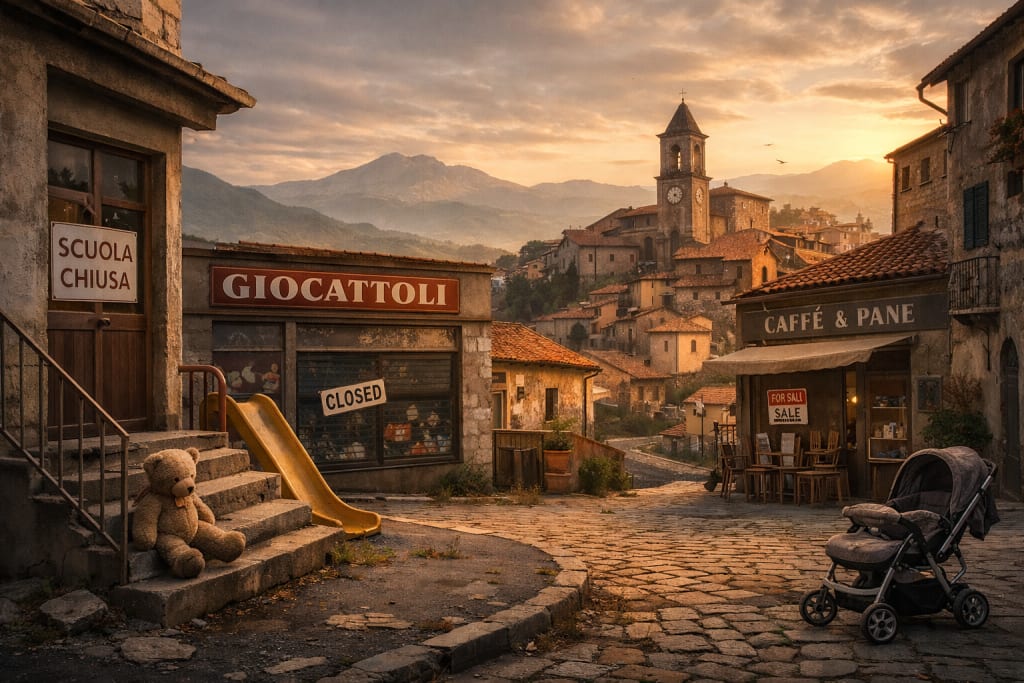
Across Italy, a quiet demographic crisis is unfolding. In many small towns and villages, the number of newborns has dropped so dramatically that schools are shutting down, businesses are struggling to survive, and communities that once thrived with families are slowly fading away. One such town has become a stark symbol of this national problem, where the absence of children is reshaping everyday life.
In this picturesque Italian village, narrow streets once echoed with the laughter of children heading to school. Today, many classrooms sit empty. Over the past decade, the number of births has fallen so sharply that the local primary school recently announced its closure due to a lack of students. For residents, the shutdown is more than an administrative decision—it represents the gradual disappearance of a community’s future.
Local shop owners are feeling the impact as well. Businesses that relied on families and young customers are seeing fewer visitors. Toy shops, clothing stores, and small grocery markets have struggled to remain open. Without new generations to sustain local demand, many owners are forced to close their doors.
Italy has one of the lowest birth rates in the world. According to recent demographic data, the country’s fertility rate is far below the level needed to maintain population stability. Experts say that for a population to replace itself, women need to have an average of about 2.1 children. In Italy, the rate has dropped to around 1.2 in recent years.
The reasons behind this dramatic decline are complex and deeply rooted in economic and social changes.
One of the biggest factors is financial insecurity. Young Italians often face unstable job markets, temporary contracts, and relatively low wages. For many couples, the cost of raising children—from housing and childcare to education—feels overwhelming. As a result, many delay starting a family or decide not to have children at all.
Housing costs also play a major role. In many parts of Italy, property prices and rent have risen faster than salaries. Young adults often remain living with their parents well into their 30s because they cannot afford to move out. Without financial independence, starting a family becomes even more difficult.
Another factor is the changing role of women in society. More women today are pursuing higher education and careers, which is a positive social development. However, balancing work and family life can be extremely challenging in a country where childcare services and parental support systems are limited. Many women feel forced to choose between career growth and motherhood.
Cultural shifts have also influenced attitudes toward family life. Younger generations increasingly value personal freedom, travel, and career development before settling down. Marriage and parenthood are happening later than ever before. In some cases, they are not happening at all.
For small towns, the consequences are especially severe. When birth rates decline, young people often move to larger cities for work, leaving behind an aging population. Over time, schools close, healthcare services shrink, and businesses lose customers. What begins as a demographic change can quickly become an economic and social crisis.
Local authorities in many Italian towns are trying creative solutions to reverse the trend. Some municipalities offer financial incentives to families who move there and have children. Others provide tax breaks, subsidized housing, or childcare support in an attempt to attract young residents.
In a few villages, officials have even offered abandoned homes for symbolic prices, hoping new families will restore them and bring life back to the community. While these initiatives have generated international attention, their long-term success remains uncertain.
Demographers warn that reversing the decline will require broader national reforms. Policies that improve job stability, expand childcare services, and support working parents could make family life more accessible for younger generations.
Despite the challenges, many residents remain hopeful. Community leaders believe that with the right policies and opportunities, young families may one day return to these quiet towns.
For now, however, the empty classrooms and closed shopfronts serve as a reminder of a profound shift taking place across Italy. In places where children once played in every street, silence has begun to take their place—raising urgent questions about the future of small communities and the country itself.
About the Creator
Irshad Abbasi
Ali ibn Abi Talib (RA) said 📚
“Knowledge is better than wealth, because knowledge protects you, while you have to protect wealth.
Keep reading
More stories from Irshad Abbasi and writers in Chapters and other communities.
The B-2 Spirit: Why the U.S. Stealth Bomber Known as “The Bone” Is Considered One of the Most Dangerous Aircraft Ever Built
The arrival of the stealth bomber **Northrop Grumman B‑2 Spirit**—often nicknamed “The Bone”—at a British airbase has once again drawn global attention to one of the most advanced and mysterious aircraft ever created. Designed during the final years of the Cold War, the aircraft remains a cornerstone of the United States’ long-range strike capability. Whenever it is deployed overseas, it signals serious military readiness.
By Irshad Abbasi 5 days ago in Chapters
The Cave Part 6
If you have ever heard a tale about yourself that you cannot remember and doubtless think is made up, you will know how I felt when Tharkin related all that the eagle had seen of me before my memories were scattered. Of far distances and traveling companions that I did not recall, camping out under the stars and making our way to the mountains with deliberate purpose. The great bird had lost contact with my party once we entered the forests, and the seven other members were not seen again by him or his brethren since.
By Jamye Sharp24 days ago in Chapters
The Conduit: Chapter I7
Chapter 17 Jonas and Anu were exhausted. They searched through the mountain structure from one end to the other as they looked for another way into the prison area. The two were getting ready to stop when Anu noticed something along the wall. She stopped Jonas and let out a sigh of frustration. Standing there, staring at the white smudge on the stone carved wall, she took a seat on the ground and started going through her bag.
By Jason Ray Morton 3 days ago in Chapters
From ad men to mad men
It's after 2am in the morning when a local police patrol vehicle in Northern New Jersey spots a figure costumed as Quasimodo, The Hunchback of Notre Dame, proceeding southbound on the sidewalk along Lydecker Street. Though the hunchback’s costume stuffing offers added insulation, it's January, and friggin’ freezing. Carefully, the officers slow down, gently question the subject, and offer him a ride home.
By David W. Maury7 days ago in Humor



Comments
There are no comments for this story
Be the first to respond and start the conversation.